
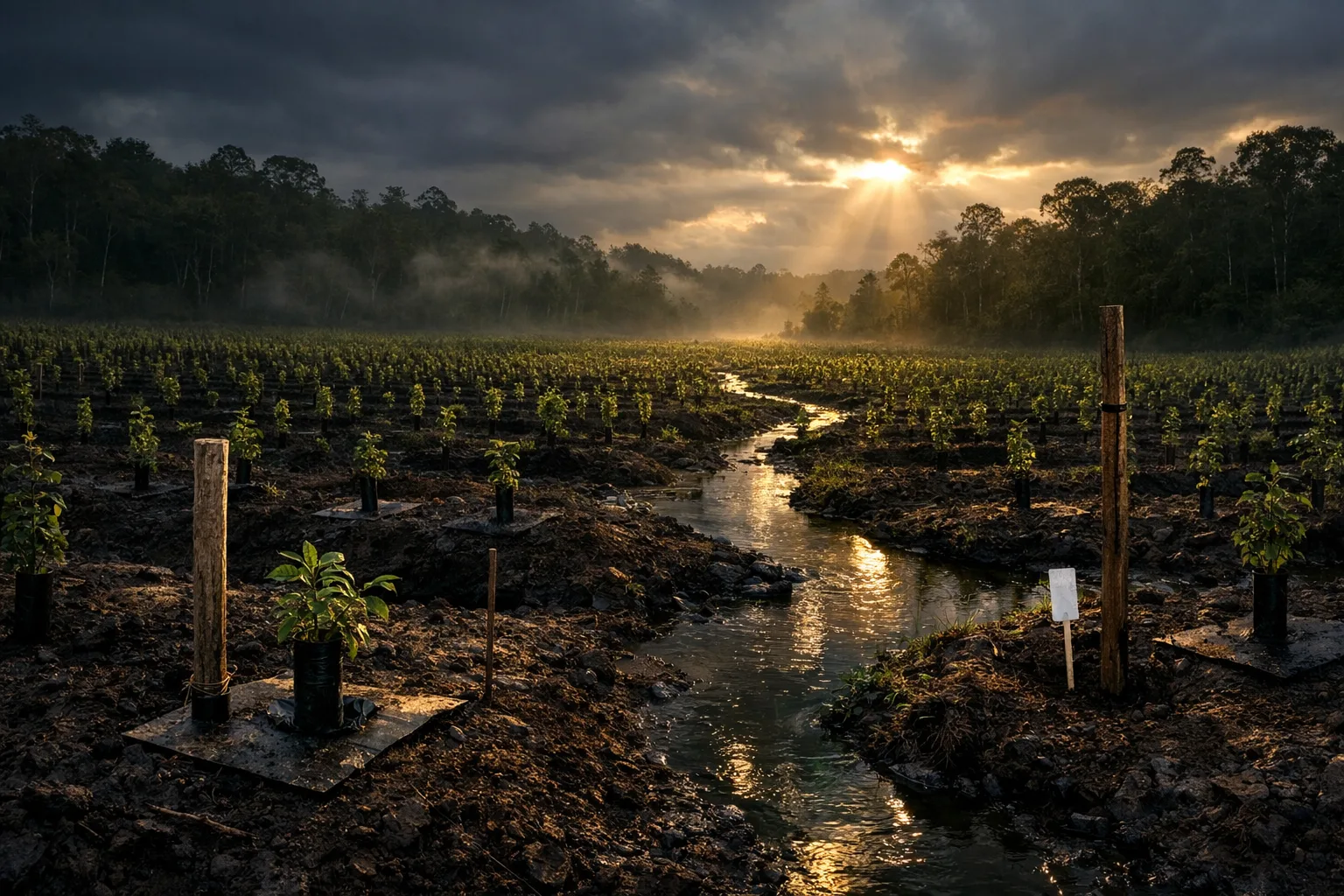
BTG Pactual’s Record Reforestation Fund and the New Economics of Forest Carbon Finance
Why a $1.24B forest fund matters beyond one headline deal
A $1.24 billion reforestation fund matters because it signals institutional capital moving into forest carbon finance, not just another large ESG headline. BTG Pactual says its Sustainable & Impact Investing platform was created in 2020 to connect global investors to sustainable opportunities in Latin America, including environmental assets and carbon markets.
The bigger point is that large-scale capital can change how forest projects are built. It can bundle land access, project development, MRV infrastructure, and forward offtake structures into one investable vehicle. That matters for buyers because institutional sponsors usually bring stronger governance, clearer capital stacks, and longer holding periods, which can reduce execution risk compared with fragmented small-project supply.
The market structure angle is just as important. If this capital targets Latin America, it could deepen regional supply for forest carbon credits, ARR credits, and REDD+ credits, while also increasing competition for high-quality project pipelines. That is happening at a time when tropical forest loss remains severe, even after a 36% drop in 2025, so the market still needs durable capital at scale.
The real question is whether this kind of capital improves project integrity and credit quality enough to matter for buyers. That leads directly to the latest deforestation data and the credibility debate around REDD+.
What the 36% drop in tropical forest loss could mean for REDD+ credit integrity
Tropical rainforest loss fell 36% in 2025, to 4.3 million hectares, according to WRI’s Global Forest Watch. The total was still 46% higher than a decade ago and remains far above the 2030 forest goal.
Lower deforestation can improve baseline credibility for REDD+ carbon credits if the decline reflects durable policy enforcement. It can also make additionality harder to prove if project claims are not calibrated to broader jurisdictional trends. Buyers should not assume that a falling forest-loss number automatically means every project is more creditworthy.
Fire risk is the key caveat. WRI says the decline partly followed an extreme fire year, and climate-driven fires remain a rising threat. That matters for permanence risk, reversal risk, and long-term carbon accounting.
Procurement teams should ask whether a REDD+ project uses updated baselines, leakage controls, and fire-response plans that fit the new forest-loss context. Historical deforestation rates alone are not enough.
Permanence science points in the same direction. WRI’s 2025 analysis found 34% of global forest lost between 2001 and 2024 is likely permanent, and in tropical primary rainforests 61% of loss is tied to permanent land-use change. Buyers should be skeptical of weak claims about reversibility.
If forest loss trends are changing, the next issue is how institutional investors and standards bodies will reshape project design, verification, and buyer confidence around forest carbon supply.
How institutional capital may change project design, verification, and long-term buyer confidence
Institutional capital usually acts as a quality filter. Large fund sponsors tend to require bankable MRV, audit-ready documentation, and clearer governance, which can push forest carbon projects toward higher operational discipline and more standardized reporting.
The standards side is moving in the same direction. Verra says all VCS land-based projects must set aside a risk-adjusted buffer contribution to protect permanence, and projects are audited by independent third-party validation and verification bodies.
The market-quality signal that matters most to institutional buyers is also getting clearer. ICVCM reported that by end-November 2025 it had approved 7 major crediting programs and 36 methodologies, and it says CCP-labelled credits have commanded an average premium of up to 25%.
A concrete forest-methodology example shows how this is playing out. Verra’s improved forest management methodology VM0045 was approved against the Core Carbon Principles, and Verra issued the first CCP-labeled IFM credits in December 2025 under that methodology.
For buyers, the message is simple. Institutional capital can support projects designed for CCP eligibility, stronger baseline logic, dynamic inventory data, and third-party assurance. That may improve offtakeability and reduce discount rates.
Once quality and verification improve, buyers still need to understand how pricing, permanence, and supply concentration risk affect portfolio strategy.
What carbon credit buyers should watch: pricing, permanence, and supply concentration risk
Pricing is already splitting the market. ICVCM’s 2025 report says CCP-labelled credits are trading at an average premium of up to 25%, which points to a bifurcated market between higher-integrity forest credits and lower-trust inventory.
Permanence has to sit at the center of procurement. Verra says forest credits face reversal risks from logging, mining, fires, and drought, and permanence is managed through buffer pools that can be cancelled if losses occur.
Supply concentration is the other risk buyers should watch. They should not over-rely on a single country, single methodology, or single project developer, especially when tropical forest outcomes can swing with policy, fire seasons, and commodity pressures.
Diversification is easier to justify now because forest loss remains elevated even after the 2025 decline. WRI notes much of the drop was driven by Brazil, so supply can tighten or reprice if one jurisdiction’s policy signal changes.
A practical procurement checklist is straightforward. Buyers should assess vintage, project type, buffer contributions, verifier reputation, reversal history, and whether credits are legacy REDD+ units or CCP-aligned forest credits with stronger integrity signals.
Once buyers understand what to avoid, developers need to know how to package assets for a more financeable market phase, especially if they want to attract institutional offtake and project finance.
How project developers can position forest assets for a more financeable market phase
Developers should build around financeability, not just credit issuance. That means investment-grade data rooms, defensible baselines, legal land tenure, and clearly documented community and biodiversity safeguards.
Methodology choice is a commercial lever. Developing under CCP-eligible, audit-ready methodologies can improve buyer trust and may support better pricing than generic forest credits.
Operational resilience now matters more than ever. Fire management, leakage monitoring, satellite monitoring, and contingency plans should be part of the project design because permanence concerns are now a core underwriting issue, not a secondary compliance matter.
Institutional investors will also look for predictable issuance schedules, verifiable cash-flow assumptions, and project portfolios diversified across geographies and carbon activity types. That is especially true for larger vehicles that need to support long-duration capital.
In practice, financeable projects are the ones that can show inventory-based baselines, third-party validation, and transparent buffer logic. Those features make projects better candidates for forward offtake, warehousing, or blended-finance structures.
As developers professionalize, the market still depends on policy and standard-setter signals to determine whether forest carbon scales with integrity or remains a niche asset class.
The policy and market signals that could determine whether forest carbon scales sustainably
Policy still sets the ceiling for scale. WRI’s 2025 data suggests strong government action can reduce forest loss, but current global loss is still about 70% too high versus the 2030 goal, so scalable finance depends on policy durability, not one-year improvements.
The standard-setter signal is moving in a supportive direction. ICVCM approval of more programs and methodologies, plus growing CCP-labelled credit demand, indicates the market is moving toward a de facto high-integrity benchmark for forest carbon supply.
That has a direct market-structure implication. If buyers concentrate demand in CCP-aligned credits, developers without robust MRV, permanence controls, and updated baselines may struggle to secure long-term offtake.
The regulatory lens also matters for B2B readers. Forest carbon scale will likely depend on how governments treat claims, credits, and claims-making frameworks, especially where national forest policy, corporate net-zero rules, and voluntary market standards intersect.
The strategic conclusion is clear. The forest carbon market is shifting from volume-led expansion to quality-led capital allocation, and the winners will be projects, buyers, and intermediaries that can prove durability, transparency, and real-world forest outcomes.