Can Forest LiDAR Improve Carbon Accounting? The MRV Debate Behind Bigger Biomass Estimates
Why remote sensing is changing how forest carbon is measured
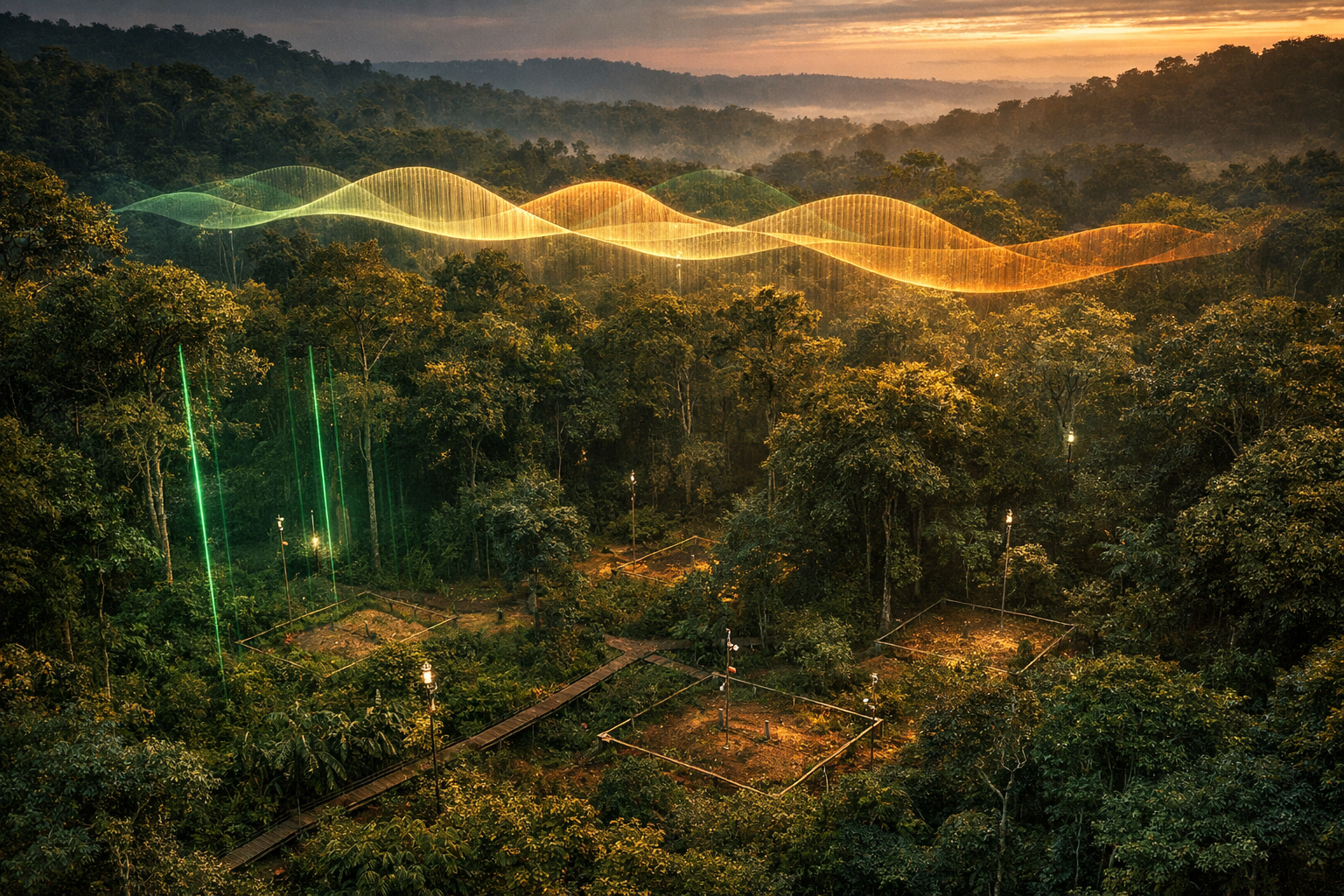
Forest carbon measurement is moving from plot inventories toward digital MRV. LiDAR, satellite remote sensing, and carbon stock mapping are making it possible to cover larger areas more continuously and update estimates more often than traditional sample-based field surveys.
The pace of that shift is visible in the literature. Recent work shows strong growth in airborne laser scanning, GEDI, and ICESat-2 for estimating aboveground biomass and forest structure, with spaceborne LiDAR publications rising sharply over the last five years.
The practical value for buyers and project developers is not just more data. It is geospatial data that can be audited by area, stratified by forest class, and tracked over time. That matters for developers, registries, and verifiers that need defensible project-level evidence.
The current direction is also multi-source. LiDAR is increasingly combined with optical imagery and SAR because no single sensor captures the full variability of biomass in heterogeneous forests. Machine learning is now part of that stack in many 2024-era workflows.
The bigger issue is credibility. If remote sensing becomes the basis for carbon credits and net-zero claims, the key question is no longer only how much carbon is there. It is how credible the estimate is. That is where the comparison between LiDAR, drones, and satellites starts to matter.
Where LiDAR, drones, and satellites outperform plot-based inventories
Airborne LiDAR has a clear advantage over plot-based inventories because it measures canopy height, vertical density, and 3D structure with high precision. Recent reviews report that ALS models combined with field data can reach very high performance, with R² values up to 0.97 in some forest use cases.
Satellite LiDAR such as GEDI and ICESat-2 is especially useful for scaling estimates from plots to landscapes and regions. Drones fill the high-resolution gap in pilot areas, buffer zones, and hard-to-reach sites. Their strength is repeatable operations, not replacing terrestrial surveys entirely.
Multi-source models are also proving stronger in tropical and boreal contexts than optical data alone. A 2024 study on boreal forests showed that combining Sentinel-2 with environmental variables improved aboveground biomass estimation, which reinforces the value of sensor ensembles.
For buyers, this creates practical use cases. It supports baseline setting for ARR and REDD+ projects, leakage monitoring across large landscapes, post-disturbance change detection, and MRV for multi-site portfolios that need standardized reporting.
Higher resolution does not remove scale error, though. The more sophisticated the sensor stack becomes, the more calibration with ground truth matters. Without that, models can overfit and produce biomass estimates that are systematically too high.
The credibility gap: calibration, ground-truthing, and model uncertainty
Remote sensing estimates are not the truth. They are statistical models that still need field plots, reliable allometries, and independent validation. Recent Scientific Data work makes the point clearly: comparing EO products with IPCC defaults is not the same as validating the absolute truth of biomass.
Ground-truthing remains the bottleneck. In many forest areas, collecting high-quality samples is expensive, logistically difficult, and sometimes dangerous. That is why the strongest models often combine national inventories, permanent plots, TLS or TLS-like measurements, and airborne or satellite LiDAR.
Uncertainty budgeting has to include several layers. It should cover plot measurement error, allometric error, machine learning error, co-registration error, and spatial propagation at project scale. For carbon operators, that matters because it affects buffers, discounting, and risk pricing.
Buyers should also be careful with high R² values. A model can predict well and still be biased. It may systematically overestimate biomass in complex forest classes or in forests with large trees.
That is the real MRV debate. If a model produces bigger numbers, the question is whether it is capturing real biomass or simply reducing statistical caution. That leads directly to the next point: more estimated carbon does not automatically mean better climate claims.
Why higher carbon estimates do not automatically mean better climate claims
Higher aboveground biomass estimates do not automatically translate into more verifiable removals or avoided emissions. For carbon claims, additionality, permanence, leakage, and conservativeness matter just as much as the absolute stock number.
For corporate buyers, the risk is buying credits built on overestimation bias or weak models. A project can look richer in carbon, but if the MRV is not defensible, the perceived climate benefit and the accounting benefit can diverge.
Standards are therefore paying more attention to methodological robustness. That means transparency on data sources, documentation of assumptions, uncertainty propagation, and consistency with verification requirements. Verra, for example, continues to frame its program around credibility and transparency, while the premium market is asking for stronger integrity evidence.
In practice, more biomass may only mean the model read the forest better. It does not mean the project has more credits to sell. That is why buyers and offtakers increasingly want dashboards that separate stock estimates, issuance logic, and risk-adjusted climate value.
This distinction between measurement and credit is what keeps the debate alive across standards, registries, and national inventories. The next issue is how better metrics can coexist with rules the market will actually accept.
What this means for carbon standards, national inventories, and buyers
Voluntary standards and registries can use LiDAR and EO data to strengthen methods, but those data still need to sit inside frameworks with eligibility rules, conservativeness, and audit trails. Technical precision alone is not enough for issuance.
National inventories are moving toward IPCC Tier 2 and Tier 3 approaches that require local datasets and consistent protocols. Recent research on IPCC Tier 1 comparisons using Earth Observation shows the value of benchmarking, but it also makes clear that independent samples are still needed before anyone can claim full validation.
Institutional and industrial buyers should ask three things before signing. They should ask how the model is calibrated, what the uncertainty intervals are per hectare and per project, and how the model is updated when the sensor, season, or forest type changes.
For developers, the commercial value is real. Satellite and LiDAR-based MRV can reduce monitoring costs across large pipelines. But that only works if verifier acceptance, registry rules, and core-carbon buyer confidence are preserved.
The next step is to build MRV systems that are scalable, interoperable, and conservative. That is the test that will decide whether forest LiDAR becomes standard infrastructure or stays a high-precision tool with limited adoption.
The next test: building MRV systems that can scale without losing trust
The market is moving toward hybrid MRV architectures. Field plots are used for calibration, airborne or satellite LiDAR extends coverage, and machine learning supports continuous updates. That is the most promising model for scaling without losing reference to ground data.
To be investable, an MRV system has to show that the data chain is replicable, versioned, and verifiable. The same area, the same protocol, and the same results should fall within known error limits. That matters especially for buyers doing portfolio accounting and for funds that need comparability across projects.
The real industrial threshold is not the maximum precision shown in a paper. It is the ability to operate across large, multilingual, and multi-ownership landscapes with sustainable costs, acceptable update frequency, and low dispute risk.
The technical priorities for the next generation of MRV are clear. They include better allometry for complex forests, robust integration of SAR, optical, and LiDAR data, explicit uncertainty management, and alignment with standard and national inventory requirements.
The practical conclusion is simple. Forest LiDAR can improve carbon accounting, but only if it is treated as a verifiable MRV engine, not as a shortcut for inflating biomass and credits.