
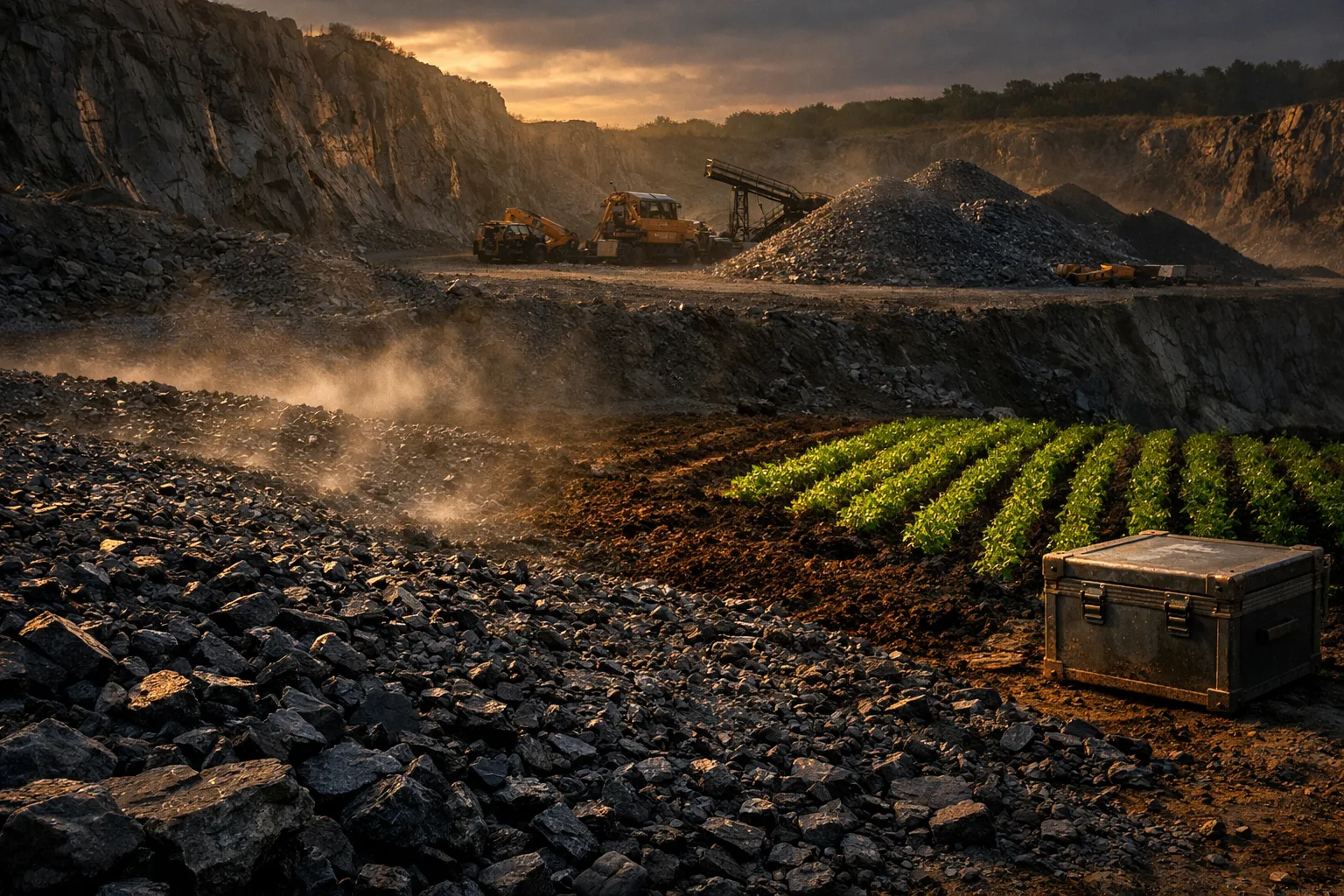
Enhanced Rock Weathering Under Scrutiny: How a High-Yield Credit Issuance Is Testing Carbon Removal Market Integrity
How Enhanced Rock Weathering Claims Are Quantified and Why the Numbers Matter
Enhanced rock weathering turns the dissolution of silicate rocks into measurable CO2 removal. The claim only holds if feedstock characterization, weathering kinetics, and carbon sink accounting are tied together in a robust MRV framework.
For buyers, the key question is not just how many tonnes are claimed. It is whether the claim can be verified, audited, and compared across projects with enough consistency to support a carbon removal purchase.
Recent protocols have pushed the market toward more detailed data. They typically require information on particle size, mineralogy, field application, soil sampling, and in some cases control plots. Isometric, for example, highlights treatment and control plots plus uncertainty documentation, which shows that statistical precision is part of credit value.
That matters commercially. Buyers, offtakers, and brokers want to know whether a tonne is ex-post measured, modeled, or inferred from chemical proxies. That distinction affects perceived quality, price premium, and the bankability of the asset.
The market is already paying attention. Carbonfuture says the enhanced weathering segment has seen meaningful contracted volume, including a largest deal of 290,000 tonnes in 2024, while delivered volume remains limited. That gap between contracts and delivery makes quantification quality even more important.
A figure like 8.3 t/ha is therefore not just a high number. It is a stress test for baseline design, sampling, and comparability across sites.
Why 8.3 Tonnes per Hectare Raised Questions Among Buyers, Verifiers, and Competitors
A result of 8.3 tCO2/ha stands out because it is high relative to many early-stage expectations in enhanced rock weathering. Field trial outcomes are still highly site-specific, so a number like that needs clear context on soil, climate, dose, mineralogy, and the monitoring window.
Buyers ask hard questions because a high-yield issuance can signal either strong performance or a methodological outlier. Corporate buyers and portfolio builders usually compare such a figure with internal benchmarks for tCO2/ha, cost per tonne, and agronomic co-benefits.
Recent evidence shows why this is not simple. Some 2024 trial results reported average yield increases of around 15% in certain cropping systems, while other studies show that the effect depends heavily on farming practice, rock type, and nutrient availability. Carbon yield and agronomic benefit do not automatically move together.
That is also why verifiers and market observers focus on replicability. A strong result in one setting does not prove the same outcome in other crop systems or geographies. The question is whether the issuance reflects broad performance or a favorable local combination of conditions.
The real issue behind the headline number is the measurement logic. Baseline soil chemistry, porewater alkalinity, and statistical uncertainty determine whether the reported yield is durable evidence or just a promising first datapoint.
The Measurement Challenge in ERW: Baselines, Soil Chemistry, and Uncertainty
Enhanced rock weathering is hard to measure with a single indicator because removal happens through distributed processes over time and space. The main methodological families include cation loss from the feedstock, soil porewater chemistry, mass balance, and watershed monitoring.
The baseline is where many disputes begin. Buyers and auditors need a credible before-and-after comparison, but soil is heterogeneous, seasonal, and affected by routine agronomic operations. That is why modern protocols call for control plots, repeated sampling, and documentation of uncertainty in the GHG statement.
The chemistry matters just as much. Monitoring pH, alkalinity, dissolved cations, bicarbonates, and mineral mobility helps distinguish actual weathering from simple mixing or natural variability. In ERW, soil chemistry is not a side note. It is the core of mass-balance MRV.
The methodology is becoming more audit-friendly. Isometric’s updated enhanced weathering protocol in January 2025, along with digital submission tools, suggests the market is moving toward more standardized review. Even so, site-to-site divergence remains a real risk because soils, seasons, and crop regimes differ.
That leaves a commercial problem as much as a scientific one. If uncertainty is still the most expensive variable, then pricing and buyer confidence depend on how much of that uncertainty can be reduced, disclosed, and insured through contract design.
What This Issuance Could Mean for Carbon Credit Pricing and Buyer Confidence
Pricing in carbon removal often follows trust in MRV more than volume alone. ERW credits with strong measurement and verified delivery can support a premium over credits built on weaker or less transparent models.
A high-yield issuance can help and hurt at the same time. It may speed up adoption by corporate buyers, but it can also intensify scrutiny around permanence, additionality, and comparability. For portfolio builders, the question is whether the project adds diversification or concentrates audit risk.
The market context makes that scrutiny sharper. Carbonfuture notes that enhanced weathering has already seen significant transacted volume, but delivery remains small relative to announced deals. That imbalance keeps the market sensitive to any issuance that appears best in class.
Sophisticated buyers usually want more than a credit certificate. They look for delivery schedules, data rights, replacement clauses, protocol version disclosure, verifier identity, sampling density, and uncertainty bands. Those terms can affect pricing, escrow needs, and willingness to prepay.
The bigger question is whether the market can trust scale, not just one issuance. That leads to the final test: can ERW hold up across regions, soils, and crop systems?
The Bigger Market Test: Can ERW Scale Credibly Across Regions and Crop Systems
Enhanced rock weathering has strong global potential, but adoption will not look the same everywhere. Recent literature points to marked regional differences in projected deployment between 2025 and 2100, shaped by climate, agricultural infrastructure, and carbon market structure.
Agronomy is a major reason scale is uneven. Outcomes differ across maize, cereals, rotations, and plow or no-till systems, so carbon yield per hectare and agronomic co-benefits are not transferable in a straight line. That makes standard procurement harder for global buyers.
Supply chains matter just as much as field results. Scaling ERW requires suitable feedstock, rock crushing logistics, field distribution, and quality control on particle size and mineralogy. In practice, removal credibility depends on the materials chain as much as on the carbon accounting protocol.
The market is still early, but the direction is clear. Large deals with limited verified delivery suggest the next phase will be defined by standardization, regional performance data, and repeatable MRV packages.
If ERW can prove it is measurable, replicable, and bankable across agricultural systems, it can become a core carbon removal category. If not, it will remain a niche with heavy verification needs and limited standardization.