
How Farmland Is Becoming a Dual Asset for Biodiversity Credits and Voluntary Nature Markets
Why UK farmland is emerging as a new supply source for nature-based credits
UK farmland is increasingly being treated as a nature asset class because England’s biodiversity net gain, or BNG, regime creates recurring demand for off-site biodiversity units that can be generated on suitable agricultural land.
That matters because the regime has been in force for most developments since 12 February 2024. Developers now need a way to meet biodiversity requirements when they cannot do everything on site.
Farmland fits that need well. It often offers scale, measurable baselines, and long-term land control. Those are the ingredients needed for habitat banks, off-site biodiversity units, and phased restoration projects that can be legally secured and registered.
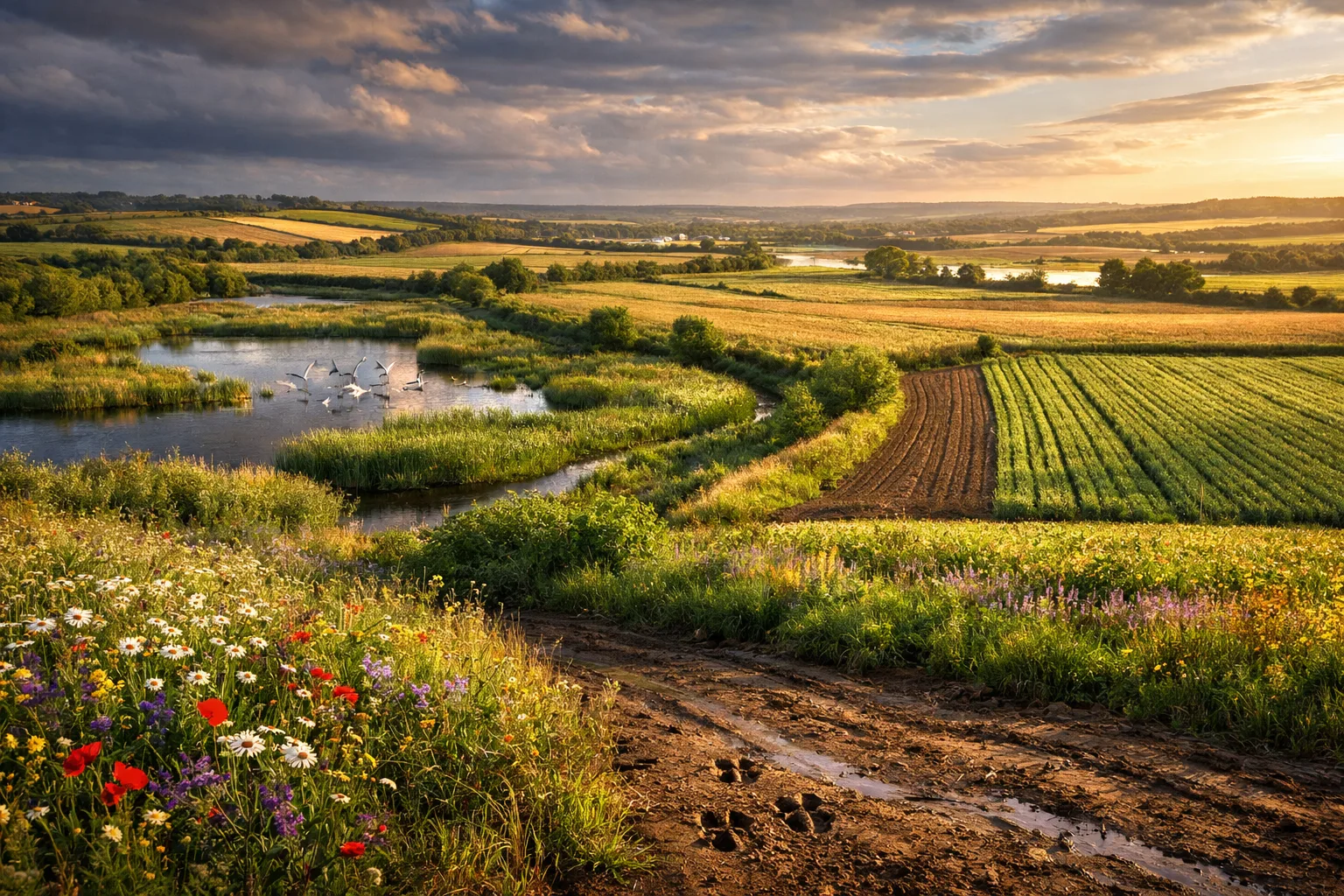
The supply usually comes from lower-yield areas. Typical interventions include field margins, wet grassland conversion, arable reversion, buffer strips, ponds, hedgerow enhancement, and other habitat creation or enhancement work that can generate measurable biodiversity uplift under the statutory metric.
Price signals are also shaping the market. Statutory biodiversity credits are a last-resort option and are priced above off-site alternatives to avoid undercutting the market. Government reporting shows statutory credit prices ranging from £42,000 to £650,000 per credit, with a weighted average of about £46,500.
For landowners and developers, the commercial question is no longer whether farmland can generate environmental value. It is how to structure land, finance, and legal tenure so biodiversity uplift can be monetised at scale. That is where the mechanics of BNG off-site units come in.
How biodiversity net gain works and why off-site units matter
BNG in England generally requires developers to deliver at least 10% biodiversity net gain. The hierarchy is clear. First, deliver on site. Then use off-site biodiversity units. Only after that should statutory biodiversity credits be used as a last resort.
Off-site units matter because many developments cannot fit enough habitat creation on the plot. That is especially true for constrained urban sites, brownfield sites, and infrastructure projects. The result is a structured demand pool for third-party land, including farmland used as registered habitat banks.
Developers cannot simply choose off-site supply first. They must show that on-site options are insufficient. That makes distance, habitat type, delivery certainty, and legal security important commercial filters for buyers of BNG units.
Land managers can sell units independently, in partnership, or through a habitat bank operator. They must still meet registration, baseline survey, and legal agreement requirements. If habitat work has not already begun, it should start within 12 months of allocation.
This creates a clear market boundary. BNG is a regulated planning mechanism. Once buyers understand that, the next question is how it differs from voluntary nature credits used outside planning obligations.
What voluntary nature credits are, and how they differ from compliance units
Voluntary nature credits are sold in markets where buyers choose to fund nature restoration or biodiversity outcomes beyond regulatory obligations. BNG units are different. They are compliance instruments tied to planning permission in England.
The UK government’s 2024 integrity principles for voluntary carbon and nature markets are direct on this point. Credits should reflect real, additional, verifiable outcomes. They should not be used as a substitute for avoiding harm or reducing impacts in the first place.
For corporate buyers, that means voluntary nature credits are more like a claims and impact tool. They can support ESG reporting, biodiversity strategy, or supply-chain stewardship. Compliance units, by contrast, are a planning solution with a defined legal use case.
The difference also matters operationally. Compliance units usually require tighter linkage to habitat metrics, registry rules, and planning evidence. Voluntary credits may include broader outcomes such as landscape restoration, connectivity, water resilience, or co-benefits tied to nature-positive procurement.
The hybrid opportunity for farmland is that the same land strategy may support both compliance-grade biodiversity uplift and future voluntary nature claims. That only works if the project can navigate claims integrity and avoid double counting.
The investment case for landowners, developers, and credit buyers
For landowners, biodiversity credits can diversify farm income by turning marginal or low-productivity land into a long-dated environmental revenue stream. In many cases, that comes with lower operational intensity than traditional agricultural output.
For developers, buying off-site units can reduce land-take pressure and planning risk when on-site delivery is constrained. A local habitat bank can be especially useful if it offers the right habitat type, location, and delivery timeframe.
For credit buyers in the voluntary market, farmland-based projects have a tangible asset story. Land, habitat uplift, monitoring, and permanence commitments are easier to explain than many abstract environmental instruments. That can improve procurement confidence.
Commercial viability depends on structure. Legal control, metric uplift, and pipeline certainty need to be in place early. Buyers will want to see baseline ecology, expected unit yield, timing of habitat establishment, and registry readiness before committing capital.
The underwriting question is not just whether it can sell. It is whether it can stand up to scrutiny. That brings in additionality, permanence, stacking, and actual demand.
Key integrity questions: additionality, permanence, stacking, and market demand
Additionality is central. Buyers will expect biodiversity outcomes to go beyond business-as-usual land management, especially where public subsidies, regulatory obligations, or pre-existing conservation duties already cover part of the activity.
Permanence is a major issue for farmland because habitat gains must be secured over long timeframes. BNG delivery depends on legal agreements and ongoing management, not just a one-off land-use change.
Stacking is possible in principle, but only if the same ecological benefit is not sold twice. UK guidance already signals that land managers may combine biodiversity units with other environmental payments in some cases, so contract design and claim separation are essential.
Market demand is still developing. Statutory BNG creates a floor, but voluntary nature markets depend on buyer trust, robust standards, and clear claims rules. The UK’s 2024 principles and later consultation responses show that government is still shaping the integrity framework.
For sophisticated buyers, the diligence package is becoming familiar. It includes baseline surveys, metric calculations, legal permanence, monitoring plans, and proof that volumes are not over-issued.
What this trend could mean for nature credit markets beyond the UK
The UK is becoming a practical testbed for nature credit market design because it combines a mandatory compliance market for biodiversity with an emerging voluntary integrity framework. That gives the sector both demand and governance signals.
If farmland-based habitat banks can reliably deliver measurable biodiversity uplift under long-term contracts, the model could inform similar market structures in other jurisdictions. The appeal is strongest where agriculture, planning offsets, and voluntary nature finance need to work together.
The relevance is not limited to biodiversity alone. Investors increasingly want blended nature outcomes such as water quality, flood resilience, carbon co-benefits, and landscape-scale restoration. Those outcomes tend to favour asset-backed projects with clear monitoring.
The big takeaway for global B2B audiences is simple. Farmland is shifting from a single-output production asset to a multi-revenue ecological platform. That only works if markets converge on credible standards, durable contracts, and transparent claims architecture.
The UK story is therefore not just about local planning reform. It is a preview of how nature markets may evolve when agricultural land, compliance demand, and voluntary capital start operating in the same investment stack.