
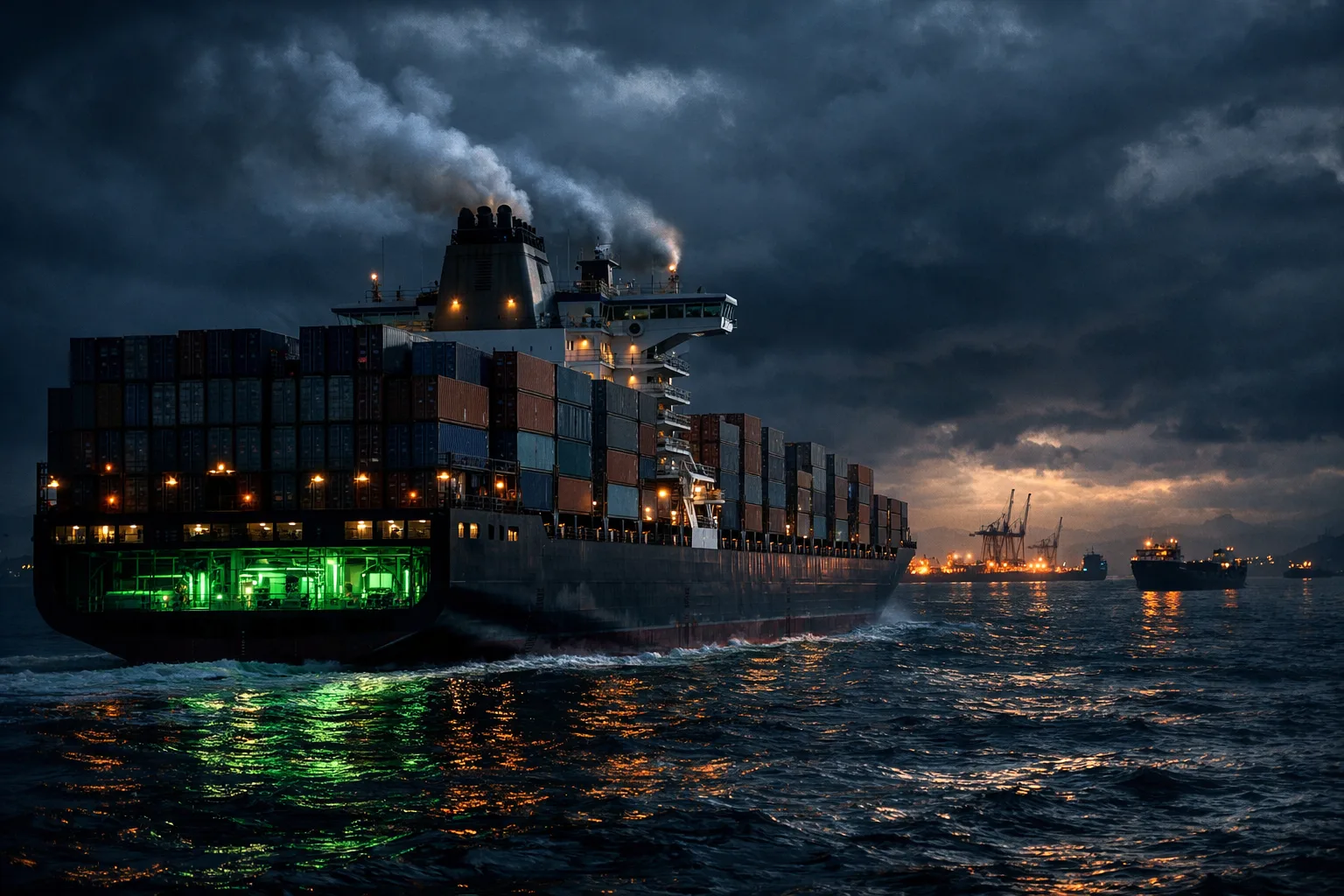
Why fuel-price volatility is pushing shipping companies to rethink energy security
Fuel-price volatility is now an energy security issue for shipping, not just a cost issue. When routes are diverted and sailing distances increase, as happened in 2024 via the Cape of Good Hope, ton-mile demand rises, fuel burn increases, and margins come under pressure for carriers and charterers.
For buyers, the key question is no longer only the spot price of bunker fuel. It is the resilience of the energy supply chain: bunker availability, exposure to geopolitical chokepoints, hedging against regional shocks, and delivery predictability across Asia-Europe and Asia-Mediterranean lanes.
Compliance costs are now part of the same equation. UNCTAD estimates that for a 20,000 to 24,000 TEU container ship on the Far East-Europe route, CO2 emissions alone can add about USD 400,000 under the EU ETS.
That is pushing shipowners and operators to reassess the total cost of ownership of dual-fuel fleets, slow steaming, route optimisation, and multi-hub bunkering contracts. CAPEX, OPEX, and regulatory risk now sit in the same decision framework.
The regulatory backdrop is also tightening. The EU ETS has covered maritime transport since 2024, and the IMO approved the Net-Zero Framework in 2025 with a fuel standard and pricing mechanism. That leaves less room for strategies built only around conventional fuels.
The strategic shift is clear. Geopolitical volatility is accelerating demand for alternative fuels and more stable supply, which leads directly to the question of which low-carbon fuels are investable now and which remain longer-term options.
Which cleaner fuels are gaining traction as short-term and long-term options
In the near term, the market is rewarding fuels with stronger readiness. LNG remains the most adopted alternative fuel in 2025 orders, while methanol continues to gain ground because bunkering infrastructure and commercial engines are already available in multiple segments.
DNV data show that in the first half of 2025, orders for alternative-fuelled vessels reached 19.8 million GT, up 78% from 2024. LNG leads, methanol is strong in container shipping, and ammonia is starting to appear in tanker and general cargo orders.
For buyers and processors, the real issue is the trade-off between drop-in capability and abatement depth. LNG and bio-methane can cut emissions intensity faster, but methanol and ammonia offer a more credible path toward net zero, provided cost, supply, and safety challenges are addressed.
Methanol is often the most credible bridge fuel for container shipping. DNV points to high engine readiness, an existing production and storage base, and a growing bunkering fleet. But bio-methanol is still expensive, at around USD 2,500 per tonne MGOe on average in 2025, and supply remains limited.
Ammonia and hydrogen are more suited to a long-term view because they have near-zero emissions potential. Their adoption depends on safety rules, port infrastructure, and low-carbon production at industrial scale.
This is where fragmentation becomes a problem. With different fuel mixes by route, port, and region, the real lever becomes a global shipping emissions framework that reduces regulatory arbitrage and channels investment toward a common trajectory.
How a global shipping emissions framework could reduce policy fragmentation
Regulatory fragmentation is already raising the cost of transition. The EU ETS applies to maritime transport from 2024, but only covers traffic linked to Europe. Without a global framework, shipowners and cargo owners must navigate different rules across routes, ports, and jurisdictions.
The IMO framework approved in 2025 is designed to close that gap with a mandatory marine fuel standard and a global GHG pricing mechanism. It applies to large ocean-going ships above 5,000 GT, which generate 85% of the sector’s CO2 emissions.
For B2B stakeholders, the main benefit is lower regulatory arbitrage. That means less stranded asset risk, better bankability for fuel-switch projects, and a clearer price signal for retrofit, fleet renewal, and bunkering infrastructure.
The IMO 2023 Strategy also adds interim checkpoints for 2030 and 2040. That helps buyers plan procurement, long-term chartering, and offtake agreements with a more credible horizon than a patchwork of regional rules.
Convergence between IMO rules and regional systems such as the EU ETS is already building practical experience around MRV, surrendering, and carbon cost pass-through. That makes it easier to include emissions cost in freight contracts.
This is not only a technical shift. If the global framework stabilises, port fees, bunker investment, and corridor planning can be repriced more consistently. The focus then moves to which logistics hubs and trade routes will gain or lose value.
What the shift means for ports, cargo owners, and international trade routes
Ports are becoming strategic nodes in decarbonisation and resilience. Those that invest in bunkering for LNG, methanol, and future ammonia corridors can attract traffic, value-added services, and long-term contracts with liner and tanker operators.
The 2024 disruption showed that rerouting changes more than costs. UNCTAD reports that Suez Canal transits fell sharply and traffic via the Cape of Good Hope increased, with effects on fuel demand, port congestion, and schedule reliability.
For cargo owners, the operational issue is total landed cost. More days at sea mean more fuel burn, more working capital tied up, higher exposure to demurrage, and possible climate-related surcharges across the supply chain.
Trade routes exposed to geopolitical chokepoints now require more sophisticated procurement decisions. Dual sourcing, selective nearshoring, contract clauses on emissions pass-through, and port selection based on bunker availability and carbon intensity all matter more.
African and Middle Eastern ports involved in rerouted traffic may see more calls and more bunkering demand, but they also face congestion and infrastructure pressure. That means investment in storage, safety systems, shore power, and digital planning.
This new trade geography makes one thing obvious. Maritime decarbonisation will not be financed by private CAPEX alone. Carbon markets and climate finance are needed to lower the cost of capital and scale next-generation infrastructure and fleets.
The role carbon markets and climate finance could play in scaling maritime decarbonisation
Carbon markets are becoming a way to monetise emissions risk. The EU ETS has already made the cost of shipping emissions tangible, creating a precedent for global pricing and for valuing fuel-switch projects.
For shipowners and investors, the issue is not just compliance. It is project financeability. Carbon pricing revenue, green premiums on freight contracts, and offtake agreements can improve IRR and shorten the payback period for retrofit, dual-fuel newbuilds, and port-side infrastructure.
The IMO framework approved in 2025, by combining fuel standards and pricing, can create a more stable base for blended finance, transition finance, and de-risking tools such as guarantees, concessional loans, and performance-linked debt.
Cargo owners can also help unlock capital. Voluntary Scope 3 commitments, green procurement, and long-term volume commitments support investment in methanol supply, ammonia export terminals, and fleet conversion.
The priority for B2B players is to build a financial ecosystem that connects port infrastructure, fuel production, vessel technology, and compliance data. That turns carbon cost into a capital allocation signal rather than a simple operating tax.
In short, geopolitical shocks, global rules, and climate finance tools can accelerate a cleaner shipping transition that is more resilient, more investable, and less fragmented.