
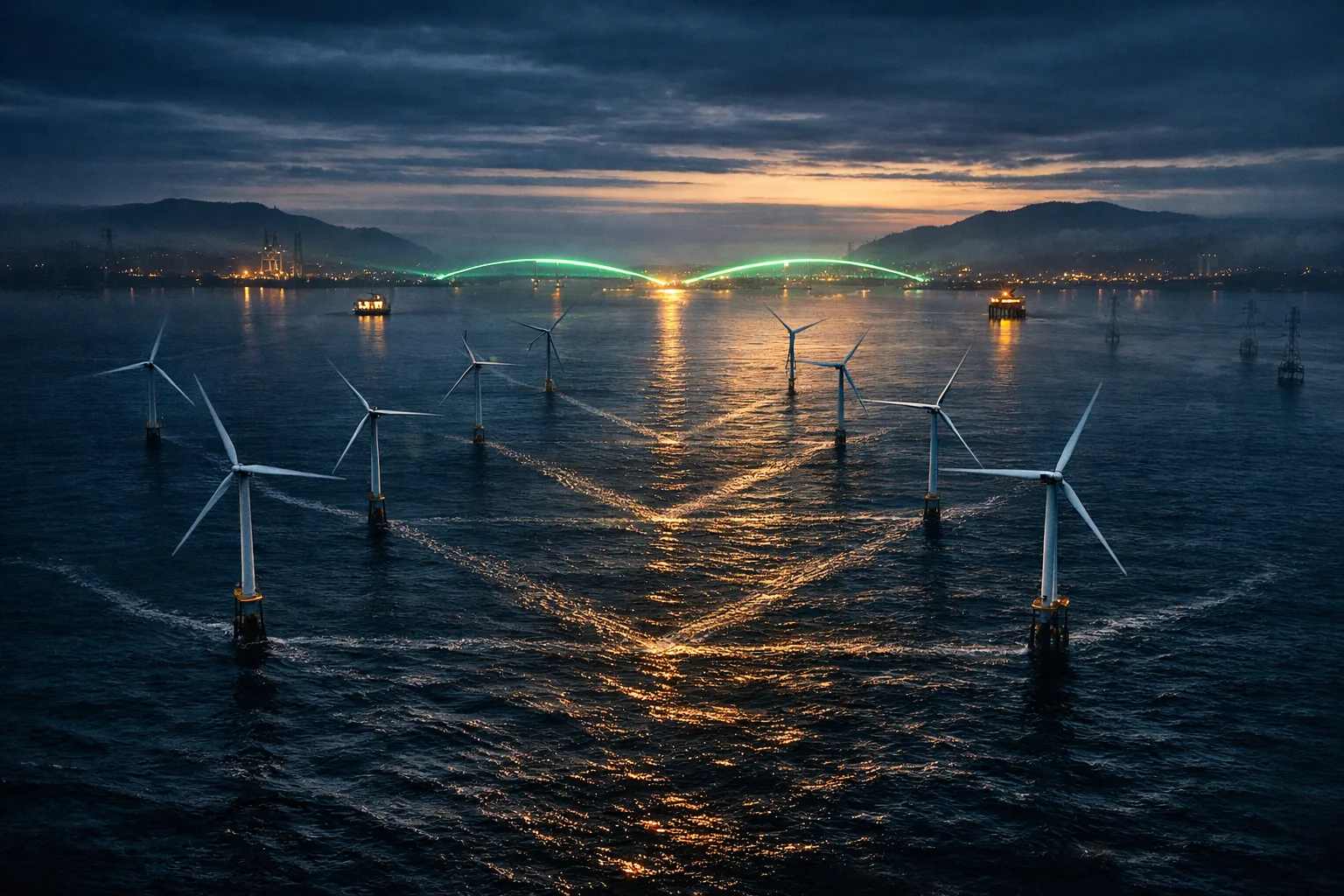
Why Ireland Is Prioritising Clean Power and Carbon Market Coordination in Brussels
Ireland is entering this agenda with more domestic credibility than it had a few years ago. Renewable electricity reached 40.2% in 2024, while the overall renewable energy share was 16.1%. That gives Dublin a stronger basis to argue for faster grid build-out, permitting reform, and cleaner power procurement at EU level.
That matters for buyers because the real question is not just whether Europe can add more renewables. It is whether wind-heavy supply can become bankable offtake, lower power-price volatility, and improve PPA pricing for corporates, utilities, and data centres facing Scope 2 targets. For power traders and industrial energy managers, clean power policy is already a commercial issue, not just a climate one.
Ireland also has recent policy backing to point to. Environmental subsidies and similar transfers rose to €2.3 billion in 2024, including a €252 million PSO levy effect tied to renewable support. That shows the market structure already includes public support for generation expansion.
The wider EU backdrop makes the timing important. The Commission is preparing further ETS and market-design work for 2026, so an Irish presidency could frame renewables and carbon coordination as part of competitiveness, not only climate policy. That is relevant for buyers comparing European industrial electricity costs with US and Asian benchmarks.
This is where the carbon-market question comes in. If Brussels and Dublin want to align carbon pricing with clean-power scale-up, an EU-UK ETS relationship could matter for market depth, hedging efficiency, and cross-border price signals.
The EU-UK ETS Link: How a Stronger Carbon Market Relationship Could Affect Prices and Liquidity
The policy basis is now real. In May 2025, the EU and UK agreed to work towards linking the EU ETS and UK ETS, and in November 2025 the Council authorised negotiations on linking emissions trading systems. That is the institutional shift behind any future market convergence.
Linking would make allowances fungible across the two systems while each side keeps its own cap and policy features. That matters for liquidity, arbitrage, and price discovery. For traders, it could widen the pool of hedging instruments. For industrial emitters, it could reduce basis risk in compliance planning.
The market-design impact would be strongest for sectors with cross-border exposure. Power generation, metals, chemicals, cement, and shipping-adjacent logistics all face carbon costs that feed into procurement contracts and margin protection strategies. A linked market could improve risk management for multinational B2B operators.
The UK is also still changing its own scheme. It is adjusting free allocation timing and expanding work on maritime and future markets policy. That suggests linkage will be negotiated alongside active UK ETS redesign, not after it. A phased and politically sensitive agreement looks more likely than a quick one.
The open question is whether this linkage supports a broader renewables-first strategy in the EU, or whether it distracts policymakers from the deeper electricity-system reforms needed to keep industry competitive.
What a Renewables-First Presidency Could Mean for EU Climate Policy and Industrial Competitiveness
A renewables-first agenda is increasingly industrial policy, not just decarbonisation. Ireland’s own 2030 electricity target is 80% renewable generation, while the EU is still balancing faster clean-power deployment against power-price competitiveness for manufacturers.
For buyers and transformers, the commercial impact would show up in long-term electricity contracting, green PPAs, and site-selection decisions for energy-intensive assets such as battery plants, food processing, and digital infrastructure. More renewable penetration usually strengthens the case for corporate offtake structures, but only if grid congestion and curtailment are managed.
Ireland’s recent data show why flexibility matters. Wind remains the largest renewable source, but 2024 also saw a 69% increase in solar-PV generation. That means a more diverse renewables mix is becoming a real grid-balancing issue, not just a policy goal.
In Brussels, that strengthens the case for permitting reform, interconnection investment, storage, and demand-response incentives. Competitive electrification depends on delivering clean power at scale, not just announcing higher targets. That is the bridge between policy ambition and industrial competitiveness.
The next issue is political reality. If the EU and UK move closer on carbon markets, what are the cross-border risks around regulation, sovereignty, and market design after Brexit?
The Cross-Border Risks: Political Friction, Market Design, and Regulatory Alignment After Brexit
Even with a linkage mandate in place, the EU and UK still run distinct schemes. They have separate cap-setting, auction rules, free-allocation design, and policy timelines. That means alignment risk remains material for compliance teams and emissions traders. Legal certainty will matter as much as headline politics.
Political friction is still a live factor because linking carbon markets requires trust in rule stability, enforcement, and governance. For B2B counterparties, any divergence in market intervention, aviation coverage, maritime scope, or allowance supply could affect forward curves and contract valuation.
Market-design complexity also matters for carbon-border policy. The UK is preparing its own carbon border adjustment mechanism timeline, while the EU continues refining ETS rules. Divergent border measures could create basis risk for exporters, importers, and manufacturers that trade across the Channel.
For heavy industry, the practical question is whether linked carbon pricing will simplify compliance or add another layer of reporting, verification, and portfolio management. That matters especially for companies with installations in both jurisdictions, or supply chains that embed carbon costs into product pricing.
That tension leads to the commercial winner and loser question. Which market participants would benefit most from deeper EU-UK carbon cooperation, and who would need to hedge the new risks most aggressively?
Who Could Benefit Most From Deeper EU-UK Carbon Cooperation: Utilities, Traders, and Heavy Industry
Utilities are likely to be among the biggest beneficiaries. A larger linked compliance pool can improve liquidity, tighten bid-ask spreads, and support more efficient hedging of generation margins across power and carbon books. For integrated utilities, that means better dispatch, fuel-switching, and allowance procurement decisions.
Carbon traders and market makers would also gain from a broader instrument set and potentially higher turnover if allowances become fungible across the two systems. That matters for structured products, spread trading, and risk warehousing, especially if future policy harmonisation deepens auction participation and secondary-market depth.
Heavy industry stands to benefit if linked markets reduce compliance-cost fragmentation and improve visibility over forward carbon prices. That is crucial for capex planning, abatement investment, and long-term supply contracts. Sectors with thin margins and high energy intensity are likely to value that predictability most.
Corporate buyers should watch for second-order effects too. A more integrated carbon market may support cleaner power procurement and strengthen the business case for electrification, but only if it does not create new regulatory complexity in cross-border trade documentation and emissions reporting.
The strongest takeaway is simple. Ireland’s agenda is not just about being pro-renewables. It is about positioning Europe for a more liquid, more competitive, and more politically durable carbon-price architecture, provided Brussels can align climate ambition with market design.