
Nigeria’s Clean Cooking Push Could Build a New Carbon Credit Supply Chain for Global Buyers
Why Africa’s Clean Cooking Credits Are Moving From Niche to Scalable Supply
The clean cooking market is moving from niche project finance to scalable supply because the access gap is still enormous. The IEA estimates that around 2 billion people worldwide still lack access to clean cooking, and that structural shortage is why cookstove carbon credits are starting to look like an industrial supply chain story rather than a one-off project story.
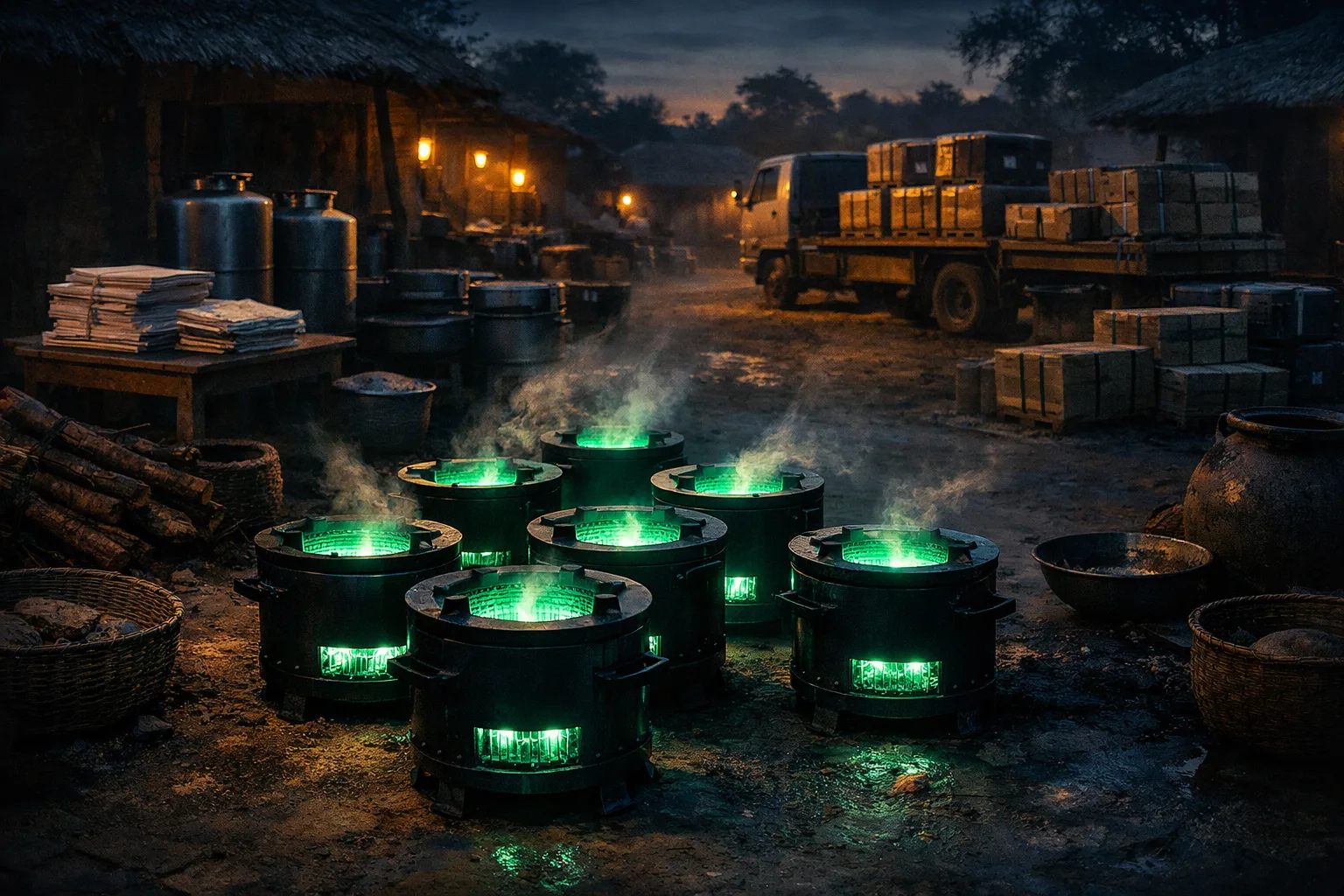
Nigeria matters because it points to volume, not just need. Reporting around the country’s 2026 plan talks about 80 million efficient cookstoves, with rollout already underway in Lagos in 2025. That changes the deal flow. Buyers are no longer looking only at isolated projects. They are looking at a national pipeline that could support standardization, procurement, and large-scale offtake.
Scale only becomes credible when it is tied to recognized methodologies. Gold Standard says its clean cooking methodologies have been confirmed as ICVCM CCP eligible, and that 185 projects have already issued almost 3 million credits. For buyers, that matters because it supports the idea of scaled supply with integrity, which is what forward offtake and portfolio allocation usually need.
The real operational story is not just emission reductions on paper. It is programmatic distribution. That means cookstove supply chains, local assembly, fuel substitution, household onboarding, and reducing stove stacking over time. Scalability depends on procurement, last-mile logistics, and adoption retention. Without those, the credit story stays theoretical.
If Nigeria can prove that model at scale, the next question is obvious: who finances the expansion, and can climate finance lower the cost of capital for developers and investors?
What Nigeria’s Climate Finance Ambition Means for Project Developers and Investors
The investable part is not only the carbon credit itself. It is the monetization structure around it. Nigeria’s clean cooking push combines climate finance ambition, Article 6 framing, and verified carbon credit revenues. For developers, that can support financing stacks that include pre-financing, results-based finance, and revenue sharing linked to issuance.
The revenue headline matters because it affects bankability. A figure circulating in the market suggests up to $5 billion a year at full scale, but that should be treated as a project scenario, not a certainty. The useful takeaway is simpler: even a fraction of that flow could change IRR, payback periods, and debt pricing for developers.
A government-led program can also reduce market risk. When a state coordinates distribution and authorization, developers have a clearer path on host country authorization, issuance timing, and credit fungibility. That is especially relevant for investors who want portfolio scale-up rather than exposure to a single asset.
Clean cooking projects also need a lot of capital upfront. Manufacturing, inventory, agent training, monitoring, and customer support all require working capital before credits are issued. That is why climate finance and carbon prepayment can be decisive. They reduce cash strain and make the model more financeable.
If the Nigerian model works, the bigger question becomes competitive. Who gets access to the volume, what happens to pricing, and does a broader green light across Africa compress margins or expand the buyer base?
How a Continent-Wide Green Light Could Change Buyer Access, Pricing, and Competition
A continent-wide expansion in clean cooking would likely shift the market from opportunistic buying to strategic procurement. Corporate climate teams, traders, energy majors, and compliance-adjacent buyers could start competing for forward volume in Africa instead of sourcing sporadically from scattered projects.
The supply potential is large, but it will not all arrive at once. The IEA’s ACCESS scenario shows clean cooking access in sub-Saharan Africa can accelerate between 2024 and 2040, which means the market will be shaped by staged deployment curves, not just issuance volume. That matters for pricing because supply growth tends to affect scarcity premiums over time.
For buyers, more access can mean less scarcity premium, but it can also mean more professional sourcing. Tender competition, aggregator platforms, standardized ERPA terms, and diversified vintages become more common. In practice, the market may become more transparent and comparable, not just cheaper.
Competition will also be geographic in a practical sense. Large national programs tend to favor developers with government relationships, supply-chain capacity, and the ability to pass due diligence. Smaller projects may be absorbed into aggregators or joint ventures. Buyers should pay attention to counterparty concentration risk, not just project count.
Once supply becomes more industrial, integrity becomes the differentiator. The next question is whether the credits can stand up to scrutiny on additionality, double counting, user adoption, and alignment with Article 6 or CORSIA claims.
The Integrity Questions Global Buyers Will Ask Before Signing Offtake Deals
Integrity will be the first filter for serious buyers. They will want clarity on additionality, host country authorization, double counting prevention, and MRV robustness. ICAO updated the list of CORSIA Eligible Emissions Units in 2026, and credits used for CORSIA need to meet eligibility criteria. For units from 2021 onward, Article 6 authorization also becomes relevant.
Buyers will also ask whether the stoves are actually being used. Distribution alone is not enough. They will want evidence on adoption rates, usage persistence, stove stacking, refill behavior, and leakage. In cookstove projects, credit quality depends heavily on household behavior, not just hardware delivery.
Gold Standard’s updated buyer guidance makes the same point in practical terms. Credibility depends on carbon finance, but also on strong methodological safeguards and quality controls. For procurement teams, that translates into a preference for high-integrity cookstove credits, robust household monitoring, and conservative baselines.
A serious offtake agreement should also define who carries the risk if issuance is delayed, methodologies change, or adoption underperforms. Traders and intermediaries usually need quality covenants, replacement rights, and volume true-up clauses to make the contract workable.
Once integrity is clear, the discussion shifts to regulation. The key question is where these credits fit in CORSIA, Article 6, and corporate net zero strategies, and which claims are actually defensible.
Where Clean Cooking Credits Fit in CORSIA, Article 6, and Corporate Net Zero Strategies
Clean cooking credits are becoming more relevant because the international compliance architecture is getting clearer. ICAO updates CORSIA eligibility regularly, and the 2026 documentation confirms the central role of CORSIA Eligible Emissions Units for the 2024 to 2026 and 2027 to 2029 phases.
For aviation-adjacent buyers and intermediaries, the key question is whether a cookstove credit can be Article 6 authorized. That matters because authorization can support stronger and less ambiguous claims. The point is simple: fungibility depends on host country authorization and the national framework, not only on the registry issuer.
For corporate net zero strategies, these credits fit best in residual emissions, beyond-value-chain mitigation, and portfolio diversification. They do not replace internal decarbonization. Companies still need to decide whether they are making offsetting claims, contribution claims, or transitional claims, and document that carefully to avoid greenwashing risk.
The market also benefits from the overlap between voluntary standards and compliance-grade thinking. ICVCM CCP eligibility for Gold Standard clean cooking methodologies makes these credits easier to defend in stricter procurement policies. That is useful for ESG funds, corporates, and traders with internal standards committees.
Even with a good regulatory frame, the market will stall if MRV, distribution, and household adoption do not work at scale. That is where the real test begins.
The Real Market Test: Can MRV, Distribution, and Household Adoption Scale Fast Enough?
The bottleneck is not only carbon accounting. It is the ability to measure, verify, and maintain real usage at scale. MRV systems, remote sensing where applicable, digital QA/QC, household surveys, and usage telemetry become mission-critical when rollout reaches millions of stoves.
Distribution is an industrial challenge. A program like Nigeria’s needs local partners, last-mile logistics, customer onboarding, service networks, and replacement cycles. Without that infrastructure, issuance slows and the buyer experience turns into delivery risk and volume slippage.
Household adoption is the real driver of credit quality. Clean cooking projects need to show sustained use, fuel displacement, and reduced stacking over time. If they cannot, the emission reduction potential does not translate into investable credits.
At a macro level, the IEA shows that clean cooking access can rise quickly when policy, finance, and delivery systems align. But universal access still takes years. That means the credit market will need to work with long timelines, milestone verification, and staged issuance.
The takeaway for global buyers is straightforward. Nigeria can become a supply-chain catalyst only if the program keeps integrity, authorization, and adoption discipline. If it does not, it will remain ambitious, but not yet fully bankable.