
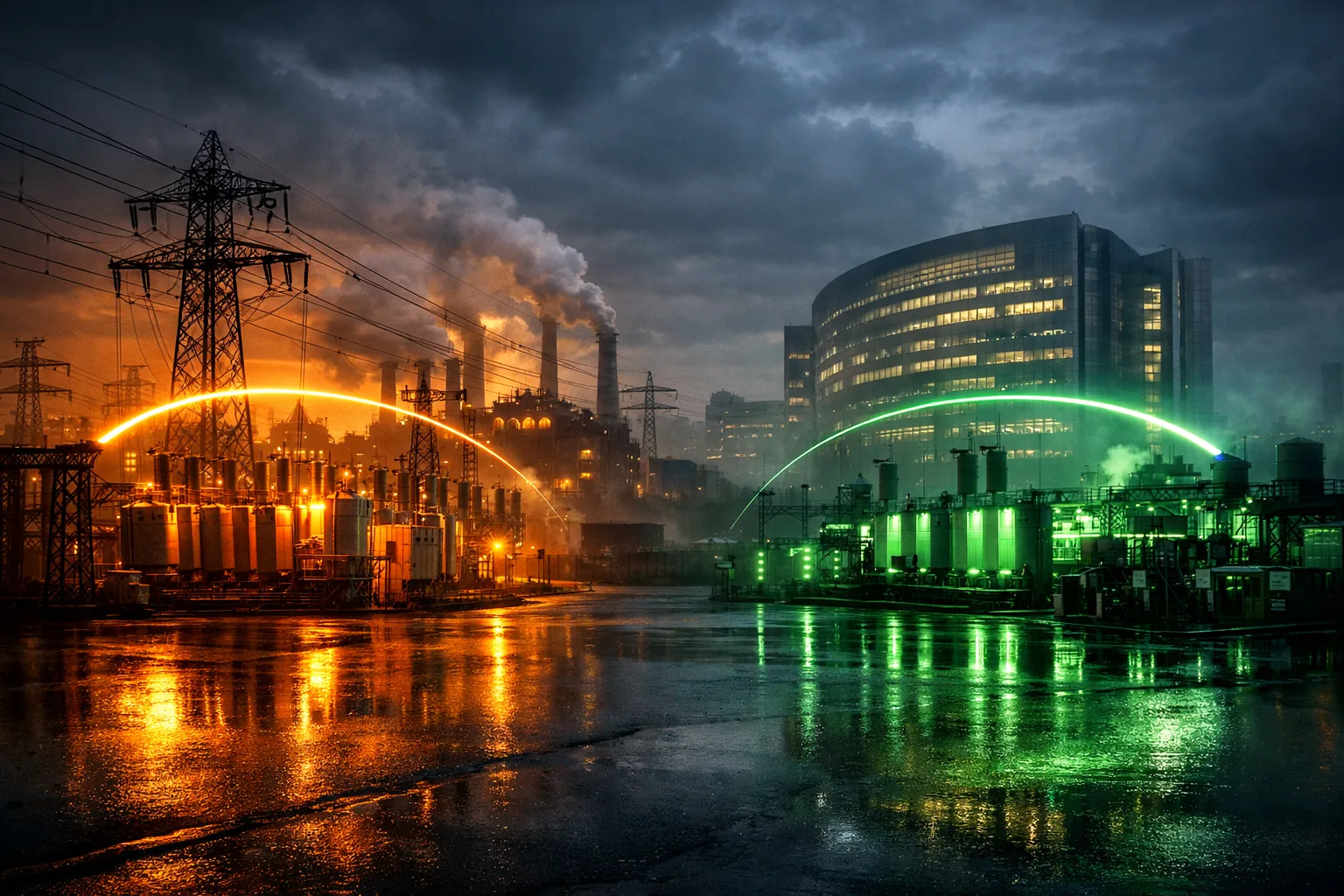
What the European Commission’s new crisis aid framework actually changes for power-intensive industries
The European Commission has changed the policy frame around industrial energy relief. The Clean Industrial Deal State Aid Framework, adopted on 25 June 2025, gives Member States a longer-running legal basis for support through 31 December 2030, instead of relying on ad hoc crisis logic.
That matters for power-intensive industries such as steel, chemicals, aluminium, paper, glass, and fertilisers. The framework explicitly allows temporary electricity price relief, plus support for renewables, storage, demand response, and other non-fossil flexibility measures.
The practical effect is clearer and faster aid approvals, but not open-ended support. The Commission still requires safeguards against distortion and overcompensation, so industrial operators should expect tighter rules on eligible costs, reinvestment conditions, and project selection.
Recent approvals show the framework is already being used. In April 2026, the Commission approved three national schemes worth €4.2 billion for temporary electricity price relief to energy-intensive companies in Bulgaria, Germany, and Slovenia.
For procurement and transformation teams, the real question is now which assets, sectors, and cost buckets qualify in each Member State. That is why the next issue is so important: whether this support can stay separate from the EU ETS and the carbon price signal.
Why the EU ETS is being insulated from the latest electricity price spike
The Commission is drawing a line between electricity-price relief and carbon-market integrity. CISAF is about affordability and industrial continuity, while the EU ETS remains the core emissions-pricing mechanism.
That separation matters because carbon costs can feed into wholesale power prices when fossil generation sets the marginal price. But a power-price spike does not automatically mean the ETS is broken. Brussels is trying to avoid turning short-term energy stress into long-term carbon-market intervention.
Official Commission reporting still describes the ETS as a well-functioning market. The 2025 Carbon Market Report noted that the highest EUA auction price in 2024 was €75.35 on 3 June, and the auctioning framework still uses a two-year reference-period average of €68.70 for certain mechanisms.
That points to an orderly price discovery process, not an emergency market. It also explains the political logic: Brussels wants lower energy costs, but it does not want to weaken the carbon price that supports decarbonisation investment.
For corporate buyers and carbon managers, the message is straightforward. Relief is more likely to come through state aid, tax tools, or national electricity schemes than through weaker EUA pricing or a frozen cap.
How state aid flexibility could affect industrial competitiveness across Europe
CISAF gives Member States more room to protect industrial competitiveness, but it also creates the risk of a two-speed subsidy landscape. Countries with more fiscal capacity can move faster and support more firms, while tighter-budget states may offer smaller relief packages.
The Commission says the framework is meant to avoid undue distortion in the single market. Even so, electricity relief, decarbonisation grants, and clean-tech subsidies will not be evenly distributed. For multinational operators, that affects site selection, capex timing, and where to place new electrified production.
The biggest business impact is likely in trade-exposed industrial clusters that compete on thin margins. Sectors such as chlorine, primary metals, ceramics, pulp and paper, and ammonia are especially sensitive to power costs, so even modest differences in support can affect margins, asset upgrades, fuel switching, and capacity retention.
Commission and Council messaging also keeps pointing to the same structural problem: EU energy and gas prices remain materially higher than in key competitors. State aid flexibility is therefore being used as a bridge for competitiveness, not as a substitute for energy reform.
That leads to the market question that matters most. If state aid cushions industrial pain without changing the ETS cap, what happens to EUA expectations, hedging strategies, and carbon-market sentiment?
What the policy shift means for carbon price expectations and market sentiment
The immediate market signal is that Brussels is protecting the carbon price signal while cushioning electricity bills. That should support the medium-term credibility of the EU ETS because intervention is being directed at the cost side of electricity, not at the emissions cap.
In practice, EUA pricing will still be driven mainly by structural factors such as fuel switching, industrial output, renewable penetration, auction supply, and compliance demand. The Commission’s auctioning and market reports still treat EUA pricing as an orderly market process.
For carbon buyers, the signal is mixed but manageable. Lower industrial power costs may reduce distress-driven pressure on the ETS, while stronger clean-tech and decarbonisation aid may increase future compliance demand for electrification, CCS, and low-carbon process upgrades.
The large relief schemes already approved may also reduce tail-risk narratives around sudden industrial collapse. That can help stabilise sentiment in EUA and power markets. But it does not imply a cap reset or a lasting fall in carbon ambition.
The broader point is simple. Brussels is trying to keep the ETS credible while making industrial stress politically manageable.
Why this matters beyond the EU for global carbon market design and climate policy credibility
The EU is showing a policy template that other jurisdictions will watch closely. Keep carbon pricing intact, but use state aid and industrial policy to manage energy shocks.
That distinction matters for countries designing ETS systems, carbon taxes, or border measures. It preserves climate credibility while acknowledging competitiveness constraints.
It is also relevant wherever carbon leakage, power affordability, and industrial strategy are all in play at once. The EU approach suggests that climate instruments are more durable when they are not asked to solve every short-term cost shock.
For buyers and investors, the practical lesson is that carbon market design is increasingly tied to industrial policy architecture. Subsidy rules, clean-tech tax incentives, grid flexibility, and electricity-market reform now sit alongside emissions caps and offset rules.
The credibility issue matters for long-term capital. If governments start blaming carbon markets for every electricity spike, allowance pricing becomes more politically fragile. Brussels is signalling the opposite: keep carbon pricing predictable, and handle crisis relief transparently through state aid channels.
The key takeaway is that Europe is not backing away from climate ambition. It is trying to make that ambition governable under stress.