Amazon’s Rice Carbon Deal in India: New Economics of Agricultural Carbon Credits and Verra’s VM0051
Why This Deal Is Bigger Than a Procurement Story
Amazon’s reported $30 million deal with the Good Rice Alliance is not just another offset purchase. It looks more like a carbon procurement strategy, with rice carbon credits being treated as a supply chain instrument rather than a generic ESG commodity.
The scale matters. Coverage describes it as one of the largest agriculture-linked carbon transactions in India and the first deal of this size for rice in the country, with a value of about ₹280 crore.
That matters for buyers and processors because the real value is not only the price per tonne. The deal points to a broader supply chain decarbonization narrative built around farmer enrollment, data capture, audit trails, and verifiable credits across the rice value chain.
The timing also matters. Agricultural credits are attracting attention because they can deliver measurable methane abatement, water savings, and farmer income benefits. That makes this kind of deal a useful benchmark for future B2B negotiations on tokenisation, forward offtake, and blended finance.
The technical question is simple. Why is this credit sellable at all? The answer is in how sustainable rice farming creates quantifiable emission reductions, especially through alternate wetting and drying, or AWD, and related water management practices.
How Sustainable Rice Farming Generates Carbon Credits in India
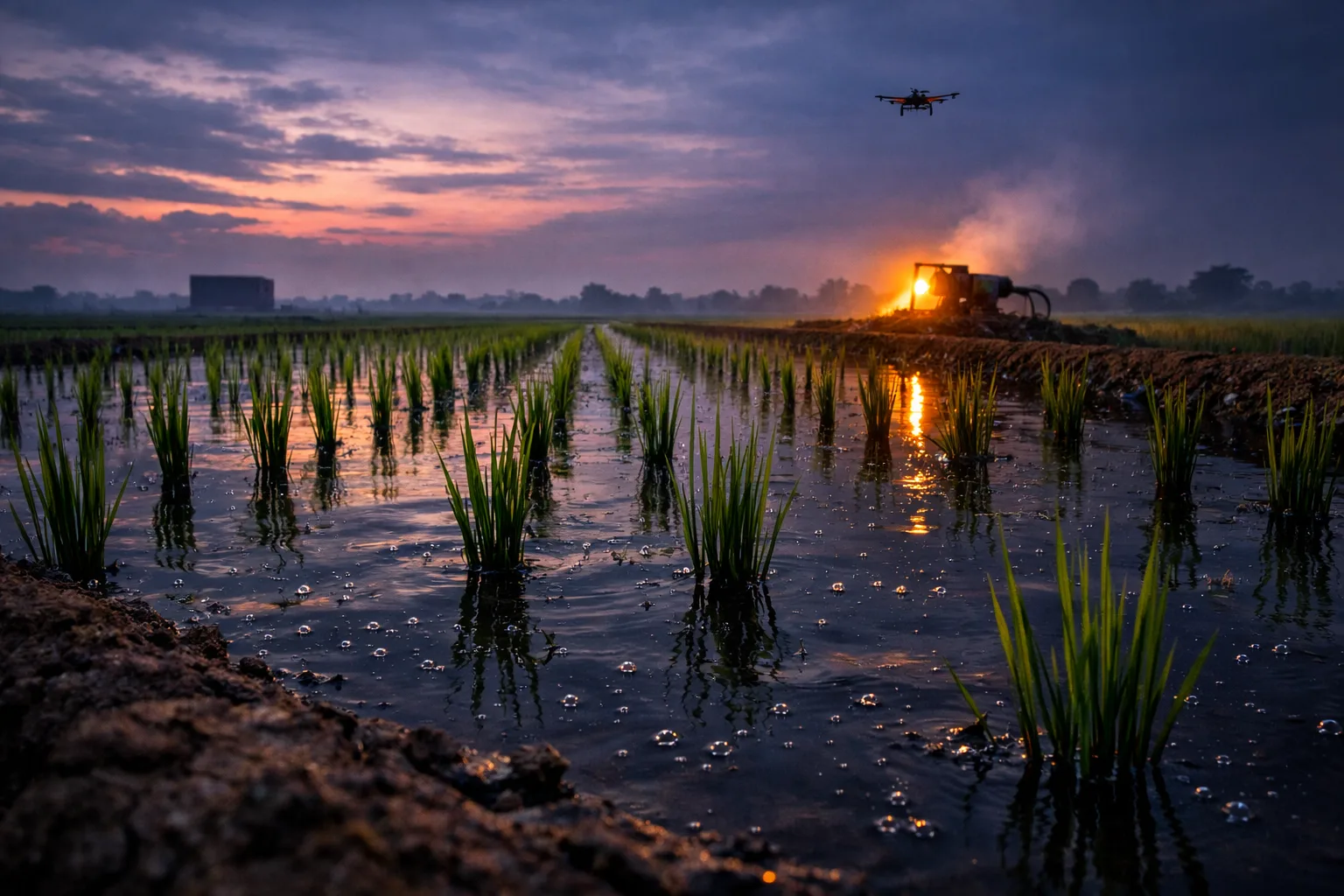
Rice carbon credits come mainly from cutting methane emissions in flooded rice systems. AWD reduces the anaerobic conditions that drive methane formation by alternating irrigation and drying cycles.
These projects depend on agricultural MRV, meaning monitoring, reporting, and verification. In practice, that often means field data, irrigation records, sampling, and increasingly remote sensing to validate agronomic practice across small, fragmented plots.
The economics can work for farmers when the reductions are verified. Recent explainers on the Indian market have cited an illustrative value of about $37.5 per hectare per crop cycle in a scenario where 2.5 t CO2e per hectare are monetizable. That is best read as an order of magnitude, not a universal price.
For B2B buyers, the most relevant practices include AWD, direct seeded rice, and better nutrient management. These can bring water and operating savings as well as carbon benefits, which helps adoption by mills, aggregators, and cooperatives.
The key point is that project cash flows depend on an approved methodology. Without a robust baseline and recognized quantification rules, credits are hard to bank and harder to sell to demanding corporate buyers.
What Verra’s Approval Means for Methodology, Integrity, and Scale
Verra published VM0051 Improved Management in Rice Production Systems in February 2025. It replaced the older CDM rice methodology, which had been inactivated in 2023, and brought a dedicated rice framework back into the VCS.
The 2026 approval by the ICAO/CORSIA TAB for credits generated under VM0051 in REDD+ countries increases marketability. It opens a regulated demand channel alongside the voluntary carbon market.
Integrity is central here. Verra says the methodology is designed for emission reductions from flooded rice systems with benefits in resource use efficiency and social co-benefits. For buyers, that means more focus on additionality, leakage, and auditability.
The digitalization of VM0051 on the Verra Project Hub in September 2025 is also important. It should make submission easier and may shorten time to issuance, which matters for offtake agreements and project finance.
The real question is scale without dilution. If VM0051 can grow while keeping rigor, it becomes more than a niche methodology. That is why big tech buyers are paying attention now.
Why Big Tech Is Turning to Agricultural Credits for Net-Zero Claims
Big tech buyers are drawn to agricultural credits because methane abatement can deliver relatively fast and measurable reductions. That is useful when companies need to address residual emissions across global value chains.
A deal like Amazon’s also sends a forward demand signal. Large buyers can help stabilize prices, give developers more visibility, and reduce inventory financing risk for projects in India.
Rice also has a strong communication advantage. It connects Scope 3, food supply chains, water stewardship, and farmer livelihoods in one story. That makes the credit easier to defend with stakeholders than many less tangible offsets.
The market is also rewarding methodologies with clearer integrity signals. Verra’s VM0051 path, together with digitalization and CORSIA access, makes these credits more suitable for procurement teams with stricter buying policies.
That still leaves a hard question for buyers. What are the remaining risks around permanence, MRV accuracy, and farmer adoption that could affect delivery? Those risks matter more than the headline deal size.
The Risks Buyers Should Watch: Permanence, Measurement, and Farmer Adoption
Non-permanence in agricultural projects is different from forest risk, but it still matters. The main issue is reversibility in practice: if farmers return to flood-intensive methods, the methane reduction can shrink or disappear.
Measurement uncertainty is also high in fragmented rice systems. Soil differences, variable water management, and plot-level variation can all affect emission factors, so buyers should ask about confidence levels, sampling frequency, and independent checks.
Farmer adoption is not automatic. Practice change such as AWD or direct seeded rice needs training, water access, agronomic timing, and often upfront incentives. Without field teams and an aggregator model, dropout risk rises.
For processors, the operational issue is supply assurance. They need to know the contracted volume is serializable, traceable, and releasable in a registry on a timeline that fits ESG reporting and net-zero claims.
If those risks are managed well, the story becomes bigger than Amazon. It becomes a signal for future demand in nature-based carbon markets.
What This Signals for Future Demand in Nature-Based Carbon Markets
The Amazon case suggests that nature-based credits are moving into a more industrial phase. Demand is being driven by procurement strategy, compliance readiness, and supply chain decarbonization, not just ESG reputation.
If VM0051 keeps its credibility and scales, rice could become a reference category for agricultural carbon credits in Asia, especially where methane reduction, water efficiency, and farmer income line up.
For investors and developers, that opens room for B2B models such as multi-buyer offtake, pre-finance, registry-backed tokenisation, and blended capital. These structures can reduce development risk and bring revenue forward.
Market signals from CORSIA and digital MRV tend to favor methodologies with stronger integrity standards. That means buyers will increasingly look for agricultural credits with traceability, audit trails, and documented co-benefits.
This is not just one deal. It is a test of how carbon markets can finance agricultural transition at scale, and which natural assets become bankable in the next wave of demand.