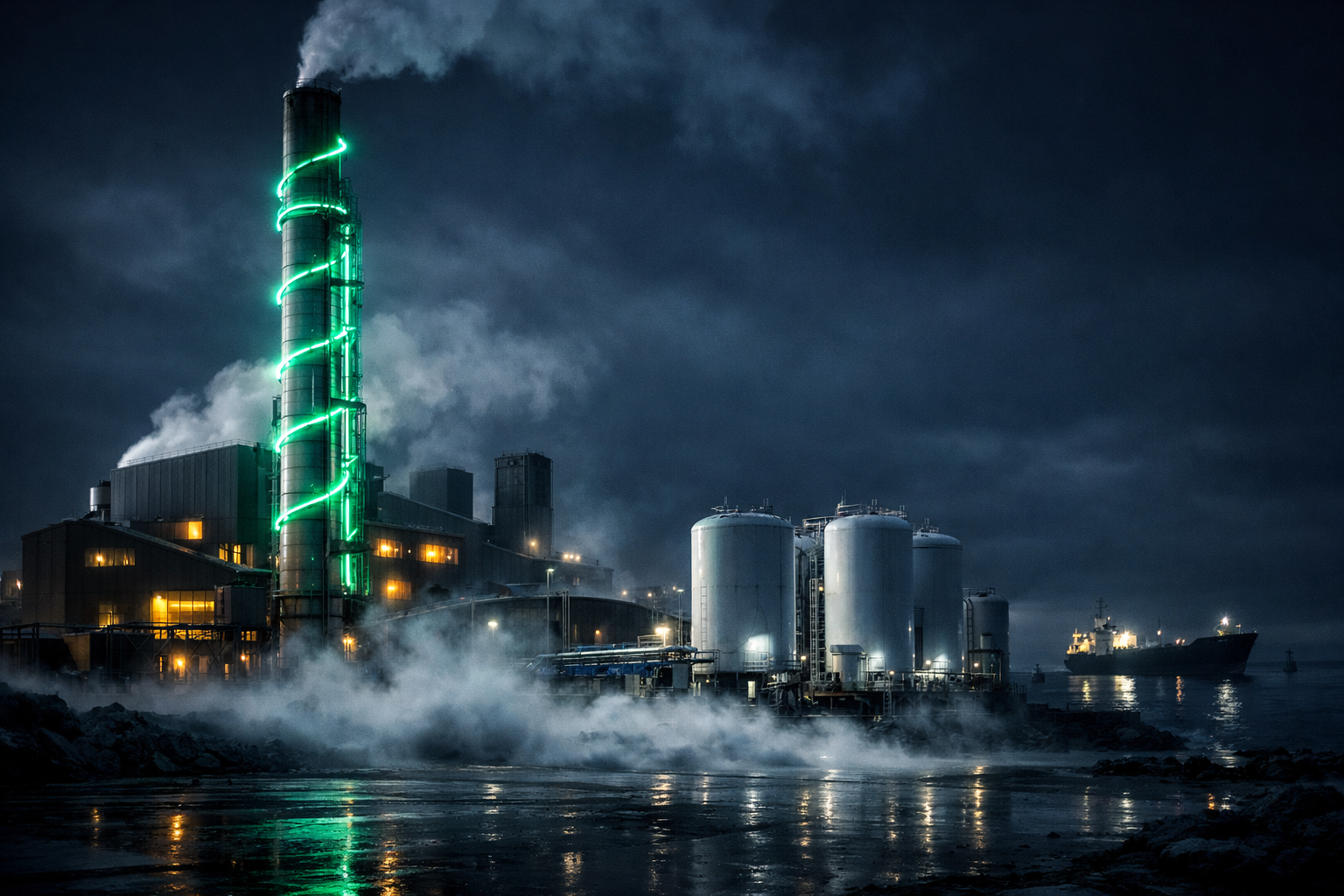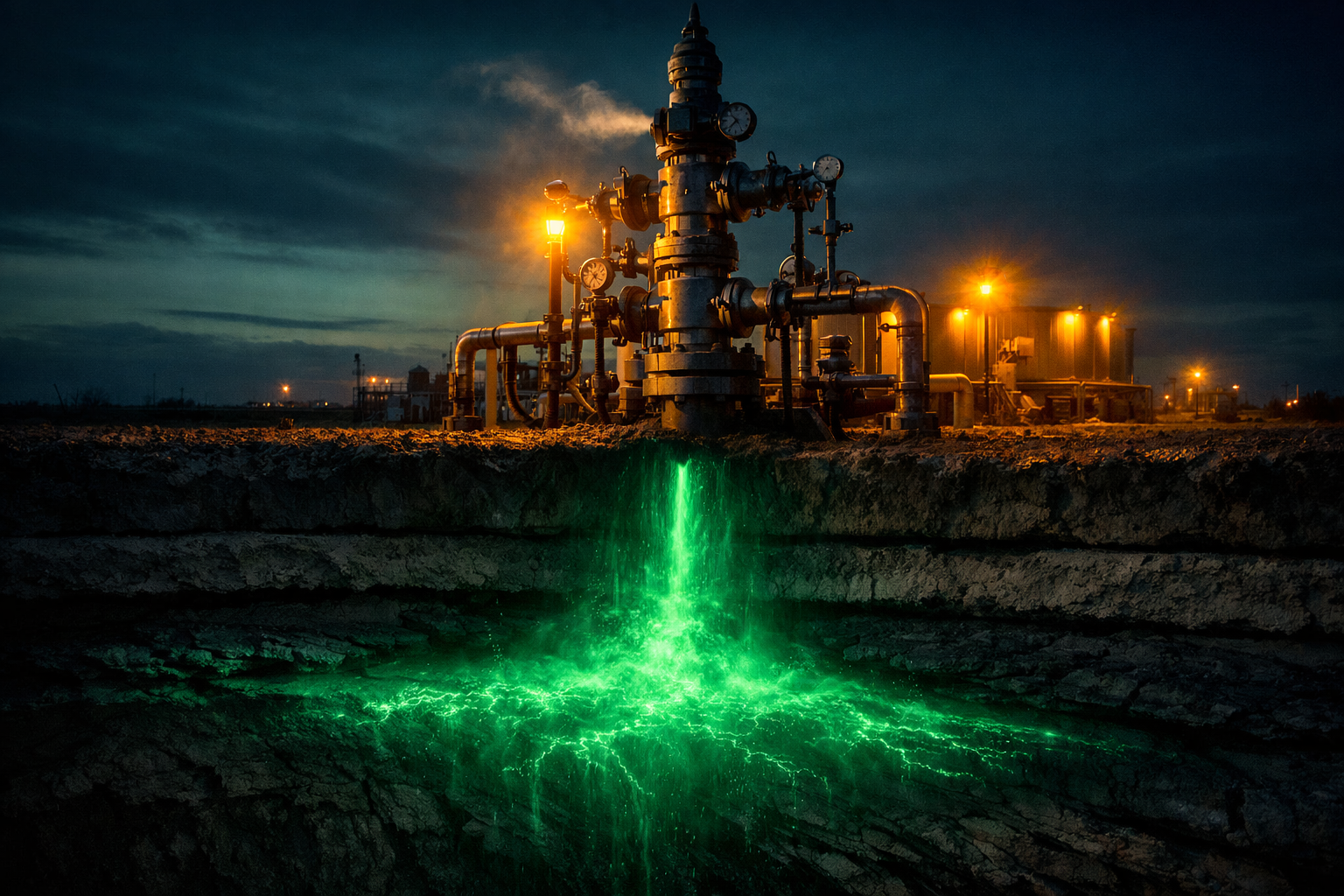
Within four days, Europe switched on its first two commercial CO2 storage value chains. On September 18, King Frederik X of Denmark officially opened Project Greensand in the Danish North Sea, the EU’s first full-scale facility for permanent CO2 storage, led by INEOS Energy with Harbour Energy and the state-owned Danish North Sea Fund. Days earlier, Yara had inaugurated its Sluiskil capture plant in the Netherlands, Europe’s largest industrial carbon capture facility, feeding liquefied CO2 by ship to the Northern Lights storage site off Norway. For carbon market participants, the significance is not ceremonial: storage, long the missing link in European carbon management economics, is now a contracted, revenue-generating service.
Greensand: 400,000 Tonnes a Year, Built to Scale to 8 Million
Greensand stores CO2 in the depleted Nini oil field beneath the Danish North Sea. The first phase can inject up to 400,000 tonnes per year, and INEOS says the project is designed to scale to between 4 and 8 million tonnes annually at full capacity. The opening ceremony at the Port of Esbjerg drew European Commissioner for Energy Dan Jørgensen and INEOS founder Jim Ratcliffe, and the project received 41 million euros in EU support through CINEA.
The strategic point is third-party access. Greensand is not an in-house disposal route for its owners’ emissions; it is being built as commercial storage infrastructure that industrial emitters across Europe can contract against. That converts carbon storage from a project-by-project engineering problem into a bookable service, which is the precondition for a broader carbon management market.
Sluiskil: The First Complete Cross-Border Chain
Yara’s Sluiskil site, its largest ammonia and fertilizer hub, will capture and liquefy up to 800,000 tonnes of CO2 per year from its primary production lines. Specialized Northern Lights vessels then carry the liquid CO2 across international waters to Øygarden in Norway, where it is injected and permanently stored 2,600 meters beneath the North Sea seabed. Over its initial 15-year operational life, the chain is projected to abate around 12 million tonnes of emissions.
The commercial agreement behind the chain was signed in 2023, making it a working proof of what Northern Lights managing director Tim Heijn called carbon management-as-a-service. The inauguration, attended by Norwegian Prime Minister Jonas Gahr Støre, Dutch Prime Minister Rob Jetten and EU Climate Commissioner Wopke Hoekstra, validated a model in which an industrial company buys capture, cross-border transport and storage as a contracted package rather than building its own geology.
Yara’s economics are explicit: capturing process emissions directly reduces the company’s exposure to rising carbon costs under the EU ETS. Northern Lights itself, a joint venture of Equinor, TotalEnergies and Shell, began injecting CO2 from a Heidelberg Materials cement plant in 2025, has a first-phase capacity of 1.5 million tonnes per year, sanctioned a second expansion phase in March 2025, and added a third liquefied CO2 carrier, Northern Phoenix, to its fleet earlier this year.
Why This Matters for Carbon Markets
Three transmission channels connect this week’s openings to carbon pricing and credit markets.
First, the EU ETS. Every tonne of CO2 that a covered installation captures and stores is a tonne of allowances it does not have to surrender. With EUA prices at levels that make capture increasingly competitive for ammonia, cement and waste-to-energy, commercial storage capacity converts the carbon price from a policy signal into an investable spread. Sluiskil is the first large industrial proof that the arithmetic closes.
Second, durable carbon removals. Bioenergy with carbon capture, and eventually direct air capture, depend entirely on permitted geological storage. Europe’s carbon removal certification framework and emerging CDR procurement programmes assume storage will exist at scale; until this month, that assumption rested on one operating site. Greensand and the Northern Lights expansion pipeline begin to de-risk the delivery side of every long-dated European removal offtake.
Third, cross-border precedent. Both chains move CO2 across national borders by ship, which normalizes CO2 as a traded commodity with its own logistics market: liquefaction terminals, specialized carriers and storage bookings. That infrastructure layer is what will eventually let smaller emitters, and credit-generating removal projects, access storage without bilateral megaproject deals.
What This Means for Buyers, Developers and Investors
For buyers of carbon removal credits, storage availability is the core delivery risk in any durable CDR contract. More operating European storage capacity narrows that risk and should, over time, widen the pool of financeable BECCS and industrial removal projects whose credits can actually be delivered.
For project developers, the openings create a concrete booking market. Capture projects that stalled on storage access now have at least two operating destinations and an expanding fleet, which changes the bankability conversation with lenders.
For investors, the signal is that European CCS has crossed from subsidized demonstration into contracted commercial operation, with a pipeline of capacity expansions already sanctioned. The open question is utilization: filling 400,000 tonnes, then millions, requires capture demand to materialize on schedule.
What to Watch
Three markers from here. First, Greensand’s phase-one injection rate and its first third-party storage contracts beyond the project’s own partners, which will test real market demand. Second, the pace of final investment decisions on capture projects that reference Northern Lights or Greensand capacity, the truest indicator of whether storage supply is unlocking capture spending. Third, Brussels: as the EU ETS revision and carbon removal framework advance, watch whether policymakers move to recognize cross-border CO2 flows and stored removals inside compliance accounting, the regulatory step that would turn this week’s infrastructure into a fully integrated carbon market.