Europe’s Peatland Restoration Could Become a New Climate Asset Class as Finance Barriers Fall
Why peatlands matter for carbon storage, water regulation, and biodiversity
Peatlands matter because they are one of Europe’s most important carbon sinks. The EEA says rewetting drained soils with high carbon content, including peatlands, is among the core land-based mitigation options, while EU land-use removals are still below the policy path needed for 2030.
That makes peatland restoration more than habitat work. It is climate infrastructure with a land-use footprint, because degraded peat soils release carbon and rewetted soils can help reverse that loss.
The investment case is stronger because Europe’s land carbon sink is weakening. The EEA also says climate stress is rising across water and land systems, with severe drought affecting around 30% of EU land area in May 2024.
Peatlands also function as a water asset. Intact or rewetted peat soils improve water retention, reduce runoff peaks, and help catchments cope with drought.
That matters for buyers and project backers because water risk is a business risk. Utilities, food processors, insurers, and land managers all face exposure to water volatility, so restoration can support downstream risk management as well as carbon goals.
Biodiversity adds another layer of value. The EU Nature Restoration Law, adopted in June 2024, requires Member States to restore at least 20% of EU land and sea by 2030, and carbon-rich ecosystems such as peatlands are priority habitats.
The key question is no longer whether peatlands are valuable. The real question is how to turn that ecological value into bankable cash flows.
What is stopping private capital from flowing into restoration projects
The main barrier is weak revenue certainty. The EEA says uptake of land-mitigation options is held back by inconsistent policies and a lack of financial incentives.
For investors, that means uncertain offtake, slow payback, and high pre-development risk. Restoration projects often need money before they generate any saleable climate or nature value.
Peatland projects also face an MRV gap. Buyers want climate claims that are scientifically robust, but the EEA warns that land-management actions can involve trade-offs, including methane and nitrous oxide effects.
That makes methodological integrity essential. If the accounting is weak, carbon buyers and ESG funds will hesitate.
There is also a tenure and aggregation problem. Restoration value often accrues across hydrological units, but land ownership, permitting, and farming incentives are fragmented.
That makes origination more complex than a standard single-site carbon project. Multiple landholders may need to coordinate rewetting, water control, and long-term stewardship.
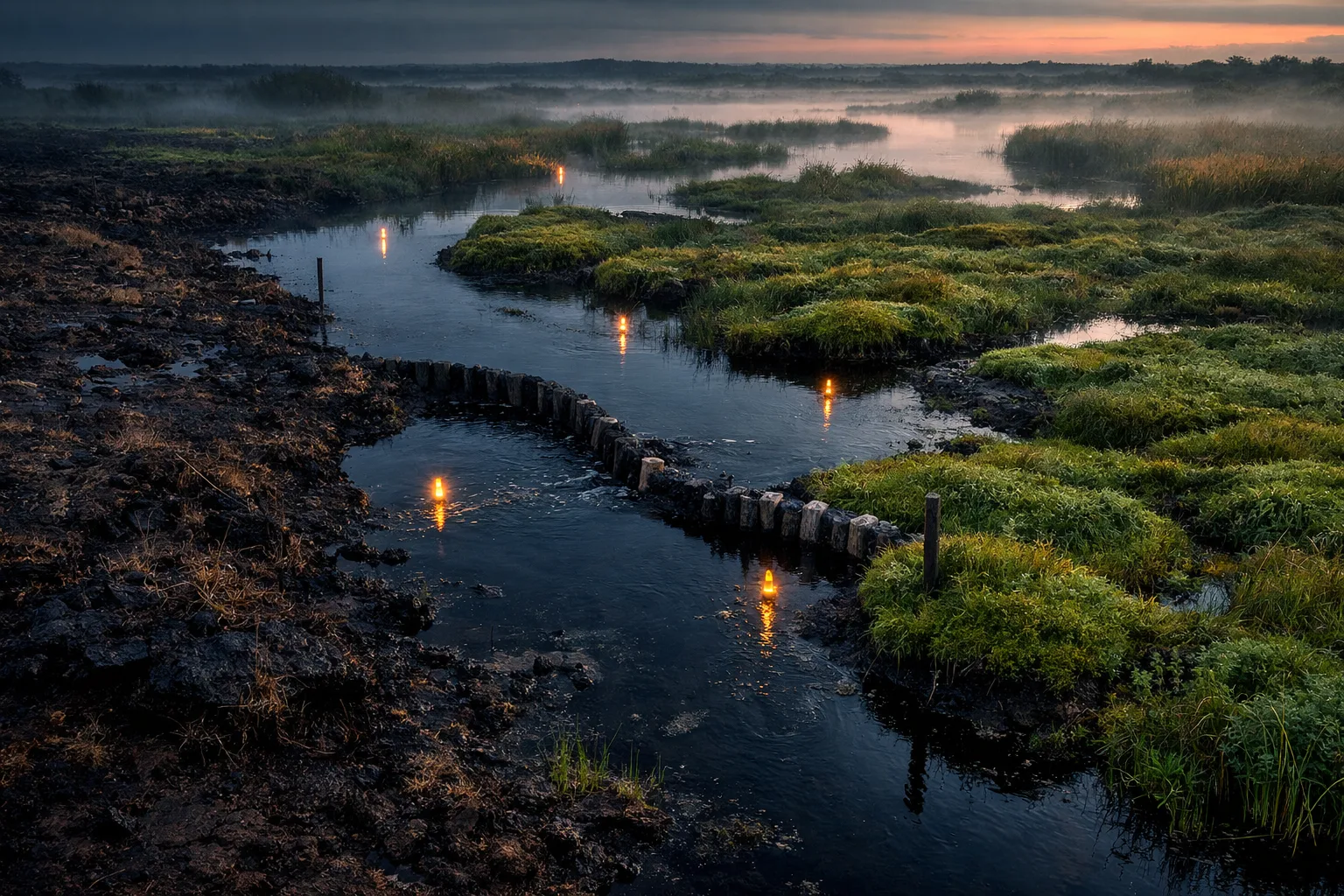
Capex and transition risk are still high. Restored peatlands may need bunds, drainage blocking, water control, and ongoing monitoring before benefits stabilise.
Private capital usually wants contracted cash flows, but many projects still depend on grants or public subsidies to close the first-loss layer.
The bottleneck is financial architecture, not just ecology. If carbon credits alone cannot underwrite the full project economics, the next step is to ask whether water markets and landscape finance can widen the revenue stack.
How water markets and landscape finance could improve project economics
Water markets matter because restoration creates measurable hydrological benefits. Better water retention, lower flood peaks, and improved drought buffering all have economic value.
A 2024 Nature Climate Change perspective argues that water markets can support climate adaptation by allocating water value more efficiently. That is relevant in catchments where peatland restoration improves water reliability.
For buyers, this points to a stacked-value model. Carbon is one layer, but avoided water-treatment costs, reduced flood exposure, and improved abstraction resilience can also support project economics.
Landscape finance can package those benefits across municipalities, utilities, and corporates that share a watershed. That matters because the ecological unit is often larger than the project boundary.
A practical way to think about it is catchment infrastructure. A multi-stakeholder special purpose vehicle or blended-finance pool can reduce dependence on one volatile commodity-like revenue stream.
That structure can also make cash flows more compatible with institutional capital. Investors generally prefer diversified and contractable revenue, not a single uncertain credit stream.
Landscape finance is especially useful where the monetisable benefit sits with a different actor than the one doing the restoration. One rewetted bog may improve downstream water regulation, but the payment may come from a utility, a municipality, or a regional adaptation budget.
If these models mature, peatlands move from grant-dependent restoration sites to infrastructure-like assets. That raises the next commercial question, which revenue streams can support the model before water markets are fully established.
Which revenue streams could support peatland restoration beyond carbon credits
The obvious layer is carbon credits from avoided emissions and verified rewetting. But the EEA’s caution on soil carbon methodologies means high-integrity crediting will matter more than volume.
Buyers will look for clear baselines, permanence safeguards, and conservative accounting. That is especially important where methane and nitrous oxide effects can affect the climate outcome.
A second stream is public climate and biodiversity funding. The EU Nature Restoration Law and related LULUCF targets create policy alignment for national grant schemes, CAP-linked measures, and regional restoration budgets.
For developers, that can de-risk early capex and fund enabling works. Public money can help bridge the period before private revenues become stable.
A third stream is water-related payments. Utility contracts, catchment partnerships, and risk-reduction agreements with municipalities or insurers can all support restoration.
These payments are attractive because they monetize an operational benefit rather than only a climate attribute. That makes them easier to justify in a broader infrastructure budget.
There is also a land-use transition angle through paludiculture and wet agriculture. These systems can generate biomass or niche agri-products while keeping water tables high.
Recent policy and research examples across Europe suggest this can support site economics where conventional farming is no longer viable. It is not a full substitute for carbon revenue, but it can help make projects financeable.
Over time, the strongest projects may combine carbon, subsidy, water, and wetland-based agricultural revenues into one diversified stack. That leads to the final question, what this means for developers, buyers, and policymakers trying to scale the market.
What the European investment case means for developers, buyers, and policymakers
For developers, the opportunity is to build pipeline-ready peatland restoration portfolios. Grouped catchments, stronger MRV, and multi-revenue underwriting can make projects more investable.
The European land-carbon sink is declining, but the EEA says mitigation potential remains significant if policies and finance improve. That supports a long-term asset creation thesis.
For buyers, the value proposition is moving toward nature-positive climate procurement. High-quality peatland projects can deliver carbon removal or avoidance, biodiversity uplift, and water resilience in one package.
That is especially relevant for food, beverage, consumer goods, infrastructure, and financial institutions with nature-risk exposure. Buyers are increasingly looking beyond carbon alone.
For policymakers, the priority is to reduce transaction costs and crowd in private capital. Clear national restoration plans, standardised methodologies, and blended-finance instruments can help.
The EU has already set the direction. The market now needs implementation that turns regulation into investable project economics.
A credible market framework should also address methane, water-table management, and long-term stewardship. Buyers will not pay institutional-scale prices if durability and environmental integrity are unclear.
That makes technical standards and monitoring central to market formation. It also means the market will reward projects that can prove outcomes over time.
Bottom line, Europe’s peatlands can become a new climate asset class only if restoration is financed as landscape infrastructure, not isolated conservation. The winners will be developers who aggregate sites, buyers who pay for multi-benefit outcomes, and policymakers who unlock revenue stacking at scale.