
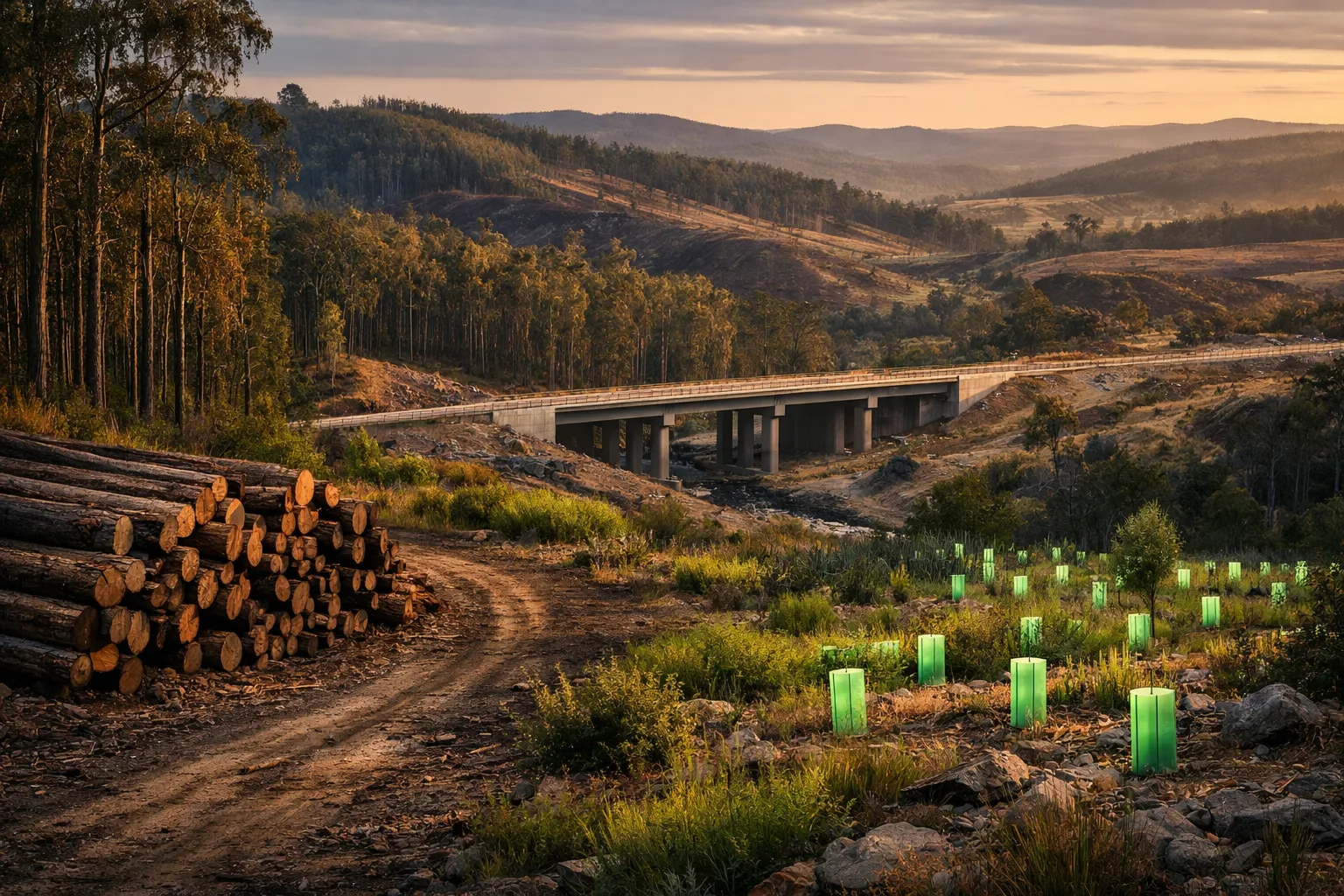
How Australia’s Native Forest Exit Could Turn Carbon Credits Into a Public-Sector Bridge
Why Native Logging Is Becoming a Financial Problem, Not Just a Climate One
Native forest logging is turning into a balance-sheet issue. NSW Forestry Corporation’s hardwood forests division reported a $14.9 million half-year loss in 2024-25, after losses of $87 million since 2020. Its annual loss in 2022-23 was $29 million. For buyers and investors, that changes the conversation. Native forest logging economics is no longer just a policy debate. It is a procurement risk, a transition-risk issue, and a question about whether public timber supply still makes commercial sense.
Timber supply is also being repriced by policy exits. In Western Australia, the post-ban market saw hardwood prices double in 12 months, which is a reminder that when native logging ends, fibre markets can move quickly. For processors, that affects fixed milling capacity, haulage contracts, and regional employment planning. If plantation timber can substitute, the case for keeping public native forest harvest alive gets weaker.
The policy direction is already clear. Victoria ended native forest logging by 1 January 2024, Western Australia has also ended native logging, and NSW is now one of the last states still operating public native forest logging at scale. That gives investors a live benchmark for orderly exit scenarios. It also shows that the sector is not just shrinking. It is becoming structurally harder to justify.
Environmental liability adds another layer of cost. Enforcement action, litigation risk, and constraints around endangered species management all increase uncertainty for state forest agencies and their contractors. That weakens the case for relying on timber income alone. It also makes the search for replacement revenue more urgent.
For carbon-market buyers, this is the key opening. If native logging is no longer a stable cashflow, can carbon revenue from forest protection replace it at a state-asset level? And if so, how many credits would be needed to do that?
How State Forest Agencies Could Use Carbon Revenue to Replace Timber Income
The strongest case is a public-sector transition finance model. State forest agencies could keep ownership, reduce or cease harvest, and monetise avoided emissions and standing carbon stock through ACCUs or related nature-credit structures. That changes the forest from a timber estate into a climate asset with recurring revenue potential.
Public modelling has already put numbers on that idea. In NSW, modelling cited publicly by Ken Henry suggested roughly $100 million a year in revenue from carbon credit farming, with enough funding to employ about 1,700 people in forest management and transition roles. Those figures matter because they let buyers and policymakers test replacement-income claims against a concrete public-finance scenario.
For government buyers, price is only part of the question. The bigger issue is whether a transition program can cover forest management, fire risk reduction, monitoring, compliance, and regional employment. Those are recurring public costs. That makes forest carbon a budget-reallocation mechanism as much as a market instrument.
Australia already has a formal registry and permanence framework for native forest protection projects. The Clean Energy Regulator says avoided-deforestation projects must generally maintain protected native forests for a 100-year permanence period, with reporting every five years. That gives agencies a route to long-duration revenue. It also creates a long-tail liability profile that buyers need to understand.
The next question is the one that matters most to the market. What kind of credit is actually being produced? Avoided logging, replanting, biodiversity, or some mix of all three? The answer affects demand, pricing, and claims.
What Kind of Credits Could Be Generated From Reduced Logging and Forest Protection
The likely credit stack splits into three buckets. The first is avoided deforestation or avoided logging. The second is replanting native forest and woodland ecosystems. The third is broader biodiversity certificates under the Nature Repair framework. Each product serves a different buyer base and carries different integrity claims.
Forest-related units are already material in the ACCU system. The Clean Energy Regulator reported 6.5 million ACCUs issued in Q2 2025, and said 48 avoided-deforestation projects contributed 1.9 million ACCUs in 2024, or about 10% of total 2024 supply. That shows forest credits are not a niche corner of the market. They are already part of mainstream supply.
For buyers, the practical distinction is between emissions avoidance and carbon removals. Reduced logging usually credits avoided emissions against a baseline. Replanting and restoration drive longer-term sequestration and can also support biodiversity claims. That matters for how corporates, funds, and public entities classify the asset in net-zero reporting.
The Nature Repair methodology for replanting native forest and woodland ecosystems, registered in February 2025, adds another pathway. It can sit alongside ACCUs rather than replace them. For developers, that opens the possibility of stacked revenue, with carbon and biodiversity value in the same landscape, subject to the rules.
That leads to the diligence problem buyers care about most. If credits come from not logging a forest, how do you prove the counterfactual, set the baseline, and defend permanence over decades?
The Integrity Questions: Additionality, Baselines, and Permanence in Native Forest Projects
Additionality is the core test. Project emissions reductions must go beyond business-as-usual forest management. In native forest contexts, buyers will ask whether the logging reduction is genuine abatement or simply a policy shift that would have happened anyway. That question is central to credit quality.
Baselines are unusually contested in native forest projects. Harvest levels, fire regimes, storm damage, pest pressure, and state policy can all change over time. That means the baseline has to be conservative and still flexible enough to survive scrutiny from auditors, ratings agencies, and due-diligence teams.
Permanence is a commercial risk as much as an environmental one. The Clean Energy Regulator says native forests protected under these projects generally carry a 100-year permanence period, and if a reversal of abatement occurs the regulator can require ACCUs to be relinquished. That creates balance-sheet implications for project proponents and offtakers.
For institutional buyers, contracts should address buffering, reversal risk, MRV frequency, and liability allocation. Public-sector forest transition projects will likely need stronger monitoring than a typical farm-based carbon project because asset values, political oversight, and ecological risks are all higher.
The strategic question now is not whether Australia can issue forest credits. It can. The question is whether its policy architecture could become a template for other jurisdictions trying to retire native logging without collapsing regional economies.
What Australia’s Shift Could Mean for Global Forest Carbon Markets and Policy Design
Australia is becoming a useful test case for public forest transition finance. A government can phase out native logging, protect standing carbon stocks, and potentially fund replacement activities through carbon and biodiversity markets. That combination matters to buyers looking for supply at scale with sovereign backing.
For global forest carbon markets, the signal is that avoidance credits tied to state-owned forests may become more investable if they are linked to clear retirement pathways for logging concessions, transparent registries, and long permanence periods. That could improve market confidence, but only if integrity rules stay strict.
Policy designers elsewhere will watch how Australia balances carbon integrity, regional employment, and timber substitution at the same time. If the model works, it could inform similar transitions in other temperate forest jurisdictions where public forest agencies still depend on harvest revenue.
The Nature Repair framework matters beyond Australia because it points to multi-asset nature markets. Carbon, biodiversity, and ecosystem restoration can all be monetised in parallel, but not necessarily with the same buyers or the same crediting rules. That is important for investors building diversified natural-capital portfolios.
The bigger thesis is simple. Australia’s forest exit is not just a domestic forestry story. It is a prototype for how governments may convert stranded timber assets into public-sector climate infrastructure, with carbon credits acting as the bridge between ecological protection and fiscal transition.