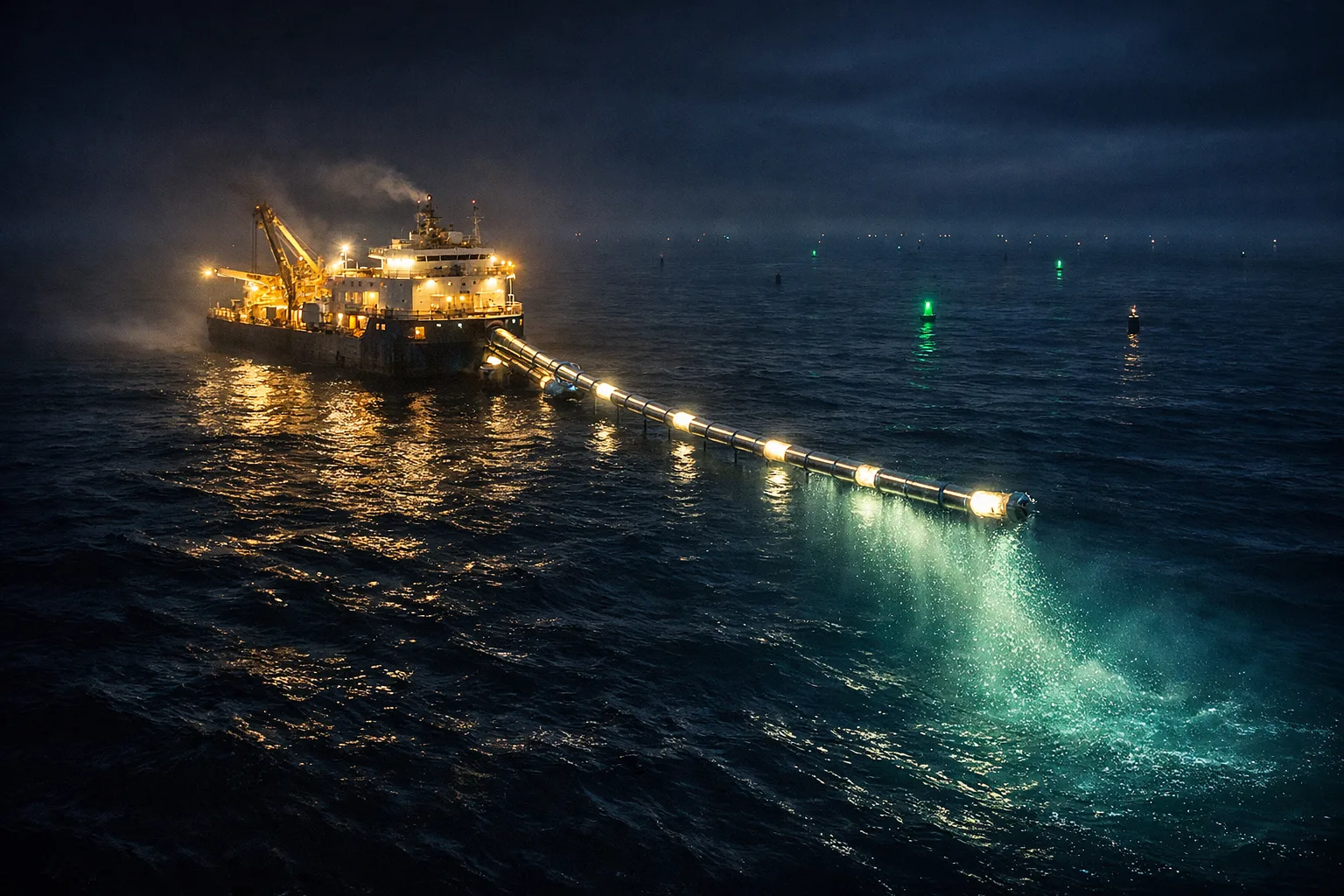
Marine carbon removal companies have less than five years to deliver roughly 237,000 credits to their buyers under contracted offtake agreements, and more than 90 percent of that volume has yet to be delivered, according to a Carbon Pulse data analysis published this week. The figure turns an abstract question about ocean-based carbon removal into a concrete commercial deadline. For buyers that signed early offtakes to secure future durable removal supply, the delivery gap is now the single largest source of portfolio risk in the marine carbon dioxide removal (mCDR) segment. For developers, it is a countdown on whether pilot-scale science can become industrial-scale issuance before contracts come due.
A Contract Book Built Almost Entirely on Future Delivery
The contracted pipeline is real, but issuance is almost nonexistent. AlliedOffsets counts 578,000 tonnes of CO2 removals secured through offtake agreements in the mCDR space to date, of which only 0.3 percent have been formally issued as credits. The Carbon Pulse data dive, using a different cut of the market, puts roughly 237,000 credits on a delivery clock of under five years. Either way, the structure is the same: this is a market where nearly everything sold is a promise, and nearly nothing sold has yet become a verified tonne.
The gap is not necessarily a failure. Early-stage removal markets are always built this way, because offtake revenue is what finances the first commercial plants. Frontier buyers, for example, signed a $31.3 million offtake with Planetary Technologies in 2025 to remove over 115,000 tonnes of CO2 between 2026 and 2030 through ocean alkalinity enhancement. Deals like that are designed to pull deployment forward. But they also concentrate delivery risk in a handful of developers, and the 2026 to 2030 window is exactly when the contracted volumes start coming due.
Who Carries the Delivery Risk
The supply side is narrow. AlliedOffsets tracks 56 active mCDR developers, concentrated in the United States and the United Kingdom, and total investment into the sector stands at about $209 million, with the majority directed at direct ocean capture initiatives. That is a thin capital base against a contracted book measured in hundreds of thousands of tonnes, and it explains why delivery schedules, not demand, are the binding constraint.
The technology mix matters for how that risk resolves. Ocean alkalinity enhancement accounts for the majority of contracted volumes and for most of what little has been issued, with Planetary Technologies the top issuer of OAE credits, followed by CREW Carbon, both operating through the Isometric registry. Weighted average credit prices run highest for direct ocean capture, then OAE, then ocean carbon fertilisation, which means the cheapest pathways to scale are also the ones carrying the most scientific and regulatory uncertainty.
The Crediting Hurdle Behind the Delivery Hurdle
Delivery is not only an engineering problem. A new study covered by Carbon Pulse this week finds that ocean iron fertilisation could offer a meaningful new source of carbon removal, but ecological risks and crediting hurdles could limit its use. That finding generalizes across mCDR pathways: the sector’s own literature lists scientific uncertainty about ecological impacts, the absence of clear international governance frameworks, and immature measurement, reporting, and verification methods as the core barriers to deployment.
This is the feedback loop buyers need to understand. Slow MRV development delays credit issuance. Delayed issuance stretches delivery timelines. Stretched timelines raise counterparty risk in offtake contracts. The 0.3 percent issuance rate is as much a verification story as a construction story, and registries, Isometric foremost among them, are effectively co-underwriting the sector’s delivery obligations by setting the pace at which tonnes can be certified.
What Buyers and Investors Should Watch
Three watch items follow from the data. First, issuance cadence: the metric that matters over the next 12 months is not new offtake announcements but the rate at which contracted tonnes convert into issued credits, especially on the Isometric registry where OAE supply is concentrated. Second, contract structure: buyers holding 2026 to 2030 delivery windows should be reviewing substitution clauses, delivery guarantees, and replacement-supply provisions, because a 237,000-credit obligation with over 90 percent undelivered will produce winners and laggards, not uniform performance. Third, regulatory plumbing: any movement toward recognized crediting standards for ocean pathways, or toward clearer international governance for open-ocean interventions, directly reprices delivery probability across the whole book.
The marine carbon removal market has done the hard part of early market building: it found buyers willing to pay real money for future ocean tonnes. The next five years will show whether it can do the harder part, which is delivering them.