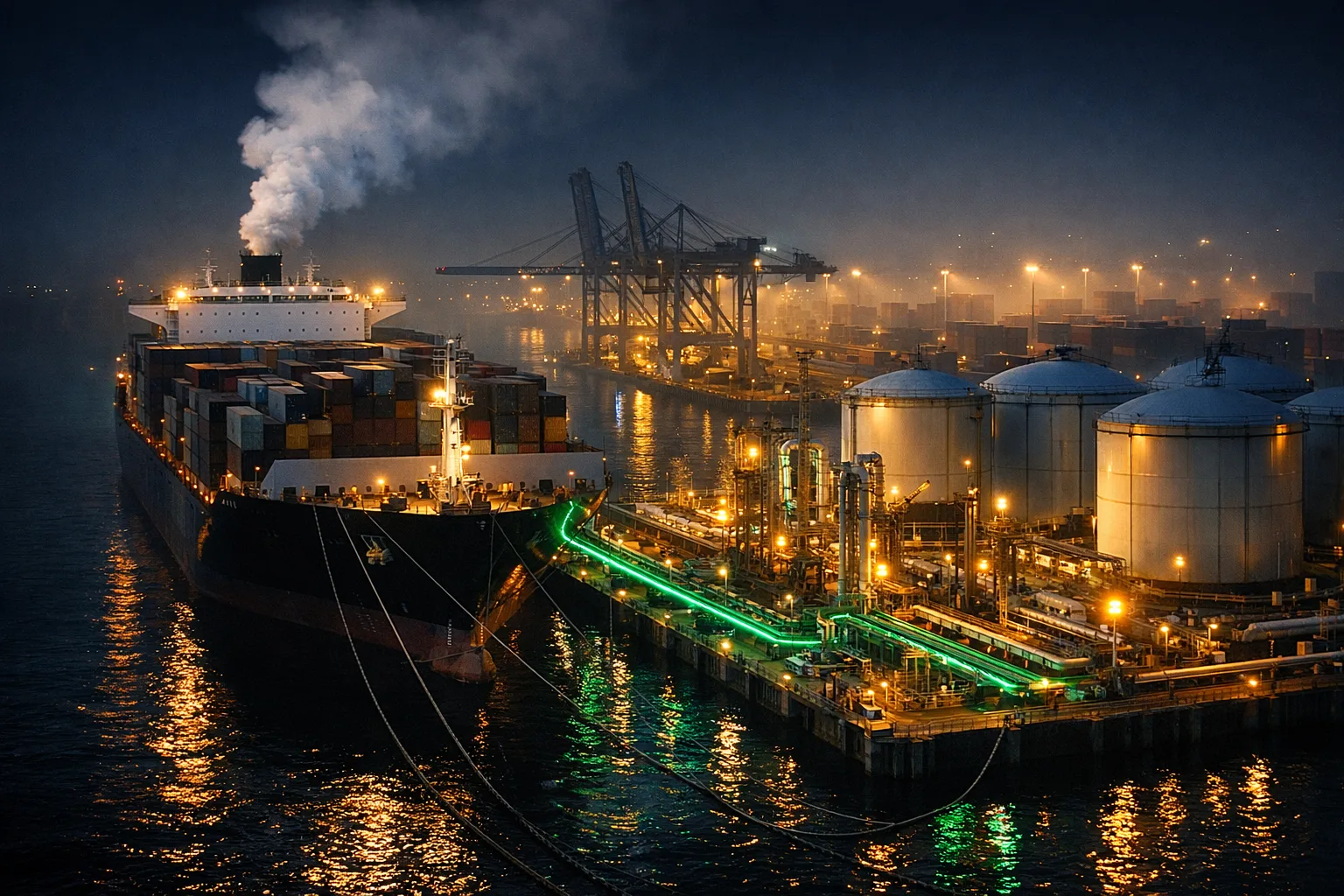
What Verra’s New Shipping Pathway Actually Enables for E-Fuels and Low-Emission Fuels
Verra’s proposed shipping methodology is built for project activities that use low-carbon alternative fuels in dedicated ships. That includes hydrogen from electrolysis, green ammonia, e-LNG, e-LPG, e-diesel, and e-methanol. It also covers ship fuel-switching on territorial or high seas, while excluding battery-electric vessels. For buyers looking at shipping carbon credits, marine fuel decarbonization, and alternative fuels crediting, that scope matters immediately.
The pathway is still under development and is currently at Step 6, Final Verra Review. That signals near-term market potential, but not full launch certainty. For procurement teams, that means timing risk and methodology risk are still part of the deal.
The broader reason this matters is Verra’s market position. VCS is presented as the world’s most widely used voluntary GHG crediting program, with over 1.3 billion credits issued and more than 1 billion tonnes of emissions reduced or removed. A shipping pathway inside that framework would likely inherit strong market recognition.
The real commercial question is not just whether the fuel is low carbon. It is whether the crediting rules can quantify incremental emissions reductions versus conventional marine fuel in a transparent, verifiable way. Baseline, additionality, and monitoring rules will decide whether the credits are bankable or just technically interesting.
That is why the quality debate comes next. Even if the methodology lands, the market still has to decide whether these credits deserve a premium.
Why Maritime Decarbonization Is Emerging as a Voluntary Carbon Market Opportunity
Shipping is moving from future optionality to near-term regulation and fleet buildout. IMO approved net-zero regulations in April 2025, including a new fuel standard and a global pricing mechanism, with detailed implementation guidelines scheduled for spring 2026. That changes the investment case for low-carbon maritime fuels.
The emissions base is large enough to matter. Maritime transport accounted for around 2.5% of total energy-related CO2 emissions in 2024. Even modest fuel switching can therefore create meaningful abatement volumes for voluntary carbon market buyers looking for measurable impact.
Fleet readiness is already ahead of supply. DNV reported 1,794 alternative-fuel-capable vessels in operation and 1,544 on order as of August 2025. Its 2025 outlook also says the number of alternative-fuelled vessels in operation is set to almost double by 2028.
Demand is not speculative anymore. DNV’s latest market data show alternative fuels held 38% of global gross tonnage in newbuilding orders in 2025, despite softer overall shipbuilding activity. That suggests cargo owners and operators are still committing capital to fuel transition.
For buyers and intermediaries, the opportunity is straightforward. Shipping decarbonization can create a new class of cargo-linked, fuel-linked, or fleet-linked credits tied to physical maritime operations rather than abstract claims. The next challenge is proving those credits meet high-integrity purchase criteria.
The Quality Debate: How Carbon Direct’s Criteria Could Shape Buyer Confidence
The central market question is whether shipping-fuel credits can satisfy stricter integrity screens than legacy offset products. Buyers increasingly want robust additionality, credible baselines, conservative quantification, and clear retirement rules before they purchase at scale.
Verra is explicit that credits only become offsets once retired. It also defines additionality as emissions reduction that would not have happened without carbon revenue. Those two concepts will sit at the center of any buyer due-diligence workflow for voluntary carbon credits for shipping.
Carbon Direct matters because it reflects the style of buyer-side filtering the market increasingly expects. The question is no longer only “is it certified?” It is also “is it durable, transparent, and financeable at scale?” That matters for corporates that need defensible Scope 3 narratives and want to avoid reputational risk.
Maritime projects may face a tougher test than many other credit types. Fuel-switch projects can overlap with compliance obligations, subsidy support, and commercial fuel-premium hedging. Buyers will want to know whether emissions claims are stacked, double-counted, or isolated with strong accounting.
That leads to the next issue. The credibility of the market will depend on which project types and accounting rules survive scrutiny, especially around fuel pathways, lifecycle emissions, and who can claim the abatement.
Which Project Types, Fuel Pathways, and Accounting Rules Are Likely to Matter Most
The most bankable project types are likely to be those with clearly measurable fuel substitution in dedicated maritime assets. Voyage-based switching, fleet conversion, or corridor-based supply can all work if the emission factor of the new fuel can be traced from production to bunkering. That favors e-methanol, green ammonia, and other drop-in or near-drop-in fuels with auditable supply chains.
Verra’s proposed scope includes hydrogen-derived fuels such as green ammonia and e-fuels like e-diesel and e-methanol. That is relevant because IMO training and safety guidance is advancing for methyl and ethyl alcohol, ammonia, hydrogen, LPG, battery-powered ships, and fuel cells. Accounting rules will need to align with operational readiness, not just chemistry.
Lifecycle carbon intensity will be the key accounting issue. Buyers will want to know whether the methodology uses well-to-wake or tank-to-wake assumptions, how renewable electricity is treated, and how embodied emissions from synthesis, transport, and bunkering are handled. That will determine whether a fuel pathway is genuinely low carbon or only marginally better than marine gas oil.
Eligibility and ownership will also matter. If a ship operator, fuel producer, and cargo buyer are all involved, who owns the credit? The market will likely need explicit rules for chain-of-custody, retirement, and claim separation to avoid double claiming across voluntary and compliance markets.
The commercial bridge is clear. Once the accounting framework is settled, the question becomes who captures value first: shipping companies, fuel producers, or corporate buyers seeking supply-chain decarbonization.
What This Means for Shipping Companies, Fuel Producers, and Corporate Credit Buyers
For shipping companies, the opportunity is to turn fuel transition into a new revenue line or cost-offset mechanism as IMO and regional rules tighten. Shipping companies already face phased EU ETS exposure, with surrender obligations reaching 100% in 2026, which raises the attractiveness of credible low-carbon fuel pathways.
For fuel producers, a Verra-style pathway could create demand-pull for green hydrogen derivatives and e-fuels by monetizing avoided emissions in addition to fuel sales. That is especially relevant for producers financing electrolyzers, synthesis plants, storage, and bunkering infrastructure.
For corporate buyers, shipping-linked credits could become a Scope 3 instrument for freight-intensive sectors such as consumer goods, industrial manufacturing, and commodity trading. The value proposition is traceability. Buyers can potentially link credit claims to specific voyages, vessel classes, or contracted fuel volumes.
The strongest B2B use cases are likely to be multi-stakeholder structures. Cargo owners can underwrite the green premium, shipowners can pass through the fuel differential, and fuel suppliers can deliver certified low-carbon molecules with auditable emissions factors. That is a more bankable model than standalone offset purchases.
But the market still needs to solve the scale question before these credits become mainstream procurement items. The final issue is whether low-carbon fuels can grow fast enough without weakening integrity or crowding out real decarbonization.
The Bigger Market Question: Can Low-Carbon Fuels Scale Without Undermining Integrity?
The scale challenge is obvious. DNV says the transition is approaching a tipping point, but fuel availability, cost, and technology and safety barriers still constrain uptake. The voluntary market may catalyze early projects, but it cannot replace the need for industrial-scale fuel infrastructure.
Integrity risk rises when credits are used to bridge structural cost gaps in fuels that are still scarce or heavily subsidized. Buyers will increasingly ask whether a credit is funding genuine additional deployment or simply subsidizing a transition that would have happened anyway because of regulation.
At the same time, market momentum is real. DNV’s 2025 data show 1,794 alternative-fuel-capable vessels in operation and 1,544 on order, while alternative-fuel orders held 38% of global GT despite a weaker shipbuilding market. Shipping is already allocating capital toward low-carbon options before crediting fully matures.
The quality test will be whether the market can distinguish between transitional fuels, true zero or near-zero fuels, and pathways that only marginally lower lifecycle emissions. If that line blurs, buyer confidence could erode and the frontier could stall.
The likely conclusion is nuanced. Low-carbon shipping fuels can become a major voluntary market frontier, but only if methodologies, buyer standards, and claim rules evolve together. Scale is possible, but only with integrity by design.