
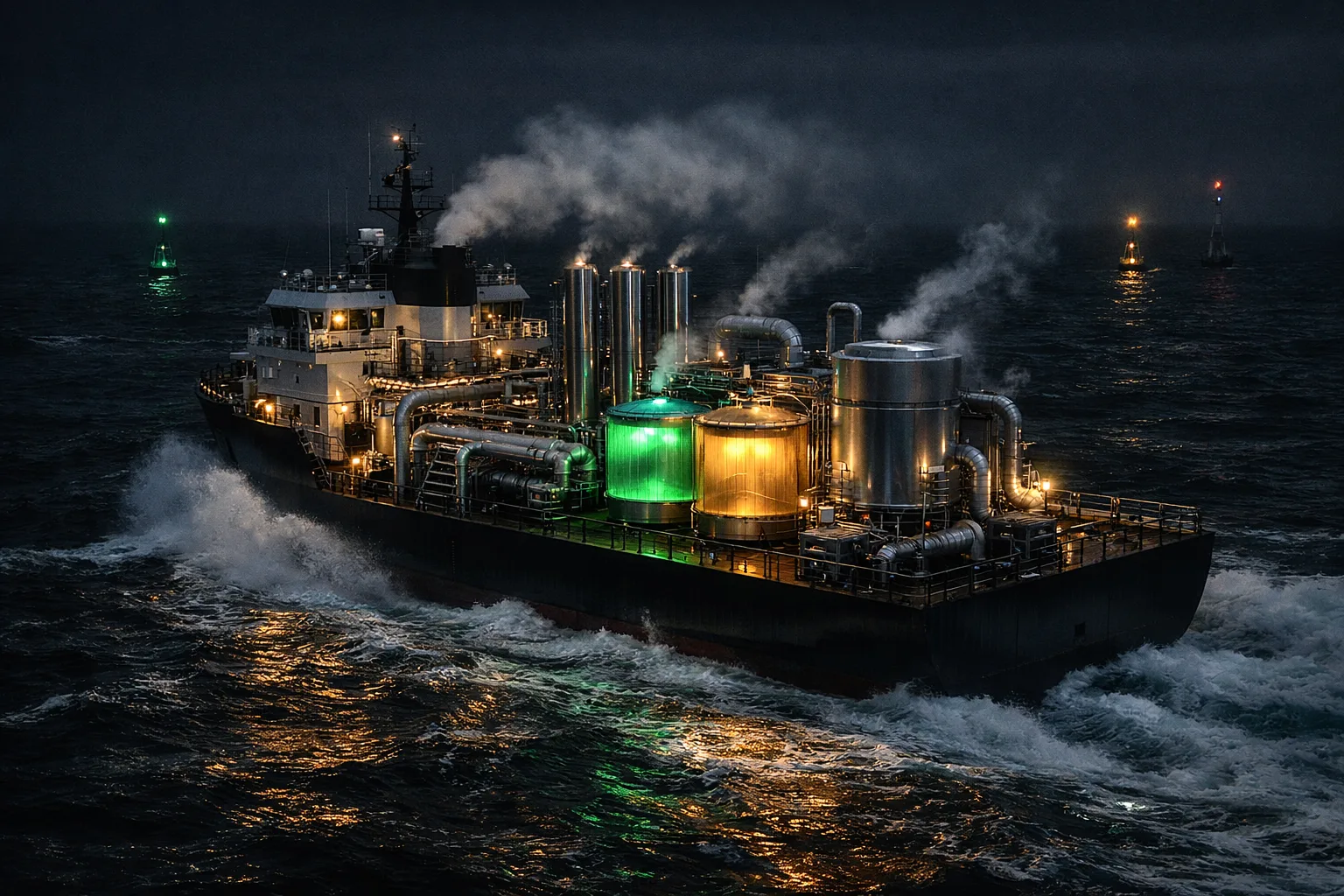
What the first at-sea methane removal pilot is testing in real commercial conditions
The first at-sea methane removal pilot is testing more than a device. It is testing whether methane removal can work on a vessel in normal commercial trading, with real operational constraints and real buyer expectations.
The pilot runs for 12 months on a 57,000 dwt supramax bulk carrier. That matters because bulk carriers operate under different cargo, port, and energy conditions than container ships or tankers. For shipowners, technical managers, and carbon credit buyers, this is a proof of operation on a high-rotation vessel class, not a lab demo.
The key question is not just whether methane can be removed. It is whether the system can deliver stable performance, reliability, manageable auxiliary power use, practical maintenance, and compatibility with onboard routines. Those are the factors that decide whether a project can become a scalable and bankable credit source.
Why methane matters for shipping climate strategy beyond CO2
Methane is now a material shipping issue because emissions from LNG-fuelled ships have risen sharply. The ICCT estimates that methane emissions from LNG ships increased by more than 2.5 times between 2016 and 2023, driven by dual-fuel engines with high methane slip.
Shipping emissions also keep rising in aggregate. Over the same period, tank-to-wake shipping emissions increased by 12% and maritime traffic grew by 21%, while the sector still accounts for about 1.7% of global anthropogenic CO2e emissions. For institutional buyers, that mix matters because it shapes abatement cost, scalability, and credit quality.
Methane also has a strong short-term warming effect. That makes onboard methane mitigation potentially more impactful in the near term than measures focused only on CO2. For decision-makers, the climate value is not just in the volume removed, but in the speed at which it can affect warming trajectories.
Regulation is moving in the same direction. The IMO Net-Zero Framework approved in April 2025 uses a well-to-wake fuel intensity indicator and includes CH4 and N2O. That gives methane-focused measures a possible role in both climate performance and compliance.
How Gold Standard certification could shape credit quality, buyer trust, and market demand
Gold Standard has already released a methodology for reducing methane emissions from combustion engine exhaust in shipping. That is important because it gives the project a recognizable MRV and certification pathway that carbon market buyers can evaluate.
Standardisation is the commercial value here. For corporate buyers and carbon asset managers, a Gold Standard methodology can reduce uncertainty around baseline, additionality, quantification, and verification. Those are usually the points that slow down offtake discussions and pre-financing.
Gold Standard also strengthened its framework for engineered removals in 2025. That signals a market shift toward higher-integrity claims and tighter requirements around monitoring and permanence. For a B2B audience, that is the difference between a technical pilot and a tradable asset.
If certification confirms integrity and measurability, the credit may command a different market position from traditional avoidance credits. That could open demand from buyers looking for higher-quality removals or compliance-adjacent instruments.
The technical and operational hurdles of deploying carbon removal systems on bulk carriers
A bulk carrier is a hard place to install new carbon equipment. Space, weight, vibration, safety, and maintenance access all matter, and each one affects CAPEX, downtime, and retrofit complexity.
The biggest technical challenge is integration with engine exhaust handling and onboard auxiliary systems. If the system creates extra backpressure, uses too much energy, or depends on consumables, the economics weaken quickly and the net removal yield falls.
For buyers and financiers, the real issue is whether the system can support continuous measurement, data integrity, and compatibility with class, flag state, and port operations. Without that, the project may remain a proof of concept that is difficult to finance or pre-purchase.
The fact that the pilot is running in normal commercial trading is crucial. It forces the system to perform under the conditions buyers care about most: uptime, failure modes, installation time, and O&M burden.
What this pilot could mean for shipowners, charterers, and maritime decarbonisation finance
If the system generates Gold Standard credits that can be sold, shipowners could gain a new revenue stream. That would sit alongside avoided regulatory costs and could improve the retrofit business case and the vessel’s financing profile.
For charterers and cargo owners, the value is different. They could buy credits or in-vessel abatement-linked services to reduce Scope 3 footprint and secure environmental attributes that are more credible than generic offsets.
The IMO pricing mechanism discussed in 2025 adds another layer. If the Net-Zero Framework leads to credit purchases, banking, or penalties, projects that lower measured emissions can benefit twice: lower regulatory costs and more monetisable assets.
For maritime decarbonisation finance, this kind of pilot could become a template for blended finance, structured leasing, or forward offtake. That becomes more realistic if the technology proves repeatable across similar fleets and the metrics are independently verified.
The bigger market question: can onboard methane mitigation scale into a tradable carbon asset?
Scalability depends on three things: a robust methodology, reliable MRV, and enough buyer demand to support price discovery. Gold Standard and the IMO’s direction make that combination more plausible now than it was a year ago.
The main risk for investors is fragmentation. If each vessel or route produces credits with different profiles, liquidity may stay thin. If the methodology normalises baseline, quantification, and permanence, the asset becomes easier to aggregate across a fleet.
The commercial appeal is that methane reduction can carry both compliance value and voluntary carbon market demand. That creates a rare hybrid monetisation path in maritime decarbonisation.
The pilot does not answer every question yet, but it does define the investability threshold. If the results show measurable performance, these credits could move from a technical experiment to a new class of carbon removal assets for shipping.