
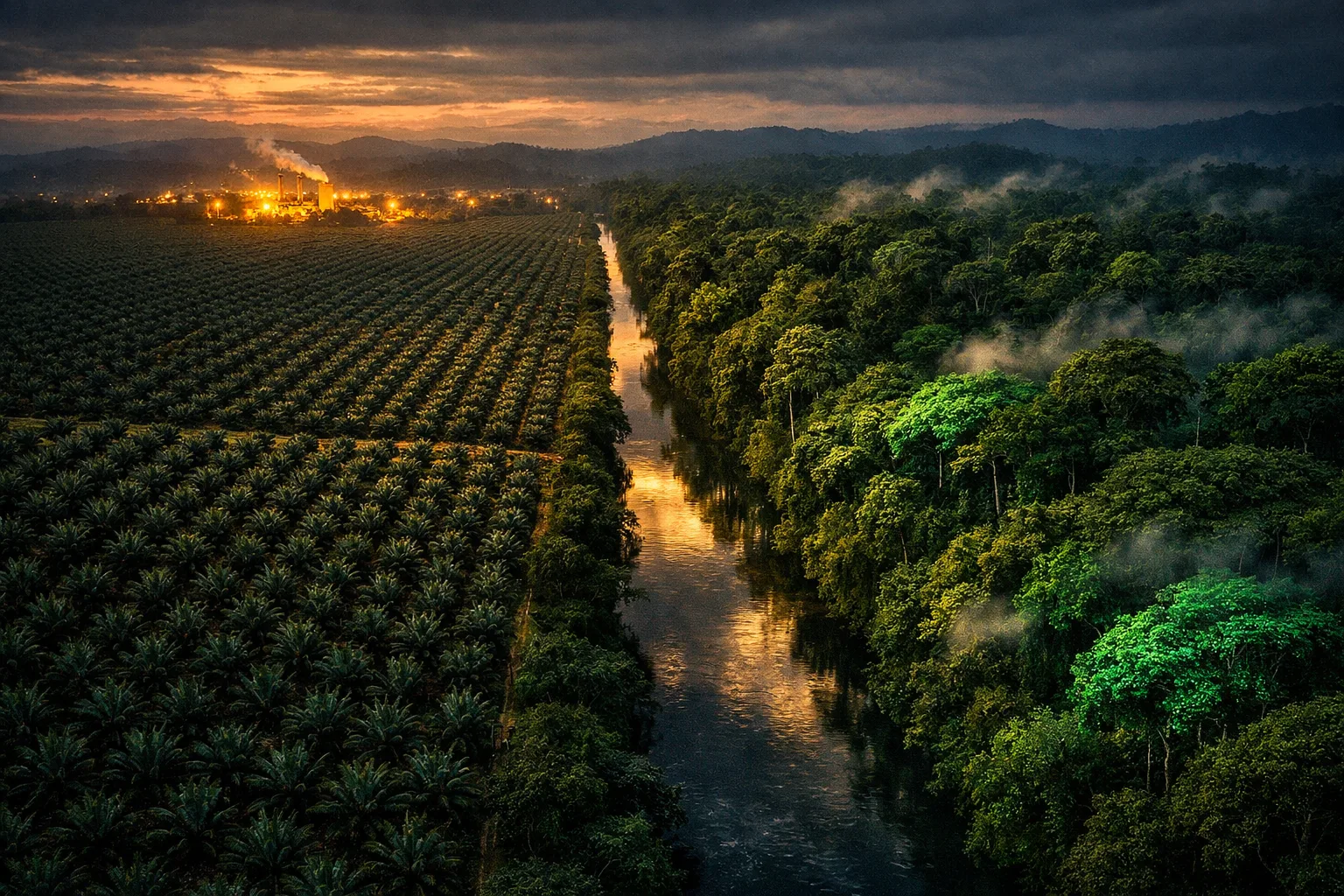
Carbon credits priced at $5 to $12 per tonne cannot compete with palm oil, rubber, or timber in Southeast Asia’s commercial concessions, and the gap is not marginal: conservation would need carbon prices between $33 and $1,677 per tonne to break even against commodity extraction, depending on the country and crop. That is the central finding of a new study in Nature Communications, and it lands directly on the business case that many buyers and project developers have built around avoided deforestation supply from the region.
What the Study Actually Measured
The paper, “Pivoting forestry and agricultural concessions toward conservation in Southeast Asia,” was led by Annabel Lim, a Ph.D. student at the National University of Singapore, with Dr. Yiwen Zeng, a conservation scientist at Nanyang Technological University, as senior author. Using high-resolution satellite data, the team analyzed 3,754 commercial concessions spanning logging, timber, oil palm, and rubber plantations across Cambodia, Indonesia, Malaysia, and Myanmar.
The scale of what is at stake is larger than most market participants assume. Southeast Asia lost nearly 68 million hectares of forest cover between 2001 and 2023, driven mainly by industrial logging, agricultural conversion, and plantation development. Yet roughly 42 million hectares of intact forest, an area larger than Malaysia itself, still stand inside commercial concession boundaries. Of that, 4.6 million hectares overlap directly with key biodiversity areas.
The emissions math is equally concrete. Clearing those concession forests over the next three decades would release roughly 1.2 gigatonnes of CO2, equivalent to nearly 20 percent of all industrial carbon emissions across the 11 ASEAN nations combined between 2000 and 2023.
The Price Gap, Country by Country
The study’s most actionable output for market participants is the breakeven analysis. Avoided deforestation credits in Southeast Asia currently trade at $5 to $12 per tonne. To make conservation financially competitive with commodity production, prices would need to reach $33 to $1,677 per tonne depending on the country and crop type. Cambodia sits at the low end of that range, with breakeven points around $30 to $51 per tonne.
Read against current market conditions, the implication is blunt: at prevailing prices, carbon revenue can cover the opportunity cost of conservation only in a narrow slice of the region’s concession landscape. Everywhere else, the concession holder earns more by clearing, planting, or extracting. This is not an integrity problem or a methodology problem. It is arithmetic.
The Legal Trap Beneath the Price Problem
Even where a buyer were willing to pay breakeven prices, a structural barrier would remain. Governments across Southeast Asia grant concession licenses under mandates that require active commercial development. A company that pivots from production to conservation risks being classified as under-developing its land, a classification that can legally trigger revocation of the underlying concession rights.
In other words, the current legal architecture penalizes exactly the behavior carbon finance is trying to buy. A developer offering to pay a concession holder to keep forest standing is, under existing permit rules, asking that holder to put its license at risk. No premium fully prices that exposure, because the risk is binary: lose the concession, lose everything.
What the Authors Conclude
The authors are careful not to dismiss carbon finance outright. “Carbon finance has an important role to play, but it will not be sufficient on its own to protect all remaining forests in concessions,” Zeng said. Lim framed the conclusion in portfolio terms: “Diversifying funding sources is textbook good economic sense. Our study lends empirical weight to this idea and shows that carbon finance can be a powerful financial incentive, but it isn’t a silver bullet. Complementary green finance mechanisms should definitely be explored.”
What This Means for Buyers and Developers
For buyers, the study reframes due diligence on Southeast Asian avoided deforestation credits. Credits priced at $5 to $12 from concession landscapes should prompt a direct question: what makes this specific project additional, when the breakeven math says conservation is uneconomic at that price almost everywhere in the region? The answers that hold up will point to specific conditions, low-opportunity-cost land, stacked revenue streams, or jurisdictional arrangements that change the concession holder’s legal position.
For project developers, Cambodia’s lower breakeven range identifies where carbon-first models remain viable, and the concession license problem identifies where project structuring matters as much as credit pricing. Projects that secure government recognition of conservation as a legitimate land use are solving the binding constraint, not the visible one.
For investors, the takeaway is that the region’s 42 million hectares of intact concession forest will not be protected by voluntary demand at current price levels. The supply of genuinely additional, legally secure credits from these landscapes is structurally scarce, which argues for premium pricing on the projects that clear both hurdles, and skepticism toward cheap supply that cannot explain how it clears them.
What to Watch
Two signals would indicate the calculus is shifting. First, any move by Cambodia, Indonesia, Malaysia, or Myanmar to amend concession licensing rules so that conservation qualifies as compliant land use, which would remove the legal barrier the study identifies. Second, the evolution of jurisdictional and blended finance structures in the region: if complementary mechanisms, from biodiversity finance to results-based public funding, begin stacking on top of carbon revenue, the combined price signal could reach breakeven in places where carbon alone cannot. Until one of those moves, buyers should treat Southeast Asian concession-based supply as a premium segment, not a volume market.