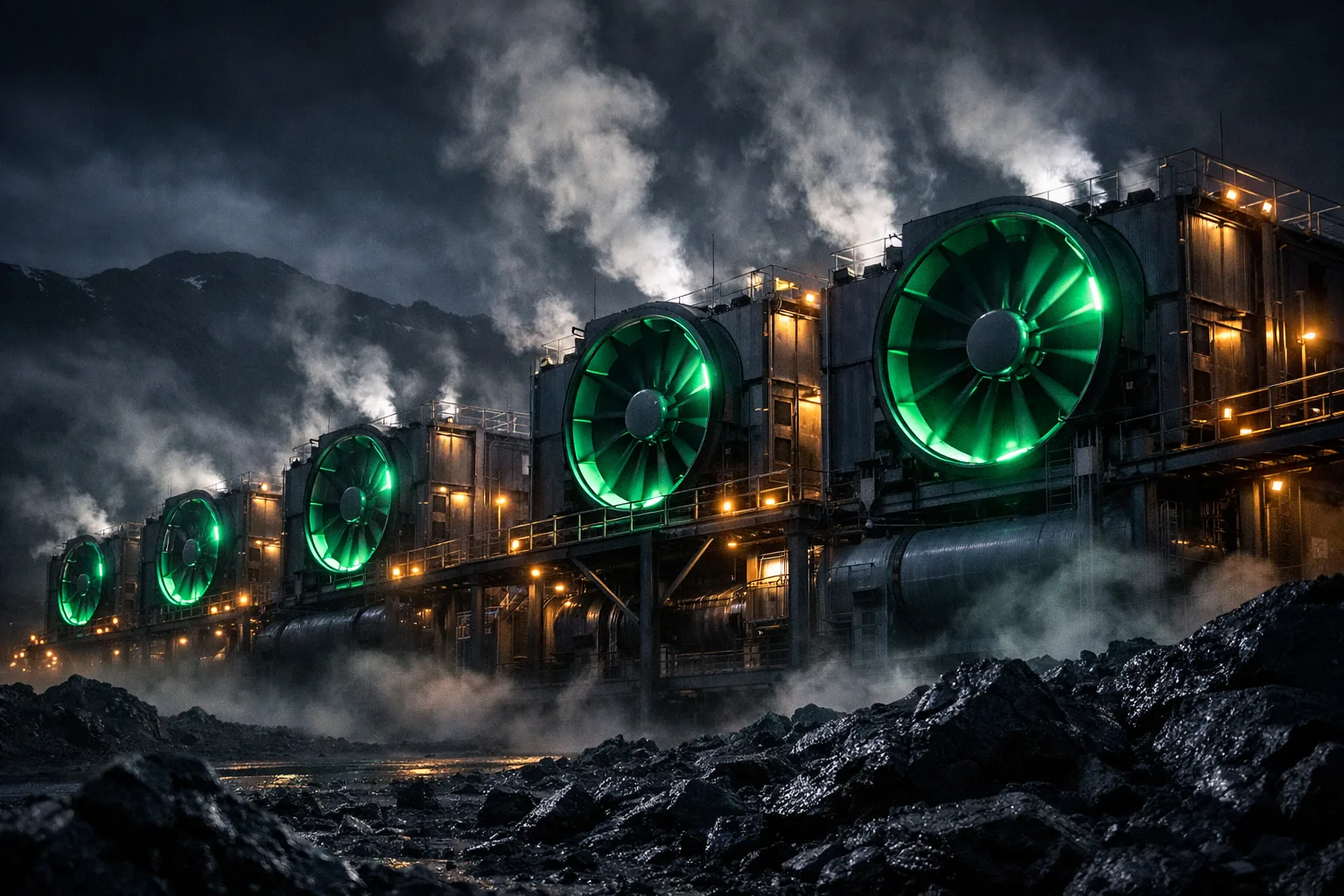
Climeworks has cut operating costs per tonne at its Mammoth direct air capture (DAC) plant in Iceland by more than 50% over the past year, while net carbon removal output rose more than fivefold in the first half of 2026, the company announced on September 10. For buyers of durable carbon removal, this is the most concrete evidence yet that DAC costs can fall through learning by doing rather than through laboratory breakthroughs alone, and it arrives at a moment when the credibility of DAC cost curves is the central question hanging over CDR procurement decisions.
The Numbers Behind the Announcement
The disclosure, detailed in an article by co-founder and co-CEO Jan Wurzbacher, is unusually specific for a sector that rarely publishes operating data. In the first six months of 2026, Mammoth produced 675 tonnes of net CDR, meaning CO2 permanently removed and stored underground after deducting maintenance downtime, weather effects and the grey emissions of operations, compared with 119 tonnes in the same period of 2025.
The gains come from two sources: a refined formulation of the proprietary sorbent filter material, and mechanical and process upgrades to the plant itself. Two collector containers running the upgraded configuration for more than six months are now hitting their design peak run rate of 1.37 tonnes of captured CO2 per day, roughly double the performance of the originally deployed containers. Their capacity factor, the share of design performance actually delivered in the field, sits at 40 to 50%. For comparison, Climeworks notes that solar plants typically run at 20 to 25% capacity factors and wind farms at 30 to 40%.
Progress, With a Sobering Baseline
The data cuts both ways, and buyers should read it whole. Even after a fivefold increase, 675 tonnes in six months annualizes to roughly 1,350 tonnes per year against a nameplate capacity of 36,000 tonnes at full build-out. Mammoth remains a first-of-a-kind industrial facility whose priority over the past 18 months, by the company’s own account, was improving performance, reliability and cost rather than maximizing production. The delivery volumes that matter to buyers with multi-thousand-tonne commitments are still some distance away.
That said, the mechanism matters more than the current volume. Climeworks’ stated strategy has long targeted costs of $250 to $350 per tonne captured and $400 to $600 per tonne of net removal by 2030. A verified halving of operating costs within a single year of focused iteration is the kind of empirical datapoint those roadmaps have been missing. It suggests the DAC cost curve behaves less like a fixed technology price and more like the early learning curves of solar or batteries, where each generation of deployed hardware feeds improvements into the next.
What It Means for CDR Buyers and Investors
For corporate buyers, the announcement strengthens the case for treating high-quality DAC offtakes as a portfolio decision rather than a spot purchase. If operating costs at the sector’s most mature plant can halve in a year, today’s premium prices for durable removal are buying learning curve position as much as tonnes. Buyers signing long-term offtakes now are effectively financing the iteration that makes later volumes cheaper, and the performance data gives procurement teams a defensible answer when boards ask whether DAC prices will ever fall.
There is a delivery-risk caveat. Net CDR output, not captured CO2, is what buyers receive, and Mammoth’s 40 to 50% capacity factor on upgraded units shows how much of the gap between run rate and delivered tonnes is operational reality: weather, maintenance and the carbon footprint of the plant itself. Contracts and claims should be written against verified net removal, with delivery schedules that assume ramp-up friction.
For investors, the signal is about where value accrues. Climeworks is the only company that has been delivering DAC-based carbon removal to customers for several years, and it is now converting that operating history into proprietary performance data. In a market where most competitors are still pre-commercial, the ability to show audited cost reduction at an operating plant is a moat that pitch decks cannot replicate.
What to Watch
Three markers will show whether the cost curve keeps bending. First, the rollout: Climeworks says it will extend the sorbent and mechanical upgrades across all 12 collector containers in one module at Mammoth by the end of 2026, which should show whether the two-container results scale to plant level. Second, net CDR output in H2 2026 and full-year 2026: continued growth against the 675-tonne first half would confirm that the capacity factor holds beyond a few upgraded units. Third, the next-generation technology: Climeworks reports a tenfold improvement in sorbent lifetime in the lab and plans to begin testing its next-generation DAC technology at Mammoth in early 2027. Lab gains that survive contact with an operating plant would set up the next cost step; lab gains that do not would be an equally important market signal.