
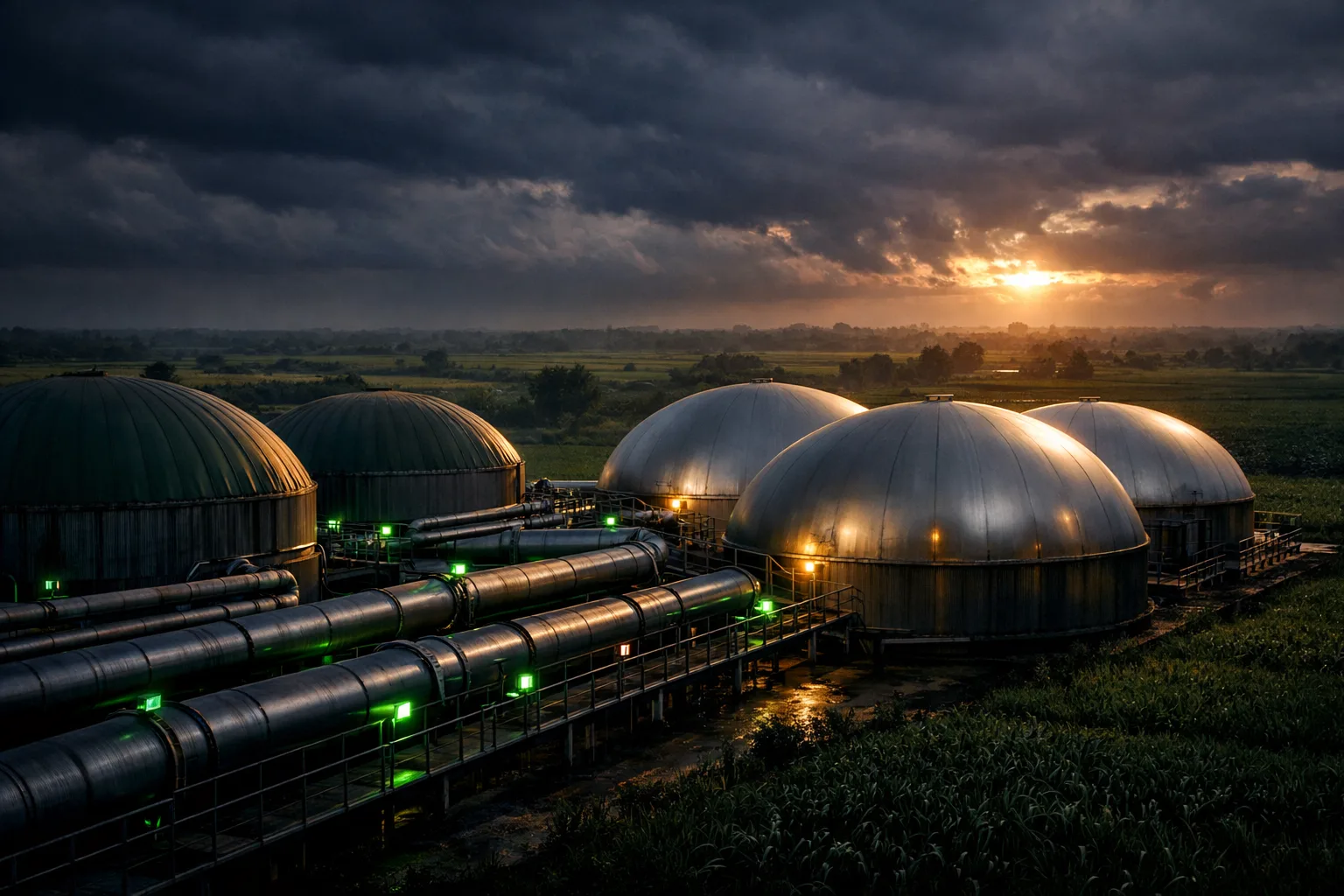
India’s Union Cabinet approved GOBARdhan, the National Circular Bioenergy Scheme, on 6 August, committing ₹23,731 crore (about $2.5 billion) over ten years to scale compressed biogas (CBG) production roughly ten-fold. Beyond the energy headline, the scheme matters to carbon market participants: it creates a subsidized, price-stabilized production base for a fuel that avoids methane emissions and displaces fossil gas, and Carbon Pulse reports it could pave the way for India to generate carbon credits under Article 6 of the Paris Agreement. For buyers looking at future Indian supply and for developers structuring waste-to-energy projects, the demand and price architecture published this week is the part worth reading closely.
What the Scheme Actually Builds
GOBARdhan consolidates a CBG ecosystem previously spread across four ministries under a single nodal body, the Ministry of Petroleum and Natural Gas, and runs from fiscal year 2026-27 to 2035-36. The design rests on six components, three of which do the heavy lifting for project economics.
First, assured offtake. City Gas Distribution entities must meet a CBG blending obligation that starts at 3% in FY 2026-27, rises to 4% in FY 2027-28 and reaches 5% from FY 2028-29 onward in the CNG transport and PNG domestic segments. That converts a policy target into a mandated buyer.
Second, a stable price. The scheme introduces a government-backed administered price of ₹2,110 per MMBTU, equivalent to about ₹105 per kilogram of CBG, with a minimum ten-year horizon. Long-duration price visibility is exactly what biogas project finance has lacked in most markets.
Third, capital and credit support. Greenfield projects can receive capital assistance of up to ₹2 crore per tonne per day of installed capacity, and a dedicated credit guarantee mechanism will cover up to 85% of eligible loans for MSME-based projects. Pipeline infrastructure, a district-level challenge fund and feedstock mapping round out the package.
The Scale Gap the Government Is Trying to Close
The government’s own numbers show how early this market is. As of 6 August, 1,908 CBG and Bio-CNG plants were registered on the GOBARdhan portal, but only 217 were commissioned, producing a combined 0.4 million standard cubic meters per day, with another 339 under construction. The ten-year targets are correspondingly aggressive: ten-fold production growth, displacement of 10 million tonnes of fossil fuel use, more than 40 million tonnes of CO2 emissions avoided through waste diversion, over ₹40,000 crore in foreign exchange savings and more than 1.5 lakh jobs.
The strategic driver is import dependence. India meets nearly 50% of its natural gas requirement through imports, and 55 to 60% of its LNG transits the Strait of Hormuz, a vulnerability the government cited explicitly in the scheme’s backgrounder. CBG is chemically equivalent to natural gas, so every tonne produced domestically slots into existing gas infrastructure without new demand-side investment.
Where Carbon Credits Enter the Picture
The carbon angle is structural, not incidental. CBG projects generate emission reductions on two sides: methane avoided by diverting organic waste from landfills and dumps, and fossil gas displaced in transport and household use. These are exactly the categories that credit under both India’s domestic Carbon Credit Trading Scheme and, potentially, cooperative approaches under Article 6.
India has been building the institutional plumbing for Article 6 participation, including a designated authority and lists of eligible activities for international transfer. A nationally scaled biogas program with standardized registration through the GOBARdhan portal gives that plumbing something to meter: a large, homogeneous pipeline of projects with government-verified production data. Carbon Pulse’s assessment that the scheme could unlock Article 6 credits rests on precisely this logic, turning thousands of small rural plants into aggregable, monitorable mitigation outcomes.
The caveat is equally clear. Nothing in the cabinet approval itself authorizes credit exports, and any Article 6 transfer would require corresponding adjustments against India’s NDC. The scheme creates supply capacity and data infrastructure; the crediting decisions come later.
What This Means for Buyers, Developers and Investors
For buyers, India is signaling that biogas-based reductions will be produced at national scale with public data trails, which is the raw material for credible credits. But anyone counting on Indian Article 6 supply should treat the government’s own NDC arithmetic as the binding constraint: New Delhi has historically been cautious about authorizing exports that complicate its domestic targets.
For developers, the bankability shift is immediate and domestic. A mandated 5% blending obligation, a ten-year administered price and 85% credit guarantees change project finance math well before any carbon revenue enters the model. Carbon income, whether from the domestic CCTS compliance and offset mechanisms or future Article 6 deals, now looks like upside on an already underwritten asset rather than the revenue line that has to close the gap.
For investors, the aggregation play stands out. Thousands of MSME-scale plants producing a uniform, metered fuel under one registry is a natural fit for portfolio-level carbon credit aggregation, provided methodologies and authorization rules catch up.
What to Watch
Three checkpoints will determine whether GOBARdhan becomes a carbon market story or stays an energy story. First, whether CBG activities appear or expand on India’s Article 6 positive lists and under CCTS methodologies. Second, the actual commissioning rate: 217 operating plants against a ten-fold growth target leaves little room for the delays typical of Indian infrastructure rollouts. Third, any bilateral Article 6 agreements that name biogas or waste-sector mitigation outcomes, which would convert the scheme’s production data into tradable, adjustment-backed units.
India has tried to scale compressed biogas before, through SATAT and a patchwork of ministry-level schemes. GOBARdhan is the first attempt that pairs the subsidy with a mandated buyer and a floor price. If execution holds, the carbon credits will be a byproduct of the gas, not the reason for it, and that is precisely what would make them credible.