
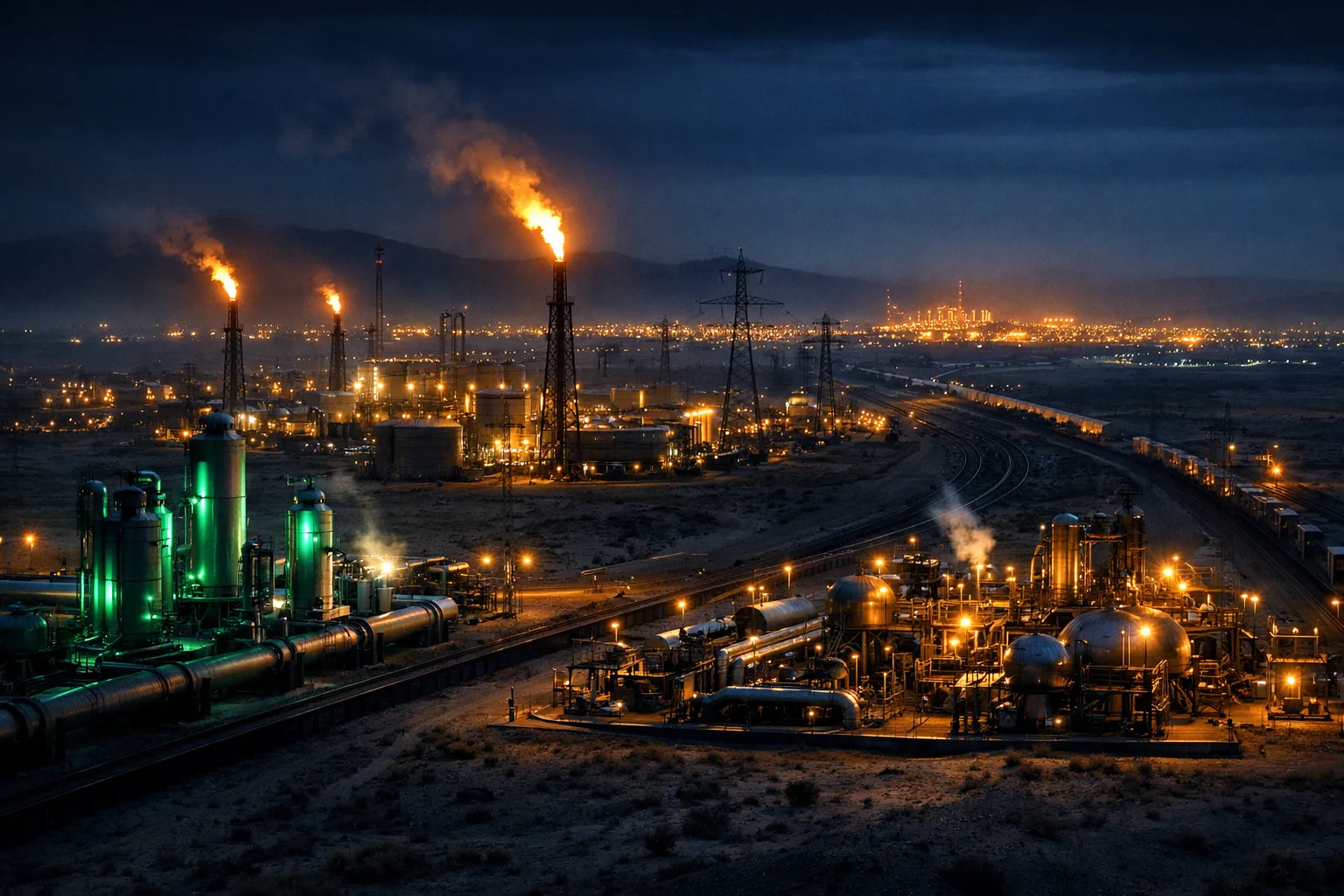
Why Turkmenistan Is Now on the Voluntary Carbon Market Map
Turkmenistan is entering the voluntary carbon market conversation from a carbon-intensive base. Oil and gas exports accounted for 84.9% of total exports in 2024, which makes methane abatement and energy efficiency the most commercially relevant entry points for carbon crediting.
Methane is the clearest near-term opportunity because the scale is large enough to support multi-year pipelines if measurement is credible. The World Bank cites estimated gas losses from Turkmenistan’s oil and gas sector at 5.5 million tonnes per year.
Methane cuts also carry outsized climate value. Methane is around 28 times more potent than CO2 over 100 years and more than 80 times more potent on a 20-year basis, so buyers focused on near-term temperature impact tend to pay close attention to this type of supply.
ADB’s recent positioning matters because it is no longer treating this as a distant concept. Its new country partnership strategy for Turkmenistan includes green transformation, low-carbon pilots, policy reform, and methane reduction support, which signals that carbon-market readiness is moving into institutional preparation.
That makes Turkmenistan relevant not only for offset buyers, but also for investors and project developers looking for frontier-market supply in methane, power, and industrial decarbonisation. The key question is what ADB is likely to assess before any crediting pathway can scale.
What ADB’s Technical Assessment Is Likely to Examine
Sector prioritisation is likely to come first. ADB has already been supporting Turkmenistan on low-carbon transition roadmaps in power, so it will likely test which sectors can generate verifiable reductions at bankable scale rather than fragmenting into small pilots.
Methodology will be the next filter. Buyers will want additionality, clear baselines, leakage controls, and permanence rules, especially for methane capture in oil and gas where quantified emission factors, monitoring frequency, and asset-level data matter more than economy-wide estimates.
Institutional readiness will also matter. ADB’s broader carbon-market work suggests it will examine MRV systems, registry compatibility, host-country authorisation, and whether national agencies can coordinate energy, environmental, and extractives authorities without duplication.
The assessment will likely map project pipelines against Turkmenistan’s existing development agenda, including the 2024 to 2028 country partnership strategy and the newer technical assistance on greener, more competitive growth. Buyers usually want to see that credits sit inside a broader reform pathway.
The final structural question is whether the assessment points to project-based credits, programmatic crediting, or a policy-crediting architecture. That choice affects transaction size, issuance speed, and who can actually originate supply.
The Sectors Most Likely to Generate Carbon Credits in Turkmenistan
Oil and gas methane reduction is the clearest near-term supply source. Fugitive emissions from transmission, distribution, and upstream operations can often be reduced through leak detection and repair, compressor upgrades, and capture of associated gas.
Power-sector efficiency is another plausible crediting area. ADB’s 500-million-dollar National Power Grid Strengthening Project and related technical assistance show that grid losses, reliability improvements, and reduced technical losses may create measurable emissions abatement if methodologies are approved.
Industrial efficiency in hydrocarbons, petrochemicals, and gas processing could also be attractive for B2B buyers. These assets are concentrated, capital-intensive, and easier to monitor than dispersed land-use projects, and they fit Turkmenistan’s export-oriented industrial structure.
Renewable energy and low-carbon pilot projects are likely to be longer-dated rather than immediate volume drivers. Even so, they may matter for portfolio diversification, especially if paired with grid integration work and future market linkage across Central Asia.
For buyers and developers, the practical issue is not whether emissions exist. It is which sectors can offer low verification risk, sufficient vintage volumes, and predictable issuance curves.
How a New Market Could Fit Into Central Asia’s Climate and Investment Strategy
Turkmenistan’s market potential should be read alongside regional momentum. The World Bank says Central Asia is moving toward a more integrated electricity market, with electricity trade currently around 3% of demand and a target of at least 15,000 GWh annually under the REMIT program.
That matters for carbon markets because cross-border power trade, grid upgrades, and harmonised energy planning can reduce emissions intensity and create more bankable project pipelines across multiple jurisdictions, not just within one country.
Kazakhstan already has an ETS and a World Bank-supported carbon-market project, while Uzbekistan has become a regional proof point for carbon finance linked to policy reform. Turkmenistan could fit as the next supply node if it aligns with this emerging policy infrastructure.
For institutional investors and carbon funds, a Turkmenistan pipeline could diversify Central Asia exposure by adding methane-heavy credits to a region already associated with energy-transition reforms, grid modernisation, and policy-linked crediting.
That said, regional fit will only translate into tradable supply if Turkmenistan solves the harder problem: integrity and MRV at a level buyers will trust enough to sign long-term offtake or results-based finance contracts.
The Integrity, Policy, and MRV Challenges That Will Decide Whether the Market Scales
Methane accounting is the biggest integrity issue. Buyers will expect project- or facility-level monitoring that can distinguish real reductions from activity shifts, because methane reductions are high-value but also high-scrutiny credits.
Policy clarity will be decisive too. Turkmenistan will need to define whether it allows host-country authorisation, corresponding adjustments, and clear rules on who can own and transfer credits. Without that, the market may attract only pilot-scale interest.
MRV capacity will likely need investment in measurement hardware, independent verification, registry architecture, and agency coordination. The World Bank’s description of Turkmenistan’s institutional effort on methane reduction shows the right direction, but not yet a mature market operating system.
Buyers will also look for safeguards against over-crediting in sectors where baseline emissions are already falling due to operational efficiency or export changes. That makes transparent baselines and conservative issuance rules essential.
The strategic question is whether ADB’s assessment can convert Turkmenistan from a high-emitting hydrocarbons state into a credible Central Asian credit supply hub. If it can, the country could move beyond pilots and support repeatable issuance for corporate buyers and climate investors.