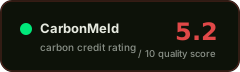
8MW Waste Heat Recovery Based Power Project By Sree Rengaraaj Power India Private Limited
Score Breakdown
Integrity
verified Additionality was tested using a barrier approach and was confirmed by the VVB, which supports the project case.
missing Leakage treatment is weakly documented: the monitoring report says it was not addressed, and the baseline is project-specific rather than a recently reassessed standardized baseline.
Transparency
verified The project has a named VVB, a defined monitoring period, and the registry record shows the project is registered under VCS.
missing The record does not state the usage monitoring method, and the emission reduction figures are inconsistent across documents.
Claim Safety
verified This is an avoidance project and the record says it is not CORSIA-eligible, which reduces some dual-market concern.
missing The baseline is project-specific, leakage justification is inconsistent, and the emission reduction totals differ materially between documents.
Documentation
verified Multiple official document types were used, including validation, monitoring, PDD, and issuance records, and extraction confidence is high.
missing The monitoring report contains many corrective actions, and the crediting period is much older than the monitoring period, which weakens recency.
Detailed Analysis
Integrity
The project has a positive additionality signal because the barrier test was confirmed by EPIC Sustainability Services Private Limited in the validation work. However, the baseline is project-specific and there is no evidence of a recent reassessment, which is weaker than a standardized baseline. Leakage is a concern because the monitoring report says it was not addressed, even though later validation material describes it as negligible.
Transparency
Transparency is moderate because the project has a named VVB, a clear monitoring period from 2021-01-01 to 2022-05-31, and the registry status is available. That said, the usage monitoring method is not stated in the extracted record, and the reported emission reductions are not consistent across documents. The monitoring report also lists multiple corrective actions, which suggests the documentation trail is not fully clean.
Claim Safety
Claim safety is middling. The project is an avoidance project and is marked as not CORSIA-eligible, which lowers some double-claim risk, but the baseline is project-specific and the leakage treatment is inconsistent. The emission reduction total of 156,573 tCO2e in the newer records conflicts with the older validation figure of 104,586 tCO2e, which raises over-crediting and reliability concerns.
Documentation
Documentation is reasonably broad because the extracted record draws from validation, monitoring, PDD, and issuance documents, and extraction confidence is high. The project also documents FPIC, a grievance mechanism, safeguards, and benefit sharing. Still, the monitoring report lists many corrective actions, and the crediting period is far older than the monitoring period, so the file is not fully complete or current.
Overall
I privileged the newer monitoring report for the claimed and verified emission reductions because it is the more recent operational record, but I still discounted the score because the older validation report shows a materially lower figure and the discrepancy is not explained. I also privileged the newer monitoring report for safeguards because it is more recent and explicitly states FPIC and grievance mechanisms, while the older report says those were absent. The contradictions reduce reliability, especially around leakage and emissions, so the overall score is held to a moderate level.
Audit Analysis
This is a real, registered VCS avoidance project with VVB-confirmed additionality and documented safeguards, but the evidence base has several gaps and some important inconsistencies. The biggest concerns are the unresolved leakage treatment, the project-specific baseline, and the fact that the reported emission reductions differ materially across documents.
Project Description
The Sree Rengaraaj Power India Private Limited (SRPIPL) project in Tamilnadu generates 8MW of electricity by utilizing waste heat from flue gases. The electricity is used within the industrial facility and the surplus power is wheeled to its sister concern through the regional grid. This project reduces annual GHG emissions by an estimated 43,186 tonnes of Carbon dioxide equivalent.
Red Flags
- The monitoring report says leakage was not addressed, while the validation report later describes leakage as negligible.
- Reported emission reductions conflict between documents, with 156,573 tCO2e in the newer records versus 104,586 tCO2e in older validation material.
Credit Vintages Exhausted
| Issued | Retired | Available | ||
|---|---|---|---|---|
| 2006 | 50,160 | 50,160 | 0 | |
| 2007 | 24,584 | 24,584 | 0 | |
| 2008 | 29,842 | 29,842 | 0 | |
| Total | 104,586 | 104,586 | 0 |
Cosa migliorerebbe questo punteggio
- Provide a clear, quantified leakage assessment and reconcile the conflicting leakage statements across documents.
- Publish a documented reconciliation of the emission reduction discrepancy between the older validation figure and the newer monitoring/claim figure.
Questi suggerimenti indicano quali prove pubbliche aggiuntive potrebbero migliorare il livello di confidenza di questa valutazione. Non garantiscono un punteggio futuro più alto.
Risk Indicators
Barrier test confirmed by VVB
Avoidance project with no reversal events reported
Leakage treatment inconsistent
Project-specific baseline
FPIC and grievance mechanism documented
Not CORSIA-eligible and no CCP approval stated
Where to buy
Marketplaces
+ Know where to buy this?
Listing multiple projects? Send us a CSV at [email protected].
⚑ Dispute this rating
Sei il proprietario di questo progetto?
Correzione metadati (gratuita)
Nome, paese, marketplace o link errati? Segnalacelo.
Non modifica lo score.
[email protected] →Rivalutazione con nuovi documenti
Hai documentazione aggiornata non ancora inclusa? Puoi richiedere un nuovo run della pipeline con i nuovi input.
Invia Documenti →