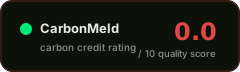
Distribution of improved cook stove- phase V
Score Breakdown
Integrity
verified Additionality was confirmed by the VVB (validation/verification documentation referenced in the extracted record).
missing Baseline method, baseline reassessment timing, and leakage deduction value were not found in the extracted record, weakening confidence in quantified emission reductions.
Transparency
verified The monitoring period is clearly stated (2012-10-11 to 2017-10-10) and a verified ER total is provided (61,959 tCO2e) in the monitoring/issuance documentation.
missing Key MRV parameters (assumed vs verified usage rates, and claimed ER total) were not found in the extracted record, limiting reproducibility.
Claim Safety
verified Leakage treatment is described as quantified and usage monitoring is specified as annual surveys in the monitoring documentation.
missing CORSIA eligibility and CCP status were not found in the extracted record, and missing usage-rate/baseline details increase perceived over-crediting and marketing-claim risk.
Documentation
verified Multiple document types are evidenced (PDD, validation report, monitoring report, issuance) with high extraction confidence and no material findings or corrective actions reported.
missing An internal inconsistency exists on the crediting period between the PDD and monitoring report, reducing reliability.
Detailed Analysis
Integrity
The extracted record indicates additionality was confirmed by the VVB (TÜV SÜD South Asia Pvt Ltd), which supports additionality robustness. However, the baseline method and the date of any baseline reassessment were not found in the extracted record, which is a material gap for cookstove crediting integrity. Leakage is described as quantified in the monitoring report (2022), but the actual leakage deduction percentage was not found, limiting confidence that leakage was conservatively applied.
Transparency
The monitoring report (2022-09-06) clearly states the monitoring period (2012-10-11 to 2017-10-10) and the verified emission reductions (61,959 tCO2e). The monitoring approach is partially transparent because the usage monitoring method is specified as annual surveys, but the assumed and verified usage rates were not found in the extracted record, preventing an independent check of the core driver of ERs. The total ERs claimed were also not found, so the claimed-versus-verified comparison cannot be assessed here.
Claim Safety
For cookstoves, over-crediting risk is highly sensitive to baseline assumptions, fNRB, and usage; the extracted record provides an fNRB value of 87.9 but does not provide the fNRB method, nor the usage-rate assumptions or verified usage rate values. Leakage is at least acknowledged as quantified in the monitoring report (2022), which is better than an unaddressed leakage claim, but the missing leakage deduction percentage limits confidence in the conservativeness of the final credits. CORSIA eligibility and CCP status were not found in the extracted record, so downstream claim constraints cannot be confirmed from the available extraction.
Documentation
Documentation coverage appears relatively strong: the evidence list includes a PDD (2021-01-15), validation report, monitoring report (2022-09-06), and issuance, with 12 documents used and high extraction confidence. The monitoring/verification record shows no material findings and no corrective actions required, which supports document completeness and audit outcomes. Still, the crediting-period inconsistency between core documents indicates a quality-control issue that reduces confidence in the overall record.
Overall
Overall quality is moderate: VVB-confirmed additionality and documented safeguards (FPIC and a grievance mechanism) support credibility, but missing baseline, leakage-deduction, and usage-rate quantifications create meaningful uncertainty for a cookstove ER calculation. One explicit contradiction exists on the crediting period: the monitoring report (2022-09-06) states 2012-10-01 to 2022-09-30, while the PDD (2021-01-15) states 2012-12-15 to 2022-12-14. I privilege the monitoring report dates because it is more recent and operationally tied to monitored/verified periods, but the discrepancy still lowers confidence and slightly depresses transparency/documentation scores.
Audit Analysis
This is a VCS cookstove distribution project with VVB-confirmed additionality and documented social safeguards (FPIC and a grievance mechanism). However, key quantification elements that drive crediting integrity for cookstoves (baseline approach details, leakage deduction value, and usage-rate parameters) were not found in the extracted record, increasing over-crediting risk. A crediting-period discrepancy between the PDD and monitoring report also reduces confidence in data consistency.
Project Description
Proponent: G K Energy Marketers Pvt. Ltd Protocol categories: Energy demand Protocols: AMS-II.G. Estimated annual GHG reductions: 13062 tCO2e Region: Asia Registration date: 2022-09-30
Red Flags
- Crediting period dates conflict between the PDD (2021) and the monitoring report (2022), indicating document inconsistency.
- Baseline approach and reassessment timing were not found in the extracted record, limiting confidence in baseline validity for a cookstove project.
- Leakage is described as quantified, but the actual leakage deduction percentage was not found in the extracted record.
- Usage monitoring is described (annual survey) but assumed and verified usage rates were not found in the extracted record, elevating over-crediting risk.
Credit Vintages
| Issued | Retired | Available | ||
|---|---|---|---|---|
| 2012 | 12,621 | 12,621 | 0 | |
| 2013 | 12,554 | 12,554 | 0 | |
| 2014 | 12,450 | 12,450 | 0 | |
| 2015 | 12,420 | 12,420 | 0 | |
| 2016 | 11,914 | 11,635 | 279 | |
| Total | 61,959 | 61,680 | 279 |
Cosa migliorerebbe questo punteggio
- Disclose the baseline approach and any baseline reassessment details (including key parameters and data sources) in the publicly available monitoring/verification package.
- Report and reconcile core quantification parameters in one place: claimed vs verified ERs, leakage deduction percentage, and assumed vs verified usage rates (with survey design and results).
Questi suggerimenti indicano quali prove pubbliche aggiuntive potrebbero migliorare il livello di confidenza di questa valutazione. Non garantiscono un punteggio futuro più alto.
Risk Indicators
VVB-confirmed additionality
Non-reversal energy efficiency activity
Leakage quantified but deduction not evidenced
Baseline approach not evidenced in extracted record
FPIC and grievance mechanism documented
CORSIA/CCP status not evidenced
Where to buy
+ Know where to buy this?
Listing multiple projects? Send us a CSV at [email protected].
⚑ Dispute this rating
Sei il proprietario di questo progetto?
Correzione metadati (gratuita)
Nome, paese, marketplace o link errati? Segnalacelo.
Non modifica lo score.
[email protected] →Rivalutazione con nuovi documenti
Hai documentazione aggiornata non ancora inclusa? Puoi richiedere un nuovo run della pipeline con i nuovi input.
Invia Documenti →