Efficient and Clean Cooking for Mozambican Low-Income Households
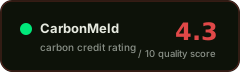
Score Breakdown
Integrity
verified Additionality was confirmed by the VVB using a combined test, which is stronger than an unverified project assertion.
missing The verification report records numerous corrective actions and findings, and reversal events are not addressed; no buffer pool share is stated.
Transparency
verified The project has a named VVB, a defined monitoring period, and a verified emission reduction total of 23,834 tCO2e.
missing The extraction confidence is low and several key fields are missing or inconsistent, including the claimed total reductions and baseline reassessment timing.
Claim Safety
verified Leakage is quantified with a 5% deduction, and the project uses a national default non-renewable biomass factor of 0.91.
missing Usage rate assumptions and verification are inconsistent across documents, and CORSIA eligibility is true while CCP status is not mentioned.
Documentation
verified The record draws on multiple official documents, including the monitoring report, verification report, validation report, and PDD.
missing The extraction confidence is low, and the verification report contains many corrective actions, indicating documentation quality issues.
Detailed Analysis
Integrity
The verification report confirms additionality through a combined test and the project applies a project baseline with a quantified leakage deduction of 5%. That said, reversal events are not addressed, no buffer pool percentage is stated, and the report lists many corrective actions and findings, which weakens confidence in implementation robustness.
Transparency
The project has a named VVB, a clear monitoring period from 2020-04-30 to 2023-03-31, and a verified emissions figure of 23,834. However, the extracted record has low extraction confidence, the claimed total reductions are not found, and baseline reassessment timing is not stated in available documents.
Claim Safety
The use of a national default non-renewable biomass factor of 0.91 and a quantified leakage deduction support the claim, and the project is an avoidance-type cookstove activity. Still, the usage rate is inconsistent across documents, with the monitoring report showing 0.9 while the verification report and PDD conflict on earlier assumptions, and CORSIA eligibility is true while CCP status is not mentioned.
Documentation
The evidence set includes several official documents, which is a positive sign, and the project has a recent verification report dated 2024-05-06. But the extraction confidence is low, and the verification report shows many corrective actions, so the documentation package is only moderately reliable.
Overall
I privileged the most recent and most specific sources where possible: the 2024 verification report for final assurance statements, the 2024 monitoring report for operational usage, and the PDD only where later documents did not override it. The contradictions on usage rate, benefit sharing, and crediting period are material; I treated them as evidence of reliability risk and reduced the score accordingly. Because the project is verified and has some strong elements, it is not a low-quality case, but the documentation and claim-safety weaknesses keep the overall score in the mid range.
Audit Analysis
This is a reasonably well-documented Gold Standard cookstove project with VVB-confirmed additionality, a quantified leakage deduction, and strong usage monitoring. However, the verification report shows many corrective actions, reversal risk is not addressed, and several key figures conflict across documents, which reduces confidence in the claimed emission reductions.
Project Description
In Mozambique, firewood and charcoal are the primary energy sources for cooking, heating, and lighting in households. An estimated 93% of the total population relies on solid biomass-based fuels for cooking, and in urban areas such as Maputo, 85% of households depend on charcoal to meet their cooking energy needs. Recently, rising charcoal prices have imposed economic hardships on peri-urban communities. Furthermore, cooking with biomass using inefficient stoves poses severe health risks, particularly for women and children, as it contributes to respiratory diseases due to indoor air pollution. Inefficient stoves also increase deforestation, forest degradation, and significant carbon dioxide emissions, exacerbating climate change. To address these challenges, Mozambique Carbon Initiatives Limitada (MozCarbon) has implemented a project distributing over 12,500 improved charcoal cookstoves to low-income households. These stoves significantly reduce charcoal consumption and related expenditure (accounting for 30% of the target group’s monthly income) improve indoor air quality, and promote access to affordable, clean energy. Locally Produced Solutions The stoves are manufactured in a factory operated by MozCarbon, creating jobs and developing local skills, particularly for young men and women. Distribution of the stoves to households is done by promoters, 70% of whom are women, using a door-to-door sales approach in Maputo. Affordable Payment Options To ensure affordability, the stoves are subsidized by MozCarbon, with beneficiaries paying 50% of the stove production cost. Payments can be made in installments for up to 90 days, with an initial down payment of 30%. Each sale is carefully recorded to track household adoption and impact. Monitoring and Certification A dedicated team, comprising call center agents, field agents, and Gold Standard approved auditors, monitors project impacts to ensure they are real, verifiable, and trace
Red Flags
- The verification report lists many corrective actions and findings, suggesting material documentation or implementation issues.
- Reversal risk is not addressed and no buffer pool percentage is stated, which weakens permanence confidence even for an avoidance project.
- There are contradictions on usage rate, benefit sharing, and crediting period across the monitoring report, verification report, and PDD.
Credit Vintages
| Issued | Retired | Available | ||
|---|---|---|---|---|
| 2017 | 23,834 | 23,725 | 109 | |
| 2018 | 26,076 | 26,076 | 0 | |
| 2019 | 20,521 | 20,521 | 0 | |
| 2020 | 8,154 | 2,047 | 6,107 | |
| 2021 | 8,665 | 1,504 | 7,161 | |
| 2022 | 8,536 | 1,165 | 7,371 | |
| 2023 | 1,959 | 0 | 1,959 | |
| Total | 97,745 | 75,038 | 22,707 |
Cosa migliorerebbe questo punteggio
- Publish a clear reconciliation of the usage-rate, benefit-sharing, and crediting-period contradictions across the monitoring report, verification report, and PDD.
- Add explicit permanence and registry-risk documentation, including reversal treatment, buffer pool participation, and a clearer statement on CCP/CORSIA claim boundaries.
Questi suggerimenti indicano quali prove pubbliche aggiuntive potrebbero migliorare il livello di confidenza di questa valutazione. Non garantiscono un punteggio futuro più alto.
Risk Indicators
VVB-confirmed combined test
reversal risk not addressed
5% quantified deduction
project baseline, reassessment not stated
FPIC and grievance mechanism present
CORSIA-eligible, CCP status not mentioned
Where to buy
Marketplaces
+ Know where to buy this?
Listing multiple projects? Send us a CSV at [email protected].
⚑ Dispute this rating
Registry Documents
monitoring
- GS6155 Monitoring-Report ver 06 R2 Answers_Track_Changes_to_be_Reviewed by SC.do
- GS6155 Monitoring-Report ver 06 R2 Answers_Track_Changes_to_be_Reviewed by SC.docx
- Monitoring Report_1st monitoring period_14.02.2017 to 31.12.2017_v9.pdf
- GS_6155_Monitoring Report MP3 2023_PR Round 3 - Clean.pdf
- GS6155 ER calculations_PUBLIC.xlsx
- GS6155 Ex Post ER Calculations MP3 2023_PR_Round 3_PUBLIC.xlsx
- +3 more
registry_page
Sei il proprietario di questo progetto?
Correzione metadati (gratuita)
Nome, paese, marketplace o link errati? Segnalacelo.
Non modifica lo score.
[email protected] →Rivalutazione con nuovi documenti
Hai documentazione aggiornata non ancora inclusa? Puoi richiedere un nuovo run della pipeline con i nuovi input.
Invia Documenti →