Efficient and Clean Cooking Stoves For Households in Kenya
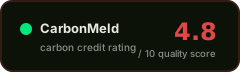
Score Breakdown
Integrity
verified Additionality was confirmed by the VVB in the verification report, and the baseline was reassessed in 2022.
missing Reversal risk is not addressed in the extracted record, with no buffer pool percentage stated and reversal events marked as not addressed.
Transparency
verified The project has a named VVB, a defined monitoring period, and a recent verification report dated 2025-11-19.
missing The record contains large inconsistencies in reported ERs and key activity assumptions, which undermines traceability and public confidence.
Claim Safety
verified Leakage is at least quantified, with a leakage deduction of 0% and a stated justification in the verification report.
missing The verification report shows 52,405 verified ERs versus 2,055,972 claimed in the extracted record, indicating a very large over-crediting concern.
Documentation
verified The extraction draws on multiple official documents, including a verification report, monitoring report, validation report, PDD, and appendix.
missing One key document was only medium-confidence extraction, and several core fields are contradicted across documents.
Detailed Analysis
Integrity
The verification report confirms additionality through VVB review, and the baseline was last reassessed in 2022, which is a positive sign for methodological robustness. Leakage is explicitly quantified with a 0% deduction, but permanence is weakly evidenced because no buffer pool percentage is stated and reversal events are marked as not addressed in the extracted record. The material findings note six clarification requests and three correction action requests that were closed successfully, which is acceptable but still indicates review issues.
Transparency
The project has a named verifier, VKU Certification Pvt. Ltd., and a clearly stated monitoring period in the verification report. However, transparency is weakened by major inconsistencies across documents, especially on usage rate, FNRB, leakage treatment, and the crediting period. The extracted record also shows a very large gap between claimed and verified ERs, which makes the public accounting harder to follow.
Claim Safety
Claim safety is materially weakened by the discrepancy between 2,055,972 claimed ERs and only 52,405 verified ERs in the verification report. The project is a cookstove avoidance activity, so usage assumptions matter; the verified usage rate is far below the earlier PDD assumption, and the FNRB value also shifts sharply across documents. Leakage is at least addressed with a quantified 0% deduction, but the overall over-crediting risk remains high.
Documentation
The evidence base is fairly broad, with multiple official documents used, including verification, monitoring, validation, PDD, and appendix materials. The extraction confidence is medium rather than high, and several important fields are contradicted across documents, which lowers reliability. The crediting period also differs between documents, suggesting the documentation set is not fully harmonized.
Overall
I privileged the verification report for the latest values because it is the most recent assurance document and directly reflects VVB-reviewed figures. That said, the contradictions are substantial: usage rate differs sharply from an earlier reported 72.56% figure, leakage treatment shifts from deemed negligible to quantified, FNRB changes materially, and the crediting period conflicts with the monitoring report. These inconsistencies reduce confidence in the accounting and justify a conservative overall score.
Audit Analysis
This is a Gold Standard cookstoves project with VVB-confirmed additionality, a recent baseline reassessment, and quantified leakage treatment, which supports moderate integrity. However, the record shows major inconsistencies in usage rates, FNRB, crediting period, and claimed versus verified ERs, which materially weaken confidence and raise over-crediting risk.
Project Description
BURN Manufacturing's project in Kenya is making a significant impact on the lives of some of the world's most vulnerable individuals. In a country where more than 90% of the population still relies on biomass fuels for cooking, deforestation rates are alarmingly high, especially in regions already facing arid conditions. Moreover, nearly three-quarters of the population live below the poverty line, exacerbating their challenges. The local production of charcoal, a common cooking fuel, is both unsustainable and costly. Additionally, using traditional and inefficient stoves leads to significant expenses for Kenyan families, with some spending up to $50 per month on fuel. Furthermore, the excessive smoke from these stoves poses serious health risks, contributing to over 3 million premature deaths annually, according to a study conducted by the Clean Cooking Alliance. In this context, BURN Manufacturing's project provides a solution by introducing the JIKOKOA, the world's most fuel-efficient biomass stove. By adopting the JIKOKOA, families can reduce their charcoal consumption by an impressive 52%, effectively slowing down deforestation and saving Kenyan households a total of $130 million to date. Additionally, this innovative stove reduces indoor air pollution by 65%, leading to reports of fewer illnesses among families who use it. The health benefits, combined with the savings in fuel expenses and time, contribute to a reduction in gender inequities and an overall improvement in the quality of life while also helping to preserve the country's forests. Through this project, BURN Manufacturing is providing a sustainable and life-changing solution to the pressing challenges faced by Kenyan families, offering them an opportunity for a better and healthier future. Project impacts and benefits: Since 2016, BURN manufacturing's work in Kenya has had the following impacts: Over 3.6m stoves distributed Over 600,000 lives impacted Over 400,000 tons of woo
Red Flags
- Large discrepancy between claimed and verified emission reductions, with the verification report showing far fewer ERs than earlier figures.
- Multiple contradictions across documents on usage rate, FNRB, leakage treatment, and crediting period reduce reliability.
Credit Vintages
| Issued | Retired | Available | ||
|---|---|---|---|---|
| 2016 | 157,226 | 157,226 | 0 | |
| 2017 | 278,593 | 278,295 | 298 | |
| 2018 | 293,547 | 266,935 | 26,612 | |
| 2019 | 277,373 | 273,084 | 4,289 | |
| 2020 | 414,682 | 400,827 | 13,855 | |
| 2021 | 510,271 | 509,943 | 328 | |
| 2022 | 516,426 | 490,587 | 25,839 | |
| 2023 | 355,898 | 347,732 | 8,166 | |
| 2024 | 62,326 | 61,080 | 1,246 | |
| Total | 2,866,342 | 2,785,709 | 80,633 |
Cosa migliorerebbe questo punteggio
- Publish a reconciled accounting table explaining the differences in usage rate, FNRB, leakage treatment, crediting period, and claimed versus verified ERs across all documents.
- Disclose permanence protections and market-claim status clearly, including buffer pool treatment, reversal handling, and whether the project is CORSIA-eligible or CCP-approved.
Questi suggerimenti indicano quali prove pubbliche aggiuntive potrebbero migliorare il livello di confidenza di questa valutazione. Non garantiscono un punteggio futuro più alto.
Risk Indicators
VVB-confirmed additionality
No buffer pool stated
Quantified 0% leakage deduction
Project baseline, reassessed in 2022
FPIC and grievance mechanism present
CORSIA/CCP status not stated
Where to buy
Marketplaces
+ Know where to buy this?
Listing multiple projects? Send us a CSV at [email protected].
⚑ Dispute this rating
Registry Documents
monitoring
- 26AUGUST2025 Kenya POA 5642_Ex Post ER Calculations CP3 MPI_Final.xlsx
- Jikokoa_Project_Renewal_ER_180322.xlsx
- 29JULY2022 T-V5.0-Deviation-Request-Form_GS5642_FINAL.pdf
- GS 5642_Monitoring Report_210301-clean (1).pdf
- GS5642_JIKOKOA Monitoring Report MP5_v1.4_CL(1).pdf
- 25AUG2022_GS 5642 Monitoring Report (1).pdf
- +11 more
Other
- 430_V1.3_IQ_SDG-Impact-tool GS 5642_Final.xlsx
- 09JUNE2023_V4.8-Project-Design-Document- BURN 5642 transition_CL.pdf
- 09JUNE2023_V4.8-Project-Design-Document- BURN 5642 transition_TC.pdf
- GS Passport_02.09.2018_v3.pdf
- T-v1.1-Design-Change-Memo_GS5642_clean.pdf
- Transition_Annex-GS_5642_181004_tracked.pdf
- +2 more
pdd
validation
Sei il proprietario di questo progetto?
Correzione metadati (gratuita)
Nome, paese, marketplace o link errati? Segnalacelo.
Non modifica lo score.
[email protected] →Rivalutazione con nuovi documenti
Hai documentazione aggiornata non ancora inclusa? Puoi richiedere un nuovo run della pipeline con i nuovi input.
Invia Documenti →