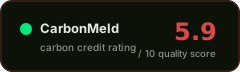
India Sundarbans Mangrove Restoration
Score Breakdown
Integrity
verified The monitoring report (2022) reports no reversal events and states a 10% buffer contribution.
missing Integrity-relevant parameters conflict across documents (buffer %, leakage approach, crediting period), reducing confidence in baseline/permanence controls.
Transparency
verified A named VVB (TÜV NORD CERT GmbH) and a clearly stated monitoring period (2018-04-01 to 2021-04-30) support auditability.
missing Key public-facing claim numbers are inconsistent across validation documents (verified ERs), undermining MRV clarity.
Claim Safety
verified Additionality is confirmed by the VVB and safeguards elements (FPIC, grievance mechanism) are documented in the extracted record.
missing Contradictory ER totals and shifting leakage justification increase greenwashing/over-crediting risk; CORSIA/CCP status is not stated in the extracted record.
Documentation
verified The extracted record indicates broad document coverage (PDD, monitoring report, validation report, issuance) with 16 documents used and high extraction confidence.
missing Multiple corrective action requests (CAR 01–CAR 06) indicate documentation/control weaknesses during audit.
Detailed Analysis
Integrity
Additionality is confirmed by the VVB, with the monitoring report (2022) describing a combined additionality approach, which is stronger than an unverified narrative. Permanence controls appear present: the monitoring report (2022) reports no reversal events and states a 10% buffer contribution, but the buffer percentage conflicts with an earlier monitoring report (2015) that states 15%, reducing confidence in the permanence risk management. Leakage is reported with a 0% deduction alongside a “quantified” justification in the monitoring report (2022), but an earlier monitoring report (2018) describes leakage as “deemed negligible,” which weakens confidence that leakage has been treated consistently over time.
Transparency
The project has a clearly identified VVB (TÜV NORD CERT GmbH) and a defined monitoring period (2018-04-01 to 2021-04-30) in the monitoring report (2022), which supports traceability. However, the extracted record shows a major inconsistency in verified ER totals between validation documents (2015 vs 2023), which makes it difficult for third parties to reconcile what was actually verified versus claimed. Several MRV-related fields (e.g., usage monitoring method, usage rate verified/assumed) are not found in the extracted record, limiting transparency on operational monitoring details.
Claim Safety
Over-crediting/claims risk is elevated because the extracted record contains conflicting verified ER totals across validation reports (2015 vs 2023), and the monitoring report (2022) also shows a mismatch between claimed and verified totals in the extracted fields. Leakage treatment is also inconsistent across monitoring reports (2018 vs 2022), while the leakage deduction remains 0%, which increases the risk that buyers could overstate climate impact if leakage was not robustly handled. CORSIA eligibility and CCP status are not stated in the extracted record, so buyers cannot rely on those labels to reduce double-claim or quality-screening risk.
Documentation
Documentation coverage appears relatively strong: the extracted record lists PDD, monitoring report, validation report, and issuance evidence, with 16 documents used and high extraction confidence. That said, the monitoring record indicates multiple corrective action requests (CAR 01–CAR 06), suggesting that auditors found issues requiring remediation. Some important fields (e.g., baseline reassessment timing) are not found in the extracted record, which reduces completeness for assessing ongoing baseline validity.
Overall
I privileged the more recent documents where conflicts exist: for reversals, I used “none reported” from the monitoring report (2022) over an older record that did not address reversals (2015), because the later monitoring period should reflect observed outcomes. For buffer contribution, I used 10% from the monitoring report (2022) over 15% from the monitoring report (2015), but scored down because the inconsistency suggests either changing risk categorization or reporting error. For verified ERs, I treated the 2023 validation figure (399,773) as the best available “verified” value due to recency, but the magnitude of the discrepancy versus the 2015 validation figure (~88,331) materially undermines reliability and increases claim-safety risk. For leakage, I used the monitoring report (2022) characterization (“quantified”) over the 2018 “deemed negligible,” but the shift without a consistent deduction basis warranted a conservative scoring adjustment; crediting period conflicts (monitoring 2022 vs validation 2015) further reduce confidence in administrative consistency.
Audit Analysis
The project shows several integrity positives typical of VCS ARR/REDD-style AFOLU work: additionality is confirmed by the VVB, a buffer contribution is stated, and no reversals are reported in the latest monitoring record. However, multiple cross-document inconsistencies (notably in verified ERs, buffer percentage, crediting period, and leakage treatment) raise reliability and over-crediting/claims risk and reduce confidence in the extracted figures.
Project Description
Proponent: Livelihoods Fund SICAV SIF Protocol categories: Agriculture Forestry and Other Land Use Protocols: AR-AM0014 Estimated annual GHG reductions: 51249 tCO2e Region: Asia Registration date: 2020-04-06
Red Flags
- Large discrepancy in verified emission reductions between documents (399,773 vs ~88,331), creating over-crediting/claims risk.
- Buffer pool contribution is inconsistent across monitoring reports (10% vs 15%).
- Crediting period dates conflict between monitoring and validation documents.
- Leakage treatment shifts from “deemed negligible” to “quantified” while a 0% leakage deduction is reported.
Credit Vintages
| Issued | Retired | Available | ||
|---|---|---|---|---|
| 2010 | 75,081 | 73,097 | 1,984 | |
| 2015 | 119,139 | 83,323 | 35,816 | |
| 2018 | 359,796 | 119,444 | 240,352 | |
| Total | 554,016 | 275,864 | 278,152 |
Cosa migliorerebbe questo punteggio
- Publish a reconciliation table across validation/verification/issuance showing claimed vs verified ERs by monitoring period and explaining the 2015 vs 2023 verified-ER discrepancy.
- Clarify and document the buffer pool contribution basis and any changes over time (e.g., risk rating updates), and align leakage treatment (quantified vs negligible) with a consistent, auditable calculation narrative.
Questi suggerimenti indicano quali prove pubbliche aggiuntive potrebbero migliorare il livello di confidenza di questa valutazione. Non garantiscono un punteggio futuro più alto.
Risk Indicators
VVB-confirmed additionality
Buffer stated but inconsistent across years
0% deduction with inconsistent justification
Project-specific baseline; reassessment timing not found
FPIC and grievance mechanism documented
CORSIA/CCP status not stated
Where to buy
+ Know where to buy this?
Listing multiple projects? Send us a CSV at [email protected].
⚑ Dispute this rating
Registry Documents
issuance
monitoring
Other
validation
- 2018-11-26 News_VCS Verification Representation.pdf
- VCS_LV_Sundarbans_Validation_Representation_061615.pdf
- VCS_LV_Sundarbans_ValidationVerification_VerificationReport_V.01-4_08092....pdf
- VCS_LV_Sundarbans_ValidationVerification_VerificationRepresentation_0908....pdf
- 2023-01-11_FVR_Sundarban_v1.4_clean (002) (1).pdf
- 2018-11-26 News_Verification Report.pdf
- +1 more
Sei il proprietario di questo progetto?
Correzione metadati (gratuita)
Nome, paese, marketplace o link errati? Segnalacelo.
Non modifica lo score.
[email protected] →Rivalutazione con nuovi documenti
Hai documentazione aggiornata non ancora inclusa? Puoi richiedere un nuovo run della pipeline con i nuovi input.
Invia Documenti →