One Pot Meals
CE-one-pot-meals
Score Breakdown
Integrity
verified Additionality is confirmed by the VVB in the validation report.
missing Baseline approach and leakage deduction are not clearly stated in the extracted record, weakening confidence in quantified ERs.
Transparency
verified Monitoring period and the VVB are identified, and a usage monitoring approach (annual survey) is described in the monitoring report.
missing Claimed vs verified ERs and cross-document ER figures are inconsistent, reducing MRV clarity and comparability.
Claim Safety
verified The project is stated as not CORSIA-eligible, reducing certain double-claiming/dual-eligibility risks.
missing Contradictory verified ER totals and missing baseline details elevate over-crediting and greenwashing risk.
Documentation
verified Core documents are present (monitoring report and validation report) with high extraction readability and no corrective actions reported.
missing Several critical fields are missing or inconsistent (baseline method, leakage deduction, safeguards), indicating incomplete/unclear documentation.
Detailed Analysis
Integrity
The validation report indicates additionality was confirmed by the VVB, which supports additionality robustness. However, the baseline method and when it was last reassessed are not stated in the extracted record, making it hard to judge baseline validity for a cookstove programme. Leakage is described as “quantified,” but the actual leakage deduction percentage is not found in the extracted record, limiting confidence that leakage was conservatively treated.
Transparency
The monitoring report provides a defined monitoring period (2021-01-01 to 2021-07-21) and identifies the VVB as Carbon Check (India) Private Ltd. The monitoring report also describes usage monitoring via annual survey and reports a high verified usage rate (94.2%). Transparency is reduced by inconsistent ER figures across documents and a mismatch between claimed and verified totals in the extracted record.
Claim Safety
The project is stated as not CORSIA-eligible, which lowers the risk of certain high-profile aviation-related claims. Still, baseline details are not stated in the extracted record, and the ER numbers show major inconsistencies across documents, both of which increase over-crediting risk. The use of a national default fNRB (0.82) is common for cookstoves, but without clearer baseline and leakage quantification in the extracted record, claims should be treated cautiously.
Documentation
The extracted record includes at least a monitoring report and a validation report, and the minimum extraction confidence is high, supporting document usability. No material findings or corrective actions are reported, which is a positive signal for audit outcomes. Nonetheless, several critical items are missing (baseline method, leakage deduction percentage, buffer/pooling or reversal treatment) and safeguards information is inconsistent, indicating documentation gaps.
Overall
Two contradictions materially affect confidence. First, verified ERs differ sharply: the validation report (2021-10-26) shows 440,618 while the monitoring report (2021-03-11) shows 209,813; for scoring, the monitoring report figure is privileged as it is the period-specific monitoring evidence, while the validation figure may reflect a different scope or aggregation—this inconsistency lowers integrity, transparency, and claim-safety scores. Second, safeguards are marked as present in the validation report but absent in the monitoring report; the monitoring report is privileged for operational reality during implementation, and the inconsistency lowers documentation and safeguards confidence. Gate rules note: integrity is above 4.0 and documentation is above 3.0, so no automatic caps would apply post-scoring.
Audit Analysis
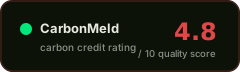
This cookstove avoidance project has VVB-confirmed additionality and no reported material findings, but key baseline and leakage parameters are not clearly evidenced in the extracted record. A major discrepancy in verified emission reductions across documents raises over-crediting and data reliability concerns. Safeguards and grievance provisions appear weak or inconsistently documented.
Project Description
Why we chose this project: “The UN considers Uganda to be a Least developed Country, and as of 2018, nearly 95% of the population still relied on traditional cookstoves – fueled by charcoal or wood. Charcoal and wood cookstoves are not only detrimental for women and children’s health, but also for the forest that
Red Flags
- Large contradiction in verified ERs between the validation report (440,618) and the monitoring report (209,813), increasing over-crediting and reliability risk
- Baseline approach and reassessment timing are not stated in the extracted record, limiting confidence in the counterfactual
- Safeguards/FPIC and grievance mechanism are absent or inconsistently documented across documents
Credit Vintages
Nessuna emissione registrata sul registro.
Cosa migliorerebbe questo punteggio
- Publish/clarify the baseline approach (including key parameters and when it was last reassessed) and reconcile it explicitly to the monitoring period ER calculation.
- Provide a clear leakage deduction value and calculation, and document safeguards implementation (FPIC, grievance mechanism) consistently across monitoring and validation materials.
Questi suggerimenti indicano quali prove pubbliche aggiuntive potrebbero migliorare il livello di confidenza di questa valutazione. Non garantiscono un punteggio futuro più alto.
Risk Indicators
VVB-confirmed additionality
Avoidance project; no reversal events reported
Leakage said to be quantified, but deduction not evidenced
Baseline method not evidenced in extracted record
FPIC and grievance mechanism not evidenced
Not CORSIA-eligible
Where to buy
Marketplaces
+ Know where to buy this?
Listing multiple projects? Send us a CSV at [email protected].
⚑ Dispute this rating
Registry Documents
monitoring
validation
Sei il proprietario di questo progetto?
Correzione metadati (gratuita)
Nome, paese, marketplace o link errati? Segnalacelo.
Non modifica lo score.
[email protected] →Rivalutazione con nuovi documenti
Hai documentazione aggiornata non ancora inclusa? Puoi richiedere un nuovo run della pipeline con i nuovi input.
Invia Documenti →