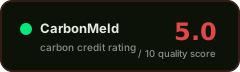
Safe Water Programme – Nigeria - VPA 95
Score Breakdown
Integrity
verified The validation report from Earthood Services Private Limited confirms additionality through a combined test, and the baseline was last reassessed in 2021.
missing Leakage treatment is not stated, and no buffer pool or reversal protection is shown in the extracted record.
Transparency
verified The validation report identifies the VVB and shows a defined monitoring period beginning on 2021-11-01, with safeguards and grievance mechanisms documented.
missing The extracted record does not provide verified emission totals, and usage monitoring is based on self-reporting rather than direct measurement.
Claim Safety
verified The project uses the TPDDTEC methodology under Gold Standard, which is generally more structured than an ad hoc baseline approach.
missing No leakage deduction is stated, and the record does not show verified usage rates or any clear CORSIA/CCP status.
Documentation
verified The record draws on multiple document types, including a validation report, stakeholder consultation material, and an appendix, with 11 documents used.
missing Extraction confidence is low, and the crediting period is contradictory across documents, which weakens document reliability.
Detailed Analysis
Integrity
The validation report from Earthood Services Private Limited confirms additionality using a combined test, which supports the project’s core integrity case. The baseline method is project-based and was last reassessed in 2021, but leakage treatment is not addressed in the extracted record and no buffer pool or reversal information is available. No unresolved material findings are shown, although the closed CLs and CAR indicate the validation process did require follow-up.
Transparency
Transparency is moderate because the validation report identifies the verifier and the monitoring period, and the record also shows FPIC, grievance mechanisms, and benefit-sharing documentation. However, the extracted facts do not include verified emission totals, and usage monitoring is self-reported, which is weaker than direct metering or third-party verification. The low extraction confidence further limits trust in the completeness of the public record.
Claim Safety
Claim safety is only moderate because the project sits on a structured Gold Standard methodology, but the record does not show quantified leakage treatment or verified usage rates. The absence of CORSIA and CCP status in the extracted facts leaves dual-claim risk unresolved rather than clearly excluded. Because the baseline is project-specific rather than jurisdictional, the over-crediting risk is not negligible.
Documentation
Documentation quality is limited by low extraction confidence and missing key quantitative fields, including verified emissions totals, usage rates, and leakage deductions. The record does show multiple document types and 11 documents used, which is a positive sign, but the contradictory crediting period values reduce reliability. I privileged the later crediting-period value from the 2024-04-12 source over the 2023-06-29 value because it is more recent, but the contradiction itself still warrants a downward adjustment.
Overall
The project appears reasonably credible on additionality and baseline governance, but the evidence base is incomplete and somewhat inconsistent. I privileged the later crediting-period value from the 2024-04-12 source because it is more recent than the 2023-06-29 value, yet the contradiction still lowers confidence in the record. The low extraction confidence and missing leakage, verification, and claim-status details keep the overall assessment in the middle range.
Audit Analysis
The project has some positive integrity signals: additionality was confirmed by the VVB, the baseline was reassessed in 2021, and no unresolved material findings are shown in the validation report. However, transparency and claim safety are weakened by missing verification figures, self-reported usage monitoring, no stated leakage treatment, and low extraction confidence across the source set.
Project Description
Developer: Impact Carbon Type: Energy Efficiency - Domestic Size: Small Scale Crediting period: 2024-10-01 → 2029-09-30 Estimated annual credits: 60000 tCO2e SDGs: Goal 6: Clean Water and Sanitation, Goal 1: No Poverty, Goal 7: Affordable and Clean Energy, Goal 13: Climate Action, Goal 3: Good Health and Well-Being, Goal 8: Decent Work and Economic Growth
Red Flags
- Leakage is not addressed in the extracted record, with no quantified deduction or justification shown.
- The crediting period is inconsistent across documents, which reduces confidence in the record and the timing of claims.
Credit Vintages
| Issued | Retired | Available | ||
|---|---|---|---|---|
| 2024 | 19,228 | 0 | 19,228 | |
| Total | 19,228 | 0 | 19,228 |
Cosa migliorerebbe questo punteggio
- Publish verified monitoring results, including total emissions reductions, usage rates, and the exact leakage treatment applied.
- Resolve the crediting-period discrepancy and provide clear registry status on CORSIA eligibility and any CCP-related claims.
Questi suggerimenti indicano quali prove pubbliche aggiuntive potrebbero migliorare il livello di confidenza di questa valutazione. Non garantiscono un punteggio futuro più alto.
Risk Indicators
VVB-confirmed combined test
No buffer or reversal evidence
Leakage not addressed
Project baseline, reassessed in 2021
FPIC and grievance mechanism documented
CORSIA/CCP status not stated
Where to buy
+ Know where to buy this?
Listing multiple projects? Send us a CSV at [email protected].
⚑ Dispute this rating
Sei il proprietario di questo progetto?
Correzione metadati (gratuita)
Nome, paese, marketplace o link errati? Segnalacelo.
Non modifica lo score.
[email protected] →Rivalutazione con nuovi documenti
Hai documentazione aggiornata non ancora inclusa? Puoi richiedere un nuovo run della pipeline con i nuovi input.
Invia Documenti →