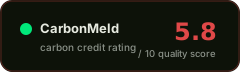
The Hyundai Waste Energy Recovery Co-Generation Project Phase II
Score Breakdown
Integrity
verified The verification/monitoring documentation indicates additionality was confirmed by the VVB using an investment test.
missing Leakage is not addressed and no leakage deduction is stated in the monitoring documentation, creating over-crediting risk.
Transparency
verified A relatively complete document set is referenced (PDD, monitoring report, validation report, issuance) with 11 documents used and high extraction confidence.
missing Multiple contradictions across documents (safeguards/FPIC/grievance and ERR totals) reduce confidence in the public record’s internal consistency.
Claim Safety
verified The project is explicitly not CORSIA-eligible, reducing aviation-claim channel risk.
missing Corrective actions and inconsistent ERR figures indicate heightened over-crediting/greenwashing risk if claims rely on the higher number.
Documentation
verified High extraction confidence and a broad set of evidence documents support document completeness.
missing Corrective actions required on metering calibration coverage and emission factor consistency indicate documentation/MRV weaknesses.
Detailed Analysis
Integrity
The monitoring documentation indicates additionality was confirmed by the VVB using an investment test, which supports additionality robustness. However, leakage is explicitly not addressed in the monitoring report (2021), and no leakage deduction is stated in the extracted record, which weakens integrity for an industrial energy efficiency/cogeneration context. The baseline is described as project-specific, and the timing of any baseline reassessment is not stated in the extracted record, adding uncertainty. Corrective actions in the monitoring report (2021) also point to MRV control issues (meter calibration coverage and emission factor consistency), which can affect the integrity of quantified reductions.
Transparency
The extracted record references a reasonably complete set of documents (PDD, monitoring report, validation report, issuance) and indicates 11 documents were used with high extraction confidence, supporting transparency. The monitoring period is clearly stated (2017-07-01 to 2019-12-31) in the monitoring report (2021). However, contradictions between the monitoring report and validation report on safeguards/FPIC/grievance and contradictions on the verified ERR total reduce transparency because readers cannot easily reconcile which statements are authoritative. The presence of corrective actions in the monitoring report (2021) further suggests that some monitoring inputs were not consistently documented.
Claim Safety
The project is explicitly not CORSIA-eligible, which lowers the risk of dual-channel aviation claims based on these credits. Nonetheless, the extracted record shows a large gap between claimed and verified emission reductions (6,008,438 claimed vs 3,892,640 verified), and contradictory reporting of the verified total across documents, which increases the risk of overstated public claims. Leakage is not addressed in the monitoring report (2021), and the baseline is project-specific with no reassessment timing found in the extracted record—both factors elevate over-crediting risk. CCP status is not stated in the extracted record, leaving uncertainty about alignment with higher-integrity labels.
Documentation
Documentation coverage appears relatively strong: the evidence list includes core VCS artifacts (PDD, monitoring report, validation report, issuance), and the extraction confidence is high. The monitoring report is dated 2021-03-07 and covers a defined monitoring period (2017-2019), which is reasonably recent relative to the crediting period (2013-2023). However, the monitoring report (2021) lists corrective actions on electricity meter calibration date coverage and an emission factor inconsistency versus the registered project description, indicating documentation and QA/QC gaps. Contradictions between the monitoring report and validation report on safeguards-related items also suggest uneven documentation across project stages.
Overall
Overall scoring reflects moderate quality with notable reliability concerns. I privilege the monitoring report (2021-03-07) over the earlier validation report (2021-01-13) for safeguards/FPIC/grievance/benefit-sharing because it is later in time and typically reflects implemented practices during monitoring, but the contradiction itself still reduces confidence and therefore lowers transparency and claim-safety. For the ERR contradiction, I privilege the lower verified total of 3,892,640 because it aligns with the extracted verified figure and is consistent with the concept of verification reducing claimed amounts; the existence of conflicting “verified” totals across documents indicates record-keeping or version-control issues and warrants a downward adjustment. Gate rules to note: integrity is above 4.0 so no overall cap applies; documentation is above 3.0 so no transparency cap applies.
Audit Analysis
This VCS industrial waste-heat energy recovery project shows moderate integrity: additionality is confirmed by the VVB using an investment test, but key risk controls (leakage treatment, baseline reassessment timing) are not clearly evidenced in the extracted record. Transparency is fair with multiple official documents available, yet several cross-document inconsistencies and corrective actions (meter calibration coverage and emission factor consistency) raise MRV reliability concerns.
Project Description
The Hyundai Waste Energy Recovery Co-generation Project Phase II is a 400MW cogeneration plant at Dangjin Hyundai Steel Mill that utilizes surplus waste gases to generate electricity and produce steam for the steel mill. This project helps to reduce emissions by reusing waste gases that would have been emitted into the atmosphere. Approximately 2,306,076MWh of electricity will be sent to the power grid.
Red Flags
- Large discrepancy between claimed and verified emission reductions (6,008,438 claimed vs 3,892,640 verified) and contradictory reporting of the verified total across documents.
- Leakage is not addressed and no leakage deduction is stated, despite an industrial energy project type where leakage screening/justification is typically expected.
- Corrective actions cite electricity meter calibration dates not covering the full monitoring period and an emission factor inconsistency versus the registered project description.
Credit Vintages
| Issued | Retired | Available | ||
|---|---|---|---|---|
| 2013 | 421,804 | 419,285 | 2,519 | |
| 2014 | 1,517,196 | 1,517,196 | 0 | |
| 2015 | 1,632,344 | 1,080,402 | 551,942 | |
| 2016 | 1,639,757 | 1,639,757 | 0 | |
| 2017 | 1,533,573 | 756,480 | 777,093 | |
| 2018 | 488,332 | 0 | 488,332 | |
| Total | 7,233,006 | 5,413,120 | 1,819,886 |
Cosa migliorerebbe questo punteggio
- Provide a clear leakage assessment consistent with ACM0012, including whether leakage is negligible and, if so, a documented justification and any applicable deduction.
- Resolve document inconsistencies by publishing a controlled set of final versions (validation/verification/monitoring) that consistently state safeguards (FPIC, grievance, benefit sharing) and reconcile claimed vs verified ERR totals with an explicit calculation and VVB confirmation.
Questi suggerimenti indicano quali prove pubbliche aggiuntive potrebbero migliorare il livello di confidenza di questa valutazione. Non garantiscono un punteggio futuro più alto.
Risk Indicators
VVB-confirmed investment test
Avoidance project; no reversals evidenced
Leakage not addressed; deduction not stated
Project-specific baseline; reassessment timing unclear
Safeguards/FPIC/grievance inconsistently documented
Not CORSIA-eligible; CCP status not stated
Where to buy
Marketplaces
+ Know where to buy this?
Listing multiple projects? Send us a CSV at [email protected].
⚑ Dispute this rating
Sei il proprietario di questo progetto?
Correzione metadati (gratuita)
Nome, paese, marketplace o link errati? Segnalacelo.
Non modifica lo score.
[email protected] →Rivalutazione con nuovi documenti
Hai documentazione aggiornata non ancora inclusa? Puoi richiedere un nuovo run della pipeline con i nuovi input.
Invia Documenti →