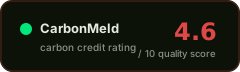
Univanich Lamthap POME Biogas Project PreCDMVER
Score Breakdown
Integrity
verified The project used a barrier additionality test and was reviewed by SIRIM QAS International Sdn Bhd, which supports some additionality credibility.
missing Leakage is not consistently justified, and no buffer pool or reversal protection details were found in the extracted record.
Transparency
verified The project has three evidence documents available, including a verification report, monitoring report, and PDD, and the monitoring period is stated.
missing Key MRV fields such as claimed versus verified ERs, usage monitoring, and baseline reassessment timing are not stated in available documents.
Claim Safety
missing The baseline is described only as project-based, with no recent reassessment or standardized baseline evidence found.
inferred Leakage treatment is disputed across documents, with the monitoring report describing it as negligible but the verification report saying it was not addressed.
Documentation
verified The extraction confidence is high and the record includes multiple official document types plus a named VVB.
missing The verification report dated 2011-11-30 lists 5 CARs and 17 CLs, showing material documentation and audit issues.
Detailed Analysis
Integrity
The project has some integrity support because the PDD and verification materials indicate a barrier-based additionality approach, and the verification was performed by SIRIM QAS International Sdn Bhd. That said, leakage is weakly supported: the monitoring report says it is negligible under AM0022v4, but the verification report says leakage was not addressed, and no buffer pool or reversal protection details were found. The large number of CARs and CLs also weakens confidence in the robustness of the project design and implementation.
Transparency
Transparency is moderate but incomplete. The record identifies the VVB, methodology version, and monitoring period, and it includes three document types, but key MRV outputs such as claimed versus verified emissions reductions are not stated in available documents. Usage monitoring method, FNRB method, and baseline reassessment timing are also not found, limiting public traceability of the accounting.
Claim Safety
Claim safety is limited by missing and inconsistent core accounting information. The baseline is only described as project-based, with no evidence of a recent reassessment or standardized baseline, and leakage treatment is contradictory across documents. No CORSIA eligibility or CCP status is stated, so dual-claim risk cannot be ruled out from the extracted record.
Documentation
Documentation quality is mixed. On the positive side, the extraction confidence is high and the record draws from a verification report, monitoring report, and PDD. On the negative side, the verification report dated 2011-11-30 lists 5 CARs and 17 CLs, which suggests substantial audit follow-up was needed, and several important fields remain unstated in the available documents.
Overall
The project is not a clear high-confidence crediting case because several core quality indicators are missing or weakly evidenced. The contradiction on leakage is important: I privileged the verification report’s statement that leakage was not addressed over the monitoring report’s claim that it was negligible, because the verification report is the higher-assurance document and directly reflects audit findings. The many CARs and CLs further reduce reliability, while the absence of stated CORSIA or CCP status leaves double-claim risk unresolved.
Audit Analysis
This project has some positive signs, including VVB involvement, FPIC, grievance mechanisms, and a stated barrier additionality test. However, the record is weak on key credit-quality items such as quantified leakage treatment, buffer protection, and verified additionality details, and the verification report raised many corrective items. Overall, the documentation suggests a project that was reviewed but not cleanly evidenced for high-confidence claims.
Project Description
Developer: Carbon Bridge Pte Ltd Type: Biogas - Electricity Size: Large scale Methodology: AMS-I.D. Grid connected renewable electricity generation Crediting period: 2008-01-02 → 2018-01-01 Estimated annual credits: 48000 tCO2e SDGs: Goal 3: Good Health and Well-Being, Goal 12: Responsible Production and Consumption, Goal 13: Climate Action
Red Flags
- The verification report recorded 5 CARs and 17 CLs after the on-site audit, indicating substantial issues needing follow-up.
- Leakage treatment is inconsistent: the monitoring report says leakage is negligible, while the verification report says it was not addressed.
Credit Vintages Exhausted
| Issued | Retired | Available | ||
|---|---|---|---|---|
| 2008 | 27,460 | 27,460 | 0 | |
| 2009 | 2,304 | 2,304 | 0 | |
| Total | 29,764 | 29,764 | 0 |
Cosa migliorerebbe questo punteggio
- Provide a clear, reconciled leakage assessment with quantified treatment and audit evidence supporting the final value.
- Publish verified ER figures, baseline reassessment details, and explicit CORSIA/CCP status to reduce claim and double-counting uncertainty.
Questi suggerimenti indicano quali prove pubbliche aggiuntive potrebbero migliorare il livello di confidenza di questa valutazione. Non garantiscono un punteggio futuro più alto.
Risk Indicators
Barrier test present but not independently confirmed in extr
No buffer pool or reversal protection details found
Leakage treatment is inconsistent across documents
Project baseline stated, but reassessment timing missing
FPIC, grievance mechanism, and benefit sharing are documente
CORSIA and CCP status not stated
Where to buy
+ Know where to buy this?
Listing multiple projects? Send us a CSV at [email protected].
⚑ Dispute this rating
Registry Documents
Sei il proprietario di questo progetto?
Correzione metadati (gratuita)
Nome, paese, marketplace o link errati? Segnalacelo.
Non modifica lo score.
[email protected] →Rivalutazione con nuovi documenti
Hai documentazione aggiornata non ancora inclusa? Puoi richiedere un nuovo run della pipeline con i nuovi input.
Invia Documenti →