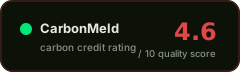
Yacumama Forest Carbon Project
Score Breakdown
Integrity
verified The validation report confirms additionality using a common-practice test and indicates it was confirmed by the VVB.
missing Leakage treatment is inconsistent across documents and the monitoring report does not address leakage justification despite a very large leakage deduction value in the extracted record.
Transparency
verified Multiple core documents are referenced (PDD, monitoring report, validation report, issuance) and a VVB is named (Environmental Services, Inc.).
missing The extracted record does not include claimed or verified emission reductions, limiting transparency on MRV outcomes for the 2014–2022 monitoring period.
Claim Safety
missing CORSIA eligibility and CCP status are not stated in the extracted record, increasing uncertainty for downstream claims screening.
missing Contradictory leakage information (quantified vs not addressed) and missing ER totals elevate over-crediting and greenwashing risk.
Documentation
verified Extraction confidence is high and the record references 10 documents including key project-cycle documents.
missing Several critical quantitative fields are missing (claimed/verified ERs, baseline reassessment timing), and multiple contradictions indicate document-to-document inconsistency.
Detailed Analysis
Integrity
The validation report confirms additionality via a common-practice test and indicates it was confirmed by the VVB, which supports additionality robustness. Permanence risk management appears comparatively strong for an avoidance project, with a 33% buffer pool contribution and no reversals reported in the extracted record. Integrity is weakened by leakage: the monitoring report indicates leakage justification is not addressed, yet the extracted record shows an extreme leakage deduction value, and the validation report is described as having quantified leakage—these inconsistencies reduce confidence in net crediting.
Transparency
The extracted record includes a defined monitoring period (2014-01-01 to 2022-12-31) and identifies the VVB (Environmental Services, Inc.), which supports basic traceability. However, neither total claimed nor total verified emission reductions are found in the extracted record, preventing an assessment of whether verification outcomes align with claims. The baseline is described as project-specific and the date of any baseline reassessment is not stated, limiting transparency on how baseline validity is maintained over time.
Claim Safety
Downstream claim safety is constrained because CORSIA eligibility and CCP status are not stated in the extracted record, so buyers cannot easily screen for program-eligibility-related claim risks. Over-crediting risk is elevated by the inconsistent leakage narrative (monitoring report does not address leakage justification while the validation report is described as quantified) and by the absence of extracted claimed/verified ER totals. The long crediting period (2012–2041) combined with no stated baseline reassessment timing further increases uncertainty around the durability of baseline assumptions.
Documentation
Documentation coverage is moderate-to-good: the evidence list includes the PDD, monitoring report, validation report, and issuance, and the extraction confidence is high with 10 documents used. Nonetheless, key quantitative outputs (claimed and verified ER totals) are not found in the extracted record, and several safeguards-related fields show contradictions against an older/unknown source. The presence of multiple contradictions suggests either document evolution over time or inconsistent reporting, which reduces documentation reliability.
Overall
Overall scoring is pulled down primarily by data reliability issues and missing quantification: the extracted record lacks claimed and verified ER totals and shows a highly implausible leakage deduction value alongside missing leakage justification in the monitoring report. For contradictions, values from the more specific and dated official documents were privileged: the validation report (2017-08-08) for safeguards items (FPIC, grievance mechanism, benefit sharing) and reversals, and the monitoring report (2017-07-18) for leakage justification; this choice reflects higher credibility than an older, unidentified 2016-12-20 source. Even with that prioritization, the leakage contradiction (quantified vs not addressed) remains unresolved and materially affects integrity and claim safety.
Audit Analysis
The project shows some strong structural elements for an avoidance project, including VVB-confirmed additionality and a relatively high buffer pool contribution with no reversals reported. However, leakage treatment appears inconsistent and potentially erroneous in the extracted record, and key quantification fields (verified ERs, baseline reassessment timing) are missing, increasing over-crediting and claims risk.
Project Description
Support for our Project helps ensure that the remaining tropical rainforests are both preserved and protected - and along with them - the inhabitants who live there. Home to the elusive pink dolphin, the Rio Yarapa meanders its way through our pristine forest as it makes its way to the Amazon. Here, our 11 square mile Project Area straddles this tributary, which not only supports an abundant aquatic diversity, but also provides nourishment for a vast array of terrestrial species as well. Carbon Units offered by YFCP are issued from this Project Area, which is dedicated to the conservation and preservation of habitat and its accompanying biodiversity. Included in this protected area are many threatened species such as the jaguar, tapir, pink dolphin, sloth, harpy eagle, and 7 species of Primates - a number second only to Uganda - which is home to 8. Not only is the forest itself a cornucopia of botanical wealth, its lofty branches are graced with a myriad of avian diversity - from the smallest hummingbirds to the majestic eagles - which share a sky filled with the radiant flocks of parrots and macaws. Yacumama - which translates as ‘Mother of the Waters’ - was established in 1992, and for the last 28 years has been invested in the preservation of indigenous traditions, species biodiversity, and habitat. Prior to converting our business model to Carbon sales, Yacumama was funded by eco-tourism, scientific research, and educational workshops - with a capacity to host up to 70 guests - although most groups and workshops averaged around 20. Our education and research groups were conducted on a regular basis and included workshops from George Washington University, the Smithsonian Institute EarthWatch Program, Miami Zoo, Florida International University, Engineers without Borders, Amazon Promise, and Shamanic Journeys. Providing accommodations in this fragile environment brings with it the responsibility of ecological me
Red Flags
- Leakage is listed as 17,500% while leakage justification is not addressed in the monitoring report, suggesting a serious data reliability or extraction issue that could materially affect credited volumes.
- Verified and claimed emission reductions are not found in the extracted record, limiting the ability to assess MRV accuracy and over-crediting risk.
- Baseline is described as project-specific and the timing of any baseline reassessment is not stated, which weakens confidence over a long crediting period (2012–2041).
Credit Vintages
| Issued | Retired | Available | ||
|---|---|---|---|---|
| 2012 | 43,125 | 43,125 | 0 | |
| 2013 | 41,693 | 37,948 | 3,745 | |
| Total | 84,818 | 81,073 | 3,745 |
Cosa migliorerebbe questo punteggio
- Provide the verified and claimed emission reductions for the monitoring period (with verification/issuance references) so MRV outcomes can be checked against claims.
- Clarify leakage treatment with a consistent, document-backed explanation and correct/confirm the leakage deduction value, including how it is applied to net credited ERs.
- Disclose when and how the baseline was last reassessed (or justify why reassessment is not required) given the long crediting period.
Questi suggerimenti indicano quali prove pubbliche aggiuntive potrebbero migliorare il livello di confidenza di questa valutazione. Non garantiscono un punteggio futuro più alto.
Risk Indicators
VVB-confirmed common-practice test
33% buffer; no reversals reported
Inconsistent and poorly justified leakage treatment
Project-specific baseline; reassessment timing unclear
FPIC and grievance reported, but inconsistent sources
CORSIA/CCP status not stated
Where to buy
Marketplaces
+ Know where to buy this?
Listing multiple projects? Send us a CSV at [email protected].
⚑ Dispute this rating
Sei il proprietario di questo progetto?
Correzione metadati (gratuita)
Nome, paese, marketplace o link errati? Segnalacelo.
Non modifica lo score.
[email protected] →Rivalutazione con nuovi documenti
Hai documentazione aggiornata non ancora inclusa? Puoi richiedere un nuovo run della pipeline con i nuovi input.
Invia Documenti →