
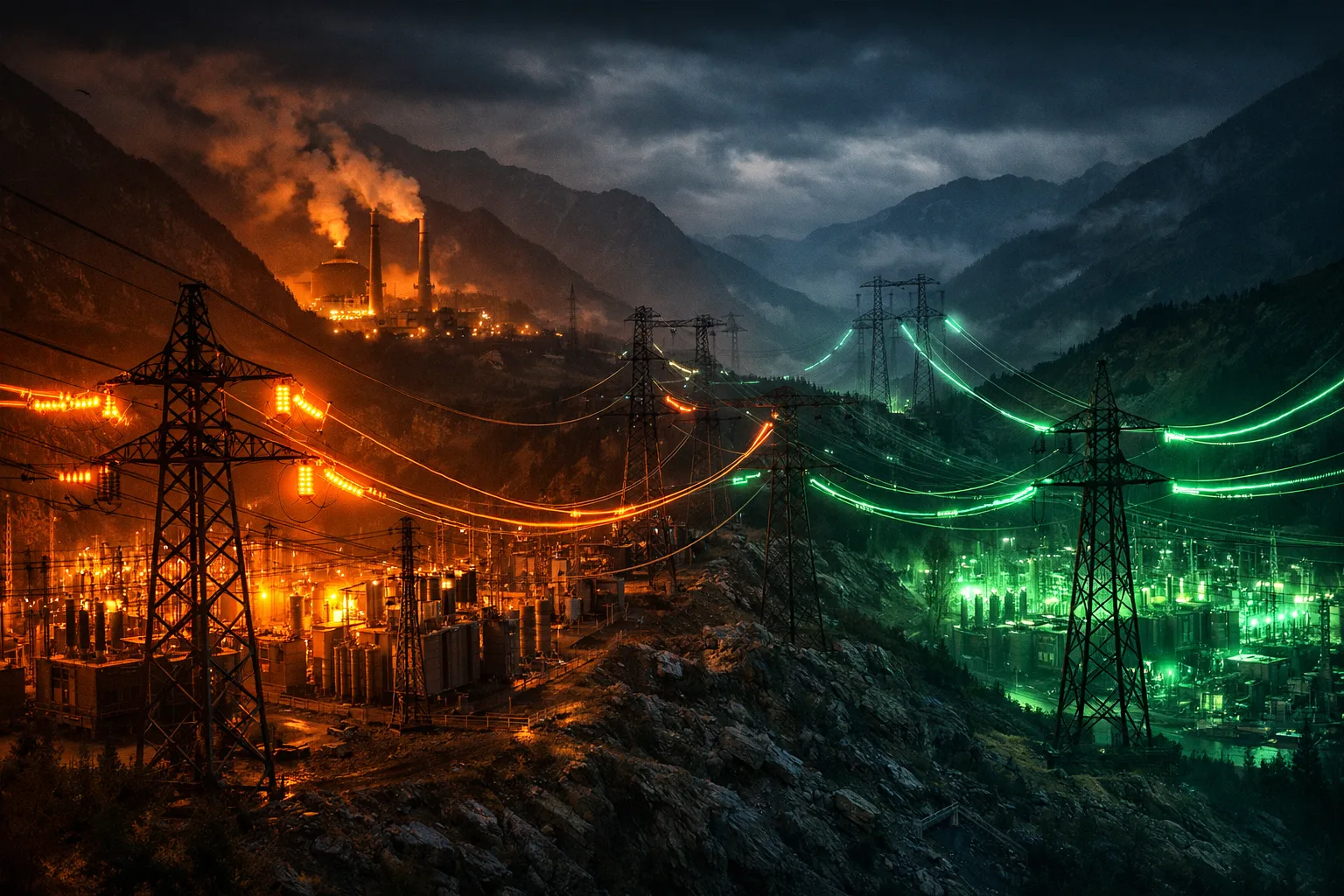
How CBAM Is Rewiring Balkan Power Trade: What It Means for Europe’s Clean Electricity Supply
Why the EU Carbon Border Mechanism Is Changing the Economics of Cross-Border Power
CBAM is no longer a reporting exercise. It entered its definitive phase on 1 January 2026, and electricity is one of the covered sectors alongside cement, iron and steel, aluminium, fertilisers and hydrogen. For cross-border power traders, embedded emissions are now a direct commercial variable.
That matters because electricity imports under CBAM are not priced like ordinary megawatt-hours. The framework relies on quarterly declarations of imported MWh, direct CO2 emissions at installation level, and any carbon price already paid in the origin country. That makes PPAs, hedge structures and supply-chain documentation more complex for utilities, traders and industrial buyers.
The carbon cost is also linked to the EU ETS. CBAM certificate pricing follows the average price of EU ETS allowances, so the charge on imported electricity moves with the carbon market rather than staying fixed. For desks modeling spark spreads, bilateral pricing and origin arbitrage, that linkage is the real story.
EU market integration still matters too. The electricity market design continues to depend on transparent cross-border trading and interconnection to move power across borders. CBAM is not replacing that system. It is changing which electrons stay competitive inside it.
The practical buyer question is now simple. Can you source Balkan power at a landed price that still works after CBAM, verification and balancing costs? That is where the pressure on Western Balkan exporters starts to show.
How Western Balkan Exporters Could Lose Their Price Advantage in the EU Market
The Western Balkans still trade heavily with the EU. Total goods trade reached €83.6 billion in 2024, and electricity sits inside a wider market relationship that now depends more on regulatory alignment and market coupling than on fuel-cost advantage alone.
The region still has a lower electricity price level than the EU average. OECD data shows average Western Balkan electricity prices around €0.097/kWh in 2024 versus about €0.29/kWh in the EU. That gap has helped exporters compete even when generation is carbon intensive.
That advantage is fragile because much of the region’s dispatchable capacity still depends on lignite and thermal generation. Hydrology also matters. Bosnia and Herzegovina, for example, remains heavily coal-and-hydro dependent and has been described as a net exporter with roughly two-thirds coal and one-third hydro generation depending on water availability.
CBAM pressure will be strongest where exporters rely on lignite-backed baseload or on mixed portfolios with incomplete emissions data. Traders selling into the EU now need to prove actual embedded emissions or risk margin loss through default values, verification friction and carbon-cost pass-through.
Industrial buyers feel this too. Metallurgy, chemicals and other power-intensive manufacturers often buy through corporate PPAs or utility contracts. As carbon charges compress the spread, the question becomes whether lower-carbon flows can still move from the Western Balkans into Europe at scale.
The market is shifting from cheap megawatt-hours to verified low-carbon megawatt-hours. That creates a real risk for regional decarbonisation plans, because CBAM can either accelerate clean investment or weaken the market access needed to finance it.
The Risk to Low-Carbon Electricity Flows and Regional Decarbonisation Plans
Renewable capacity in the wider Energy Community reached 5.1 GW in 2024, more than doubling since 2020. That shows the region is already adding cleaner generation, and CBAM could either reinforce that trend or make it harder to monetise.
Cross-border electricity trade still matters for supply security and decarbonisation. The EU continues to import electricity as a material energy product category, and power trade depends on interconnectors, market coupling and transparent balancing arrangements. If low-carbon flows are disrupted, both supply and emissions outcomes can suffer.
The risk is not only that coal-heavy exports become less competitive. Hydropower-rich or renewables-backed exporters may also face weaker incentives to sell into the EU if verification, registry data and carbon-cost allocation become too burdensome relative to the premium they can capture.
Energy Community analysis links CBAM to electricity market coupling and suggests that exemption pathways depend on integration with the EU market. That means decarbonisation plans in Serbia, Montenegro, North Macedonia, Bosnia and Herzegovina, Albania and Kosovo are tied to market-architecture reform as much as to new generation.
For buyers, the strategic risk is supply fragmentation. Fewer tradable low-carbon MWh, more country-specific documentation and potentially higher volatility in forward curves for renewable power attributes and guarantees of origin.
That sets up the commercial reality. The value created by CBAM will not be spread evenly. Some market participants will gain, some will lose, and traders will need to adapt quickly.
Who Gains, Who Loses, and How Traders May Adapt to the New Market Reality
The likely winners are exporters and utilities that can document actual emissions, prove low-carbon generation portfolios, and offer bankable certificates or guarantees of origin in a form that fits EU market expectations.
The likely losers are generators exposed to lignite, weak metering or incomplete emissions reporting. CBAM pricing compresses arbitrage between high-carbon origin markets and EU wholesale prices, especially once carbon cost is added to cross-border transfer and balancing costs.
Traders are likely to respond by changing portfolio strategy. That means mixing hydro, wind and solar assets across multiple Balkan jurisdictions, locking in longer tenor PPAs, and prioritising counterparties that can supply verifiable installation-level data for CBAM reporting and future audit trails.
Infrastructure and market design matter too. As the Energy Community advances market coupling, day-ahead and intraday integration could reduce friction costs, but only if regulatory convergence keeps pace with carbon-accounting requirements.
For B2B buyers, the operational question is whether a supplier can still deliver price certainty, origin credibility and compliance-ready data in one package. That is why mitigation is no longer just a trader issue. It is a policy issue as well.
The next step is therefore clear. Policymakers need to make sure CBAM supports clean electricity imports instead of blocking them.
What Policymakers Could Do to Prevent CBAM From Undermining Clean Power Imports
Policymakers can reduce unintended friction by aligning CBAM rules with electricity market coupling. Low-carbon exports from the Western Balkans should not be penalised simply because the region is still finishing technical and regulatory integration with the EU market.
Better emissions data infrastructure is one of the most important levers. The Commission’s CBAM Registry already allows non-EU installation operators to upload and share emissions data, and that should be used more broadly so traders, producers and verifiers work from a single source of truth instead of fragmented spreadsheets and country-by-country submissions.
Renewable investment and transmission upgrades also matter. Platforms like WBIF have already supported €1.8 billion in clean energy-related investments between 2020 and 2024, and that kind of financing can help turn local renewables into exportable, auditable clean power.
Regional governments also need faster transposition of the Electricity Integration Package and cleaner market rules. CBAM exemption pathways for electricity are closely linked to market coupling and EU-aligned electricity governance.
For EU policymakers, the trade-off is straightforward. If CBAM is implemented without enough flexibility for verified clean power imports, it may weaken the cross-border decarbonisation flows Europe needs for supply security and industrial competitiveness.
The best outcome is also the simplest one. CBAM should work as a carbon signal and an integration accelerator, not as a blunt barrier to low-carbon Balkan electricity reaching the EU market.