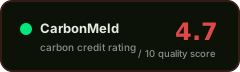
140 MW Solar Photovoltaic Project in Rajasthan
Score Breakdown
Integrity
verified Additionality was tested using an investment test and was confirmed by the VVB in the monitoring record.
missing Leakage is not addressed, with a zero deduction but no supporting justification, and reversal risk is not clearly handled because buffer pool coverage is not stated.
Transparency
verified The project has a named VVB, a defined monitoring period, and a substantial set of extracted source documents.
missing The monitoring report includes several corrective actions and missing details, including inconsistent ER data, missing calibration certificates, and incomplete stakeholder communication records.
Claim Safety
verified The project is not CORSIA-eligible, which reduces dual-market claim risk.
missing The baseline is project-specific rather than a more conservative standardized or jurisdictional baseline, and leakage treatment is weakly justified.
Documentation
verified The extraction confidence is high and the record includes both validation and monitoring materials.
missing The monitoring report is dated later than the crediting start, but key items remain unresolved, and several contradictions indicate reliability issues in the document set.
Detailed Analysis
Integrity
The project’s additionality is stronger than average because the monitoring record says the investment test was used and the VVB confirmed it. However, the baseline is project-based, leakage is shown as a 0% deduction without justification, and buffer pool coverage is not stated, so permanence and leakage robustness are only moderate. The monitoring report also lists multiple corrective actions, including inconsistent ER calculations and missing calibration certificates, which weakens confidence in the emissions accounting.
Transparency
Transparency is mixed: the project has a named verifier, a defined monitoring period, and a large document set, which helps traceability. But the monitoring report includes several unresolved issues, such as missing stakeholder communication details, missing metering line diagrams, and inconsistent reporting of vintage-wise reductions. The record also shows contradictions between documents on safeguards and grievance-related disclosures, which lowers trust in the completeness of the public record.
Claim Safety
Claim safety is constrained by the project-specific baseline and weak leakage treatment. The project is not CORSIA-eligible, which helps reduce dual-claim exposure, but CCP status is not stated. Claimed and verified emission reduction figures differ across documents, and the contradictions in reported totals suggest some over-crediting or reporting reliability risk.
Documentation
Documentation quality is moderate rather than strong. The extraction confidence is high and the record includes multiple official documents, but the monitoring report still contains many corrective actions and missing details. The contradictions on grievance mechanisms, FPIC, safeguards, and emission reduction totals indicate that the document set is not fully internally consistent, even though the core evidence is present.
Overall
The project looks viable but not especially robust from a credit-quality perspective: additionality is supported, yet leakage, permanence, and reporting consistency are only middling. I privileged the more recent monitoring report for safeguards and grievance-related facts because it is later and more operationally specific, while the later validation/verification figures were used for the higher emission reduction totals because they are the newest quantified values. The contradictions between documents, especially on safeguards and ER totals, reduce reliability and keep the overall score in the mid range.
Audit Analysis
This is a registered solar project with VVB-verified additionality and a clear project baseline, but the documentation shows several gaps and inconsistencies. The monitoring report also contains multiple corrective actions and unresolved details on stakeholder communication, meter calibration, and ER sheet consistency, which reduce confidence in the claimed reductions.
Project Description
Proponent: Multiple Proponents Protocol categories: Energy industries (renewable/non-renewable sources) Protocols: ACM0002 Estimated annual GHG reductions: 241573 tCO2e Region: Asia Registration date: 2019-08-19
Red Flags
- The monitoring report lists multiple corrective actions, including inconsistent ER calculations, missing calibration certificates, and missing metering line diagrams.
- Claimed and verified emission reduction figures differ across documents, and the record contains contradictions on safeguards and grievance documentation.
Credit Vintages
| Issued | Retired | Available | ||
|---|---|---|---|---|
| 2017 | 75,294 | 75,294 | 0 | |
| 2018 | 292,954 | 292,954 | 0 | |
| 2019 | 281,092 | 281,092 | 0 | |
| 2020 | 293,640 | 21,952 | 271,688 | |
| 2021 | 289,043 | 120,500 | 168,543 | |
| 2022 | 135,000 | 101,000 | 34,000 | |
| Total | 1,367,023 | 892,792 | 474,231 |
Cosa migliorerebbe questo punteggio
- Provide a clear leakage assessment and justify the zero leakage deduction with project-specific evidence.
- Submit complete calibration certificates, metering diagrams, and a reconciled ER table that resolves the reported inconsistencies and contradictions.
Questi suggerimenti indicano quali prove pubbliche aggiuntive potrebbero migliorare il livello di confidenza di questa valutazione. Non garantiscono un punteggio futuro più alto.
Risk Indicators
VVB-confirmed investment test
No buffer pool stated
Zero deduction without justification
Project baseline only
Safeguards partly documented
Not CORSIA-eligible; CCP status unstated
Where to buy
+ Know where to buy this?
Listing multiple projects? Send us a CSV at [email protected].
⚑ Dispute this rating
Sei il proprietario di questo progetto?
Correzione metadati (gratuita)
Nome, paese, marketplace o link errati? Segnalacelo.
Non modifica lo score.
[email protected] →Rivalutazione con nuovi documenti
Hai documentazione aggiornata non ancora inclusa? Puoi richiedere un nuovo run della pipeline con i nuovi input.
Invia Documenti →