*4.5 MW Biomass (low density Crop Residues) based Power Generation unit of Malavalli Power Plant Pvt Ltd. (300011)
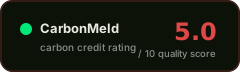
Score Breakdown
Integrity
verified Additionality was confirmed by DNV Climate Change Services AS, and the project used a combined additionality test under the AMS-I.D methodology.
missing Leakage and permanence are not cleanly documented: one verification record says leakage was quantified, but no deduction percentage is stated, and reversal treatment is not addressed.
Transparency
verified The project has a named VVB, a defined monitoring period, and verified emissions are reported in the verification record.
missing Transparency is weakened by conflicting emissions and crediting-period figures across documents, and the usage monitoring method is only described as self-reported.
Claim Safety
verified The project uses a project baseline under a recognized CDM methodology, which is better than an unstated baseline approach.
missing Claim safety is reduced by the lack of a stated leakage deduction percentage, missing usage-rate evidence, and contradictory verified emissions figures across reports.
Documentation
verified The record includes multiple evidence documents, a named verifier, and a medium extraction confidence level rather than low.
missing Several key fields are not stated in available documents, including buffer pool coverage, grievance mechanism, and reversal details, and there are multiple contradictions between reports.
Detailed Analysis
Integrity
The verification report from DNV Climate Change Services AS confirms additionality using a combined test, which supports the project’s core crediting logic. The baseline is project-specific and was last reassessed in 2006, but permanence is weakly evidenced because reversal events are not addressed and no buffer pool percentage is stated. Leakage is also only partially supported: one verification record says it was quantified, but the deduction percentage is not provided.
Transparency
The project has some transparency positives, including a named VVB, a stated monitoring period, and a verified emissions figure in the verification report. However, the record is weakened by inconsistent reporting across documents, including different verified emissions totals and conflicting crediting periods. The usage monitoring method is described as self-reported, which limits independent traceability.
Claim Safety
Claim safety is moderate at best because the project relies on a project baseline rather than a more standardized or jurisdictional baseline, and the leakage treatment is not fully quantified in the extracted record. The absence of a stated usage-rate verification and the conflicting verified emissions figures increase over-crediting risk. The project is not shown to be CORSIA-eligible, and CCP status is not mentioned, so dual-claim risk cannot be ruled out from the available record.
Documentation
Documentation quality is fair but not strong: there are multiple official documents and a named verifier, and extraction confidence is medium rather than low. Still, several important items are not stated in available documents, including buffer pool coverage, grievance mechanism, and reversal details. The presence of multiple CARs and a calibration delay also suggests the verification process identified operational issues that required follow-up.
Overall
I privileged the later verification report for the final verified emissions figure of 15,036 because it is more recent and appears to reflect the final verification outcome, but the earlier monitoring report’s 9,211 figure remains a material contradiction that lowers confidence. I also privileged the later verification report’s statement that leakage was quantified over the earlier report’s deemed-negligible wording, again because it is more recent, but the absence of a leakage deduction percentage prevents full validation. The crediting-period contradiction between 2001-08-01 to 2008-07-31 and 2008-08-01 to 2015-07-31 is a serious consistency issue, and together with the unresolved reversal treatment and missing buffer information it justifies a cautious mid-range score.
Audit Analysis
The project has some positive integrity signals, including VVB-confirmed additionality and a quantified leakage treatment in at least one verification record. However, the record also shows material documentation issues, unresolved reversal treatment, and contradictions across verification documents that reduce confidence in the claimed emissions reductions. Overall, this looks like a moderately documented project with meaningful reliability concerns rather than a high-confidence crediting case.
Project Description
Developer: South Pole Ltd Type: Biomass, or Liquid Biofuel - Electricity Size: Small Scale Methodology: AMS-I.D. Grid connected renewable electricity generation Crediting period: 2008-08-01 → 2015-07-31 Estimated annual credits: 20691 tCO2e SDGs: Goal 13: Climate Action, Goal 8: Decent Work and Economic Growth, Goal 7: Affordable and Clean Energy
Red Flags
- The verification records conflict on credited emissions, with one report showing 15,036 verified ERs and an earlier monitoring report showing 9,211; the later verification report was privileged because it is more recent and directly reflects the final verification outcome, but the discrepancy still weakens reliability.
- Leakage treatment is inconsistent across verification documents, with one report describing leakage as quantified and an earlier one describing it as deemed negligible.
- The crediting period is contradictory across verification reports, which raises concerns about record consistency and version control.
- Reversal events are not addressed and no buffer pool percentage is stated, which is a weakness for permanence even though this is a biomass avoidance project.
Credit Vintages
| Issued | Retired | Available | ||
|---|---|---|---|---|
| 2001 | 8,560 | 0 | 8,560 | |
| 2002 | 16,362 | 0 | 16,362 | |
| 2003 | 17,606 | 0 | 17,606 | |
| 2006 | 6,821 | 0 | 6,821 | |
| 2007 | 12,856 | 0 | 12,856 | |
| 2008 | 8,631 | 0 | 8,631 | |
| 2009 | 13,972 | 0 | 13,972 | |
| 2010 | 6,965 | 0 | 6,965 | |
| Total | 91,773 | 0 | 91,773 |
Cosa migliorerebbe questo punteggio
- Provide a reconciled emissions and crediting-period schedule across all verification and monitoring documents, with a clear explanation of which figures are final and why.
- Disclose a quantified leakage deduction, buffer pool treatment, and reversal management approach, along with clearer public evidence on safeguards and grievance handling.
Questi suggerimenti indicano quali prove pubbliche aggiuntive potrebbero migliorare il livello di confidenza di questa valutazione. Non garantiscono un punteggio futuro più alto.
Risk Indicators
VVB-confirmed combined test
No reversal treatment stated
Quantified in principle, but no deduction stated
Project baseline, reassessment timing limited
FPIC and benefit sharing noted, grievance mechanism missing
CORSIA/CCP status not stated
Where to buy
+ Know where to buy this?
Listing multiple projects? Send us a CSV at [email protected].
⚑ Dispute this rating
Registry Documents
monitoring
- (1)Monitoring Report_1st monitoring period_01-08-08 to 30-04-09_v4.0.pdf
- (1)Monitoring Report_2nd monitoring period_01-05-09 to 30-06-10_v2.0.pdf
- Monitoring Report_monitoring period_01-08-2008 to 30-04-2009_v02.pdf
- Monitoring Report_monitoring period_01-08-2008 to 30-04-2009_v04.pdf
- (1)Monitoring Report_2nd monitoring period_01-05-2009 to 30-06-2010_v01.pdf
- (1)Monitoring Report_monitoring period_01-10-2007 to 31-07-2008_v01.pdf
- +2 more
pdd
registry_page
validation
Sei il proprietario di questo progetto?
Correzione metadati (gratuita)
Nome, paese, marketplace o link errati? Segnalacelo.
Non modifica lo score.
[email protected] →Rivalutazione con nuovi documenti
Hai documentazione aggiornata non ancora inclusa? Puoi richiedere un nuovo run della pipeline con i nuovi input.
Invia Documenti →