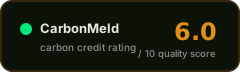
6 MW Wind Power Project in Maharashtra by PTC India
Score Breakdown
Integrity
verified Additionality is confirmed by the VVB (validation report).
missing Baseline and leakage substantiation are weak in the extracted record (project-specific baseline; grid emission factor and reassessment timing not found; leakage inconsistently treated across documents).
Transparency
verified VVB is identified (LGAI Technological Center, S.A. / Applus+ Certification) and the monitoring period is clearly stated (monitoring report).
missing Claimed ERs are not found in the extracted record and the monitoring report flags incomplete ER sheets and missing months, reducing MRV transparency.
Claim Safety
verified The project is stated as not CORSIA-eligible, reducing cross-program claim risk (registry extract).
missing Over-crediting risk is elevated by MRV issues (missing data, unclear metering details) and an internal inconsistency in verified ER figures across validation report versions.
Documentation
verified Multiple core document types are present (validation report, monitoring report, issuance) with high extraction confidence.
missing Numerous corrective actions in the monitoring report indicate documentation quality/control issues (template errors, incorrect crediting period end date, incomplete datasets).
Detailed Analysis
Integrity
The validation report confirms additionality via VVB assessment, which supports the additionality case even though the specific test type is not found in the extracted record. The baseline is project-specific (AMS-I.D), but key baseline parameters such as the grid emission factor and the year used are not found in the extracted record, limiting robustness checks. Leakage is not consistently handled: the validation report describes leakage as deemed negligible, while the monitoring report indicates it is not addressed, which weakens confidence in completeness. No material findings are reported, but the monitoring report’s corrective actions on metering and missing data create integrity risk around quantified generation and ER calculations.
Transparency
The monitoring period is clearly stated as 2014-03-31 to 2018-03-30 (monitoring report), and the VVB is clearly identified (Applus+). However, total claimed ERs are not found in the extracted record, preventing a straightforward claimed-versus-verified comparison. The monitoring report lists several corrective actions (missing months in the ER sheet, incomplete datasets, unclear meter details), which reduces transparency and auditability of the monitoring evidence trail.
Claim Safety
The project is indicated as not CORSIA-eligible, which lowers the risk of claims being marketed under multiple eligibility labels. Nonetheless, the monitoring report raises MRV weaknesses (incomplete data and unclear metering continuity/calibration), which increases over-crediting and greenwashing risk if credits are claimed without clear, complete underlying evidence. In addition, the extracted record shows inconsistent verified ER figures across validation report dates, which further elevates claim risk until reconciled.
Documentation
The extracted record includes key document types (validation report, monitoring report, issuance) and uses multiple documents overall, with high extraction confidence. Documentation quality is mixed because the monitoring report includes numerous corrective actions (template/content errors, incorrect DNA/MoEFCC naming, incorrect crediting period end date, incomplete monitoring datasets, and unclear meter specifications). These issues suggest weaknesses in document control and completeness even if ultimately correctable through the VVB process.
Overall
I privilege the more recent monitoring report (2022-04-28) over the earlier validation report (2022-03-18) for safeguards and grievance mechanism, because it is later in time and reflects updated project documentation; however, the contradiction itself reduces confidence and slightly lowers transparency/documentation. For the verified ER contradiction (69,543 vs 47,316 across validation report versions), I privilege the higher figure (69,543) because it is associated with the later-dated validation report entry (2022-03-28 vs 2022-03-18), but the inconsistency materially undermines reliability and lowers claim_safety. For leakage, I privilege the monitoring report’s statement that leakage is not addressed over the validation report’s “deemed negligible,” because monitoring should confirm how leakage was actually treated during crediting; this reduces integrity/claim_safety. Overall, the project has a credible structure (VCS, AMS-I.D, VVB involvement) but is held back by MRV corrective actions and multiple cross-document inconsistencies.
Audit Analysis
The project is a VCS wind power activity using AMS-I.D with VVB-confirmed additionality and no material findings reported, which supports basic credibility. However, key baseline and leakage parameters are not clearly evidenced in the extracted record, and the monitoring report includes multiple corrective actions related to metering, calibration, and incomplete data, increasing over-crediting risk.
Project Description
Proponent: PTC India Ltd. Protocol categories: Energy industries (renewable/non-renewable sources) Protocols: AMS-I.D. Estimated annual GHG reductions: 11562 tCO2e Region: Registration date: 2020-04-06
Red Flags
- Monitoring report corrective actions cite missing/incomplete monitoring data and unclear meter continuity/calibration across the monitoring period.
- Leakage treatment is inconsistent across documents (deemed negligible vs not addressed), weakening confidence in the completeness of the quantification narrative.
- Baseline inputs (grid emission factor and year) are not found in the extracted record, limiting independent checks of credited reductions.
Credit Vintages Exhausted
| Issued | Retired | Available | ||
|---|---|---|---|---|
| 2008 | 4,934 | 4,934 | 0 | |
| 2009 | 11,973 | 11,973 | 0 | |
| 2010 | 11,534 | 11,534 | 0 | |
| 2011 | 12,536 | 12,536 | 0 | |
| 2012 | 13,073 | 13,073 | 0 | |
| 2013 | 13,876 | 13,876 | 0 | |
| 2014 | 12,547 | 12,547 | 0 | |
| 2015 | 10,744 | 10,744 | 0 | |
| 2016 | 13,046 | 13,046 | 0 | |
| 2017 | 11,814 | 11,814 | 0 | |
| 2018 | 781 | 781 | 0 | |
| Total | 116,858 | 116,858 | 0 |
Cosa migliorerebbe questo punteggio
- Publish/append the full baseline calculation inputs used for ER quantification (grid emission factor value, year, and source) and clearly state when/if it was reassessed.
- Resolve MRV corrective actions by providing complete monthly generation datasets, clear main/check meter specifications, evidence of meter continuity, and calibration certificates covering the full monitoring period, then disclose the final corrected ER sheet.
- Reconcile and explain the inconsistent verified ER figures across validation report versions and provide a single authoritative issuance/verification summary table.
Questi suggerimenti indicano quali prove pubbliche aggiuntive potrebbero migliorare il livello di confidenza di questa valutazione. Non garantiscono un punteggio futuro più alto.
Risk Indicators
VVB-confirmed additionality (test type not specified)
Renewable energy project with no reversal risk indicated
Leakage inconsistently treated (negligible vs not addressed)
Project-specific baseline; key baseline inputs not evidenced
Safeguards/FPIC/grievance reported but contradicted across d
Not CORSIA-eligible; CCP status not stated
Where to buy
+ Know where to buy this?
Listing multiple projects? Send us a CSV at [email protected].
⚑ Dispute this rating
Registry Documents
Sei il proprietario di questo progetto?
Correzione metadati (gratuita)
Nome, paese, marketplace o link errati? Segnalacelo.
Non modifica lo score.
[email protected] →Rivalutazione con nuovi documenti
Hai documentazione aggiornata non ancora inclusa? Puoi richiedere un nuovo run della pipeline con i nuovi input.
Invia Documenti →