9 MW Beas Kund Hydel Power Project
#745of 1935 in Renewable energy#371of 975 in India#511of 1459 in CDM (UNFCCC)#258of 806 in AMS-I.D
Audit Analysis
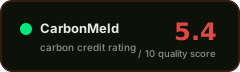
The 9 MW Beas Kund hydro project in India has a sound design foundation with a VVB-confirmed investment additionality test and a jurisdictional baseline, but the record is marred by a critical discrepancy in verified emissions reductions (zero versus the 200,948 tCO₂e lifetime estimate) and the absence of any stated buffer pool, FPIC, or grievance mechanism. Ten corrective action requests during verification, all since closed, suggest moderate compliance friction. Overall the project is a conventional run-of-river hydro avoidance project with reasonable design but significant data-reliability concerns that limit confidence in the credit claims.
Red Flags
- Verified ERR of 0 tCO₂e appears in the monitoring record alongside a lifetime claim of 200,948 tCO₂e — a discrepancy that, if genuine, would indicate no credits were actually delivered or a serious data-extraction failure
- No buffer pool percentage is stated in any available document, leaving permanence risk unquantified even though hydro reversal risk is inherently low
- Ten corrective action requests (CARs) were raised and closed during verification, indicating recurring documentation or compliance gaps
- Free, Prior and Informed Consent (FPIC) and a grievance mechanism are not documented in any extracted record
Credit Vintages
No issuances recorded on the registry.
Risk Indicators
VVB-confirmed investment test
mixed evidence / unresolved risk
0 % deduction, reasonable for grid-displacement hydro
Jurisdictional baseline, 2008 grid EF
Safeguards mentioned but FPIC and grievance mechanism not do
CORSIA and CCP status not stated in available records
⚑ Dispute this rating
Are you the project owner?
Metadata correction (free)
Name, country, marketplace or links incorrect? Let us know.
Does not modify the score.
[email protected] →Pipeline re-run with new documents
Have updated documentation not yet included? You can request a new run of the pipeline with the new inputs.
Submit Documents →Share this rating