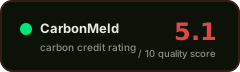
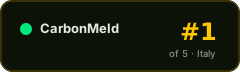
AgroEcology_Italy
Score Breakdown
Integrity
verified The validation/verification chain indicates additionality was confirmed by the VVB (validation report).
missing Baseline method and leakage treatment are not stated/are not addressed in the extracted record (PDD/monitoring report).
Transparency
verified A specific monitoring period is disclosed (monitoring report, 2024-04-29).
missing Quantified claimed vs verified results are not available in the extracted record, limiting MRV transparency (monitoring report).
Claim Safety
missing CORSIA eligibility and CCP status are not stated in the extracted record, increasing uncertainty for downstream claims (registry/standard records not found).
missing Leakage is not addressed and the baseline approach is not stated, elevating over-crediting risk for soil carbon credits (PDD/monitoring report).
Documentation
verified Core document types are present (PDD, validation report, monitoring report).
inferred Extraction confidence is only medium and several key fields are missing, suggesting incomplete/unclear source text or gaps in disclosed content.
Detailed Analysis
Integrity
Additionality is indicated as confirmed by the VVB (validation report), which supports integrity. However, the baseline approach is not stated in the extracted record (PDD/validation/monitoring), and leakage is explicitly marked as not addressed (monitoring report), both of which are material weaknesses for an agriculture/soil carbon project. No buffer pool contribution or reversal monitoring outcomes are provided in the extracted record, leaving permanence risk management unclear.
Transparency
The monitoring report clearly states the monitoring period (2022-01-01 to 2023-12-31) and identifies the VVB as Carbon Check (India) Private Limited. But the extracted record does not include total claimed or verified ER/ERR quantities for that period, preventing an external reader from checking whether issuance aligns with monitored outcomes. Registry completeness is also limited because key eligibility/status fields are not stated.
Claim Safety
Because the baseline method is not stated and leakage is not addressed, there is elevated risk that credited soil carbon outcomes could be overstated relative to a credible counterfactual (PDD/monitoring report). CORSIA eligibility and CCP status are not stated in the extracted record, so buyers cannot easily determine whether additional claim constraints apply. The absence of quantified verified totals in the extracted record further increases greenwashing risk for public claims tied to specific volumes.
Documentation
Three core documents are listed (PDD, validation report, monitoring report), and the monitoring report is recent (2024-04-29). Still, many key decision-useful fields (baseline method, leakage deduction, reversals/buffer pool, and verified totals) are not present in the extracted record, reducing confidence in completeness. Medium extraction confidence also warrants caution that some details may be missing or unclear in the underlying files.
Overall
No contradictions were identified in the extracted record, so there is no need to privilege one document over another. The main limitation is evidence gaps: baseline and leakage treatment are not available/are not addressed, and quantified claimed/verified results are missing for the stated monitoring period. These gaps materially weaken integrity and claim safety, keeping the overall score in the mid-low range.
Audit Analysis
This soil carbon project has some credibility signals (a named VVB and no reported material findings), but key integrity-critical elements are missing from the extracted record. In particular, the baseline approach, leakage treatment, and quantified results for the monitoring period are not stated, which increases over-crediting and greenwashing risk.
Project Description
This project is dedicated to transforming local agriculture by encouraging sustainable practices among farmers, reducing dependence on synthetic fertilisers and pesticides, enhancing soil organic matter, promoting efficient recycling of organic materials, and regenerating degraded land through agroforestry. These efforts aim not only to improve environmental well-being but also to enhance the economic sustainability of the region’s agriculture by reducing reliance on EU subsidies. Designed as a grouped project for registration with its initial instance, the initiative is poised for significant expansion, targeting an increase to at least 25,000 hectares of cultivated land by the end of 2024. The ambition is to grow by an additional 25,000 hectares each year, aiming to cover a minimum of 200,000 hectares by 2030. The project is expected to generate a total of 51,420,690 tCO2e over a 45-year period (2022-2066), with an average annual reduction of 1,142,682 tCO2e. Initial monitoring has already confirmed the effective sequestration of 8,044 tCO2e across 67 farms who manage a combined area of 1,474.89 hectares from January 2022 to December 2023, demonstrating alignment with the project’s ambitious environmental objectives. Furthermore, an additional 1,367 farmers have committed to adopting similar practices and farmers onboarding is underway as of 2024. At the heart of Alberami’s mission is the goal to mitigate carbon emissions while boosting the prosperity of local landscapes and communities through sustainable, scientifically-supported methods. The project adheres to the International Carbon Registry standards under ISO 14064-2 and incorporates the LIFE C-Farms methodology, benefiting from collaborations with Italian universities, research institutions, and industry partners. This methodology, co-financed by the 2020 LIFE Programme of the European Commission (LIFE20 PRE IT/017), is complemented by elements from Verra's VM0042 v2.0: A Verifie
Red Flags
- Baseline approach and any baseline reassessment timing are not stated in the extracted record (PDD/validation/monitoring).
- Leakage is marked as not addressed, with no leakage deduction reported for an agriculture/soil carbon activity.
- No verified or claimed emission reduction/removal totals are provided for the 2022–2023 monitoring period.
Credit Vintages
Nessuna emissione registrata sul registro.
Il marketplace dichiara i vintage: 2023 (non verificato).
Cosa migliorerebbe questo punteggio
- Disclose the baseline approach used under VM0042 v4.0 and when it was last reassessed, with enough detail to reproduce baseline calculations (PDD/monitoring annexes).
- Provide a clear leakage assessment (sources, quantification, and any deduction) appropriate to the agricultural practices and geography, and report verified net credited tonnes for 2022–2023.
Questi suggerimenti indicano quali prove pubbliche aggiuntive potrebbero migliorare il livello di confidenza di questa valutazione. Non garantiscono un punteggio futuro più alto.
Risk Indicators
VVB-confirmed additionality
Reversal/buffer approach unclear
Leakage not addressed
Baseline method not stated
Safeguards mentioned but incomplete
CORSIA/CCP status not stated
Where to buy
Marketplaces
+ Know where to buy this?
Listing multiple projects? Send us a CSV at [email protected].
⚑ Dispute this rating
Sei il proprietario di questo progetto?
Correzione metadati (gratuita)
Nome, paese, marketplace o link errati? Segnalacelo.
Non modifica lo score.
[email protected] →Rivalutazione con nuovi documenti
Hai documentazione aggiornata non ancora inclusa? Puoi richiedere un nuovo run della pipeline con i nuovi input.
Invia Documenti →