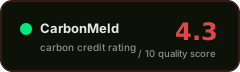
Avoidance of Methane Emissions at Organic Compost Soil Amendment Facility
Score Breakdown
Integrity
verified Additionality was confirmed by the VVB using an investment test, which is stronger than an unverified claim.
missing The verification report recorded material findings on green waste handling and calculation methods, and reversal risk is not addressed.
Transparency
verified The monitoring period, verifier name, and methodology version are stated in the available documents.
missing Claimed versus verified ER totals are not provided, and key operational details such as usage monitoring and FNRB inputs are not stated.
Claim Safety
verified Leakage was quantified with a 0% deduction, which reduces the risk of hidden emissions shifting.
missing The project uses a project-specific baseline and the verification findings raise concerns about the accuracy of the waste input calculations.
Documentation
verified Multiple official documents were available, including the PDD, monitoring report, and verification report, and extraction confidence is high.
missing The crediting period and monitoring period do not align cleanly, and some important fields remain unstated in the extracted record.
Detailed Analysis
Integrity
The project’s integrity is supported by VVB-confirmed additionality through an investment test and a quantified leakage deduction of 0% in the verification report. That said, the verification report also records material findings about green waste being included in calculations even though not all received waste was used, and the reversal risk is not addressed because reversal events are marked as not addressed and no buffer pool is stated.
Transparency
Transparency is moderate because the monitoring period, verifier name, methodology version, and registry are identified in the available documents. However, the record does not provide claimed or verified ER totals, and several operational fields such as usage monitoring and FNRB inputs are not stated, which limits auditability.
Claim Safety
Claim safety is weakened by the verification findings that question the accuracy of waste accounting and the source/location information for purchased green waste. The project does benefit from a quantified leakage treatment and a project method baseline, but the absence of verified usage-rate details and the calculation concerns increase over-crediting risk.
Documentation
Documentation quality is fair because multiple official documents were used and extraction confidence is high. Still, some key items are missing from the extracted record, including buffer pool information, verified totals, and several monitoring inputs, so the evidence set is incomplete for a high-confidence assessment.
Overall
I privileged the verification report over the earlier PDD where the documents conflict, because it is more recent and directly reflects the monitored period; that means I treated leakage as quantified, additionality as investment-test based, and the crediting period as the monitoring-period slice rather than the full PDD period. The contradictions matter: the PDD and verification report differ on additionality framing, leakage treatment, and crediting period, which lowers reliability and keeps the score below a strong-investment grade. Under the deterministic gate rules, the integrity score remains above 4.0 so no overall cap is triggered, but the unresolved accounting findings and missing claim totals still constrain confidence.
Audit Analysis
The project has some strengths: additionality was confirmed by the VVB, leakage was quantified at 0%, and safeguards such as FPIC and a grievance mechanism are documented. However, the record also shows material verification issues around waste accounting and missing details on sourcing and calculations, which reduce confidence in the claimed emission reductions.
Project Description
Developer: GEC Organics Type: Other Size: Large scale Methodology: ACM0010 GHG emission reductions from manure management systems Crediting period: 2014-01-06 → 2021-12-31 Estimated annual credits: 201712 tCO2e SDGs: Goal 3: Good Health and Well-Being, Goal 13: Climate Action, Goal 12: Responsible Production and Consumption
Red Flags
- The verification report lists material findings about green waste accounting and unclear calculation inputs, suggesting possible over-crediting risk.
- The project is marked as CORSIA-eligible while CCP status is not mentioned, leaving some dual-claim uncertainty.
Credit Vintages
| Issued | Retired | Available | ||
|---|---|---|---|---|
| 2015 | 5,352 | 5,258 | 94 | |
| Total | 5,352 | 5,258 | 94 |
Cosa migliorerebbe questo punteggio
- Provide a reconciled emissions table showing claimed versus verified reductions and the exact calculation inputs used for waste quantities.
- Document reversal management and permanence protections, including whether a buffer pool applies and how any future reversals would be handled.
Questi suggerimenti indicano quali prove pubbliche aggiuntive potrebbero migliorare il livello di confidenza di questa valutazione. Non garantiscono un punteggio futuro più alto.
Risk Indicators
VVB-confirmed investment test
No buffer pool stated
Quantified 0% deduction
Project baseline, reassessment not stated
FPIC and grievance mechanism documented
CORSIA-eligible; CCP status not mentioned
Where to buy
+ Know where to buy this?
Listing multiple projects? Send us a CSV at [email protected].
⚑ Dispute this rating
Sei il proprietario di questo progetto?
Correzione metadati (gratuita)
Nome, paese, marketplace o link errati? Segnalacelo.
Non modifica lo score.
[email protected] →Rivalutazione con nuovi documenti
Hai documentazione aggiornata non ancora inclusa? Puoi richiedere un nuovo run della pipeline con i nuovi input.
Invia Documenti →