China Guangdong Shenzhen Qianwan LNG Generation Project
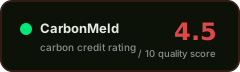
Score Breakdown
Integrity
verified Additionality was confirmed by the VVB using an investment test (validation report, 2009-09-21).
missing Baseline and key quantification inputs show contradictions (grid emission factor and ER totals), and baseline reassessment timing and leakage deduction are not stated in the extracted record.
Transparency
verified Monitoring period and methodology are clearly identified (monitoring report, 2009-07-28; AM0029 v01.1).
missing Core accounting figures are inconsistent across extracted documents (ER totals, grid emission factor, crediting period), reducing MRV transparency.
Claim Safety
verified The project is stated as not CORSIA-eligible, reducing some downstream claim risk (registry extract).
missing Over-crediting risk is elevated due to contradictory ER totals and grid emission factors, plus unclear leakage deduction despite leakage being discussed.
Documentation
verified Multiple core documents are available (PDD, validation report, monitoring report) and extraction confidence is high.
missing Contradictions across documents suggest document control/versioning problems, lowering confidence despite the document set.
Detailed Analysis
Integrity
The validation report (2009-09-21) confirms additionality using an investment test, which supports additionality robustness. However, the baseline is project-specific and the timing of any baseline reassessment is not stated in the extracted record, which weakens baseline credibility over time. Leakage is described as “quantified” in the monitoring report (2009-07-28), but the actual leakage deduction percentage is not found in the extracted record, limiting confidence in net ERs. No material findings or corrective actions are reported, but the numerous quantification contradictions reduce confidence in integrity.
Transparency
The monitoring report (2009-07-28) clearly states the monitoring period (2008-10-01 to 2009-05-11) and the project applies methodology AM0029 version 01.1, which helps traceability. Still, the extracted record contains conflicting ER totals and grid emission factors attributed to the validation report (2009-09-21), which undermines transparency of the MRV calculations. The crediting period is also inconsistent across monitoring reports (2009-07-28 vs 2008-10-12), making it harder to reconcile what period was actually credited.
Claim Safety
The project is indicated as not CORSIA-eligible, which reduces the risk of certain high-stakes aviation claims. However, claim safety is weakened by major inconsistencies in the quantified outcomes: the validation report (2009-09-21) is associated with two different ER totals and two different grid emission factors in the extracted record, which raises over-crediting and misstatement risk. Leakage is treated inconsistently between the PDD (2009-04-23) and monitoring report (2009-07-28), and the absence of a stated leakage deduction percentage further increases uncertainty around the credited volume.
Documentation
The extracted record includes a PDD (2009-04-23), monitoring report (2009-07-28), and validation report (2009-09-21), with a relatively high number of documents used (7) and high extraction confidence. Despite this, the presence of multiple contradictions across documents suggests weak version control or inconsistent reporting, which reduces the practical reliability of the documentation set. Safeguard-related elements (FPIC and grievance mechanism) are not evidenced in the extracted record, further limiting completeness for non-carbon aspects.
Overall
I privileged the ER total of 308,576 because it matches between claimed and verified values in the extracted record and aligns with the monitoring/crediting timeframe shown in the 2009 monitoring report, whereas 1,577,524 appears as an outlier despite being attributed to the same-dated validation report (2009-09-21); this unresolved internal inconsistency materially lowers confidence. For the grid emission factor, I used 0.5772 because it is the value carried in the merged facts and is paired with the lower ER total, but the competing 0.6816 value (also attributed to the same validation report date) indicates calculation ambiguity and increases over-crediting risk. For leakage, I treated it as “quantified” (monitoring report, 2009-07-28) rather than “deemed negligible” (PDD, 2009-04-23) because monitoring reports are closer to actual implementation, but the missing leakage deduction percentage remains a key gap. For safeguards, I treated safeguards as not evidenced overall because the monitoring report does not mention them and FPIC/grievance are not supported in the extracted record, despite the PDD indicating safeguards were mentioned.
Audit Analysis
The project has VVB-confirmed additionality via an investment test and reports no material findings or corrective actions. However, multiple internal inconsistencies across documents (including two different ERR totals and two different grid emission factors in the same-dated validation report) materially weaken confidence in the quantified results and increase over-crediting risk.
Project Description
The Qianwan LNG Generation Project (QLGP) constructed a high-efficiency LNG CCGT plant with a capacity of 1083.09 MW, generating 3700 GWh of electricity annually and reducing CO2 emissions in China Southern Power Grid. By using LNG and CCGT, the QLGP offers an environmentally friendly way to generate electricity, producing positive environmental and economic benefits while contributing to local sustainable development.
Red Flags
- Same-dated validation report shows conflicting values for both verified/claimed ERs (308,576 vs 1,577,524) and the grid emission factor (0.5772 vs 0.6816), indicating serious internal data reliability issues.
- Leakage treatment is inconsistent between the PDD (deemed negligible) and the monitoring report (quantified), but the actual leakage deduction is not stated in the extracted record.
- Safeguards are inconsistently described (PDD mentions safeguards, monitoring report does not), and FPIC/grievance mechanism are not evidenced in the extracted record.
Credit Vintages
| Issued | Retired | Available | ||
|---|---|---|---|---|
| 2006 | 33,183 | 33,183 | 0 | |
| 2007 | 1,303,807 | 709,947 | 593,860 | |
| 2008 | 803,782 | 753,782 | 50,000 | |
| 2009 | 191,963 | 191,858 | 105 | |
| Total | 2,332,735 | 1,688,770 | 643,965 |
Cosa migliorerebbe questo punteggio
- Provide the final, version-controlled validation/verification package (including calculation spreadsheets) that reconciles the ER total and grid emission factor to a single authoritative set of values.
- Disclose the quantified leakage deduction (percentage and calculation) and align leakage treatment consistently between the PDD and monitoring report.
- Document and publish safeguard evidence (FPIC process, grievance mechanism, stakeholder consultation outcomes) and ensure consistent reporting across project documents.
Questi suggerimenti indicano quali prove pubbliche aggiuntive potrebbero migliorare il livello di confidenza di questa valutazione. Non garantiscono un punteggio futuro più alto.
Risk Indicators
VVB-confirmed investment test
Avoidance project; no reversal events reported
Leakage discussed but deduction unclear/inconsistent
Project-specific baseline; reassessment timing unclear
FPIC/grievance not evidenced; inconsistent safeguards mention
Not CORSIA-eligible; CCP status not stated
Where to buy
Marketplaces
+ Know where to buy this?
Listing multiple projects? Send us a CSV at [email protected].
⚑ Dispute this rating
Sei il proprietario di questo progetto?
Correzione metadati (gratuita)
Nome, paese, marketplace o link errati? Segnalacelo.
Non modifica lo score.
[email protected] →Rivalutazione con nuovi documenti
Hai documentazione aggiornata non ancora inclusa? Puoi richiedere un nuovo run della pipeline con i nuovi input.
Invia Documenti →