Clean Cooking Programme Uganda
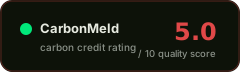
Score Breakdown
Integrity
verified additionality confirmed by the VVB in the validation report (validation report, 2025-09-05)
missing leakage treatment is unclear: leakage justification 'not addressed' in the validation report and no buffer pool percentage stated (validation report, 2025-09-05)
Transparency
verified VVB named and recent monitoring period provided (monitoring period 2024, VVB: 4K Earth Science Private Limited, validation report 2025-09-05)
missing total emissions reductions claimed not found in the record while verified ERR is present (total ERR claimed not stated; total ERR verified = 785,635)
Claim Safety
verified additionality tested with a combined test and confirmed by the VVB (validation report, 2025-09-05)
missing usage monitoring relies on self-reporting per the validation report and the usage rate is not quantified in available documents, increasing over-crediting risk
Documentation
verified multiple documents used (n_docs_used = 15) and a recent validation report exists (2025-09-05)
missing extraction confidence is low and evidence_docs include unspecified items, indicating gaps in the available record
Detailed Analysis
Integrity
The validation report (2025-09-05) confirms additionality using a combined test and the VVB has validated that result, which supports integrity. However, the project uses a project-specific baseline method and baseline reassessment timing is not stated in the available records. Leakage treatment is inconsistent: the validation report states leakage justification is not addressed, and no buffer pool percentage is given, which is a material gap for an avoidance cookstove project. There are no reversal events reported, and no corrective actions or material findings listed in the validation report.
Transparency
Transparency is mixed: the VVB is named (4K Earth Science Private Limited) and a recent monitoring period is provided (2024), and total emissions reductions verified (785,635) are present. But total emissions claimed is not found, registry details are minimal beyond Gold Standard and some evidence documents are 'unknown'. Low extraction confidence further reduces trust in the completeness of disclosed data.
Claim Safety
Claim safety is weakened by reliance on national default factors (fnrb value 0.39) rather than conservative project-specific factors, and the usage monitoring method is reported as self-report in the validation report, with the usage rate itself not found in the records. CORSIA/CCP status is not stated, so double-claim risk cannot be ruled out. These factors raise the possibility of over-crediting.
Documentation
Documentation has strengths (15 documents used, a recent validation report, no material findings or corrective actions listed, FPIC and grievance mechanism documented). However, minimum extraction confidence is low and several important fields are missing or listed as unknown (buffer pool pct, baseline reassessment, grid emission factor), reducing the documentation score.
Overall
I privileged the validation report (validation report, 2025-09-05) as the authoritative source because it is the most recent and is explicitly cited in the merged record. The contradictions list contains three items: leakage justification (validation report says not addressed; another document dated 2025-08-28 reportedly says quantified), usage monitoring method (validation report: self-report; another doc: annual_survey), and crediting period (validation report gives 2023–2028; another doc gives 2021–2040). I privileged the validation report values because it is more recent and explicit in the extracted record, but the existence of contradictory documents (some of which are unnamed) and the low extraction confidence reduce my trust in the data and have been reflected by downward adjustments to transparency, claim safety, and documentation. Overall score reflects confirmed additionality but notable gaps and contradictions that limit confidence in the project's reported emission reductions.
Audit Analysis
The project shows some strengths (VVB-confirmed additionality, FPIC and grievance mechanism, recent validation report) but has significant evidence gaps and contradictions around leakage, monitoring method and crediting period. Low extraction confidence and missing quantifications (buffer, baseline reassessment, usage rates) reduce overall confidence in claimed emissions reductions.
Project Description
In Uganda, over 96% of the population is dependent on dirty, unsustainable biomass for cooking. This is driving significant deforestation, and the country is now facing a projected future wood biomass deficit of over 100 million tonnes annually. Much of the population experiences energy poverty, spending significant amounts of their monthly income on expensive charcoal, also known as 'black gold'. The problem is that there is no affordable, accessible alternative cooking solution, and households remain trapped using basic, inefficient stoves that need replacing every few months. At Community Carbon, we deliver cleaner cookstoves to households in Uganda who are dependent on burning charcoal for cooking. Our stoves, manufactured locally in Uganda, have improved thermal efficiency and durability, reducing the amount of charcoal required for daily cooking, thereby reducing demands on vulnerable forests, reducing emissions, and improving lives. Our project is designed to fight energy poverty by stimulating community development, well-being, and creating tangible co-benefits that build greater climate resilience. We go outside of the initial project's scope and impact by reinvesting a portion of the carbon credit revenue back into the communities via the Climate Resilience Impact Fund . This Fund invests in programmes that empower and educate women and girls, recognising their vital role in combating climate change. At Community Carbon, we value quality and credibility. We uphold meticulous procedures that guarantee high-quality carbon credits, quantifying emissions reductions precisely and transparently. This is made possible by managing the end-to-end project development process on the ground with a team directly employed to manufacture the project from manufacturing and distribution through to specialists who work to monitor and record stove usage during their lifetime. Project Impacts and Benefits This community focused project delivers impacts f
Red Flags
- leakage justification reported as not addressed in the validation report (contradiction with a later document claiming quantified leakage)
- min_extraction_confidence is low and some source documents are listed as unknown or missing
Credit Vintages
Nessuna emissione registrata sul registro.
Il marketplace dichiara i vintage: 2022 (non verificato).
Cosa migliorerebbe questo punteggio
- Provide the missing documents cited as 'unknown' and resolve contradictions by issuing a consolidated, dated report reconciling leakage, monitoring method and crediting period.
- Disclose quantitative monitoring details: verified usage rates, buffer pool percentage or reversal treatment, baseline reassessment timing, and a clear statement on CORSIA/CCP eligibility.
Questi suggerimenti indicano quali prove pubbliche aggiuntive potrebbero migliorare il livello di confidenza di questa valutazione. Non garantiscono un punteggio futuro più alto.
Risk Indicators
VVB-confirmed
buffer unknown
justification missing
project baseline
FPIC and grievance present
status not stated
Where to buy
Marketplaces
+ Know where to buy this?
Listing multiple projects? Send us a CSV at [email protected].
⚑ Dispute this rating
Sei il proprietario di questo progetto?
Correzione metadati (gratuita)
Nome, paese, marketplace o link errati? Segnalacelo.
Non modifica lo score.
[email protected] →Rivalutazione con nuovi documenti
Hai documentazione aggiornata non ancora inclusa? Puoi richiedere un nuovo run della pipeline con i nuovi input.
Invia Documenti →