Dongfang Minsheng Balikun Santanghu Phase IV 49.5 MW Wind Power Project
#428of 1935 in Renewable energy#165of 1084 in China#274of 1459 in CDM (UNFCCC)#317of 1287 in ACM0002
Audit Analysis
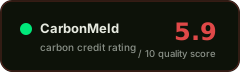
A standard 49.5 MW onshore wind project in China validated by DNV under CDM methodology ACM0002, with a combined additionality test and jurisdictional grid baseline. The project carries low inherent permanence risk as an avoidance-type wind installation, but the available record contains no monitoring or verification data, and two document-level discrepancies (leakage treatment and ERR magnitude) require reconciliation. Overall a credible but data-thin project file.
Red Flags
- No monitoring reports or verified ERR figures are present in the extracted record; the crediting period (2014–2020) has ended without visible verification data.
- The PDD states a total ERR of 706,251 tCO₂e while the validation report states 100,893 tCO₂e; although the ratio (≈7×) is consistent with a 7-year crediting period, the discrepancy was not explicitly reconciled in the documents.
- Leakage treatment is described as 'deemed negligible' in the validation report but as 'quantified' in an earlier appendix, creating ambiguity about whether a quantitative leakage analysis was actually performed.
- No buffer pool, permanence mechanism, or reversal-risk mitigation is documented, despite the absence of a formal buffer being less critical for wind.
Credit Vintages
No issuances recorded on the registry.
Risk Indicators
Combined test, VVB-confirmed (DNV)
mixed evidence / unresolved risk
0% deemed negligible; doc inconsistency on quantification
Jurisdictional grid EF (0.89635, 2012)
Safeguards mentioned, benefit sharing described; no FPIC or
CORSIA and CCP status not stated
⚑ Dispute this rating
Are you the project owner?
Metadata correction (free)
Name, country, marketplace or links incorrect? Let us know.
Does not modify the score.
[email protected] →Pipeline re-run with new documents
Have updated documentation not yet included? You can request a new run of the pipeline with the new inputs.
Submit Documents →Share this rating