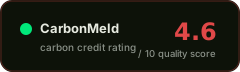
GS1247 VPA 49 Improved Kitchen Regimes:Kaliro Safe Water Project
GS-808 ↗ · current registry ID: GS4553
#830of 1329 in Industrial#104of 163 in Uganda#1229of 1801 in Gold Standard (GS)
Audit Analysis
The Kaliro Safe Water Project (VPA 49) is a Gold Standard energy-efficiency project displacing thermal energy for water heating, with VVB-confirmed additionality and no reversal events. However, the project is undermined by a 0% leakage deduction with an internally contradictory justification, a project-specific baseline, over 50 corrective actions and clarifications flagging calculation errors and data inconsistencies, and 12 documented contradictions across verification, monitoring, and design documents. The overall picture is of a project with a sound conceptual design but weak execution and documentation quality.
Red Flags
- Leakage deduction of 0% in the 2024 verification report contradicts the 5% stated in the PDD, and the justification shifts between 'quantified' (verification report) and 'deemed negligible' (monitoring report) — a water project where users may revert to alternative water sources warrants a non-zero deduction
- Crediting period (2014–2021 per the 2022 verification report; 2015–2022 per the 2024 monitoring report) ends before the 2023–2024 monitoring period, raising questions about whether credits are being issued outside the approved crediting window
- ERR figures differ by a factor of ~5 between the 2023 verification report (3,054) and the 2024 verification report (592); if these cover comparable two-year periods this represents an ~81% decline, though the 2023 figure may cover both VPAs (35 and 49) combined
- Over 50 corrective actions and clarifications were raised, including errors in ER calculation sheets, inconsistent monitoring period references, incorrect fNRB sourcing, and missing monitoring evidence — indicating systemic documentation and calculation weaknesses
- CCP status and CORSIA eligibility are not stated in any available document, leaving the double-claiming risk unassessed
Credit Vintages
| Issued | Retired | Available | ||
|---|---|---|---|---|
| 2015 | 1,257 | 1,257 | 0 | |
| 2016 | 10,003 | 10,003 | 0 | |
| 2017 | 10,000 | 10,000 | 0 | |
| 2018 | 10,000 | 10,000 | 0 | |
| 2019 | 8,411 | 8,411 | 0 | |
| 2020 | 2,731 | 2,319 | 412 | |
| 2021 | 1,948 | 1,406 | 542 | |
| 2022 | 1,315 | 0 | 1,315 | |
| Total | 45,665 | 43,396 | 2,269 |
Risk Indicators
VVB-confirmed combined test
mixed evidence / unresolved risk
0% deduction, contradictory justification
Project-specific, fNRB locally measured
FPIC, grievance mechanism, benefit sharing documented
CCP and CORSIA status not stated
⚑ Dispute this rating
Are you the project owner?
Metadata correction (free)
Name, country, marketplace or links incorrect? Let us know.
Does not modify the score.
[email protected] →Pipeline re-run with new documents
Have updated documentation not yet included? You can request a new run of the pipeline with the new inputs.
Submit Documents →Share this rating