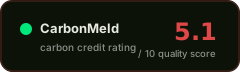
GS1729 Myanmar Stoves Campaign - Soneva in Myanmar - VPA No. 009
Score Breakdown
Integrity
verified Additionality confirmed by the VVB (verification report; VVB: Ecolance)
missing Reversal risk not addressed and buffer pool percentage not stated, baseline last reassessed in 2018 (monitoring/PDD documents)
Transparency
verified VVB named (Ecolance) and monitoring period provided (2022-01-01 — 2023-06-30)
missing Key ERR figures and total ERR claimed/verified are not in the extracted record and evidence docs are listed as unknown; extraction confidence is low
Claim Safety
verified Leakage was quantified with a leakage deduction reported (0.95) and a quantified justification
missing Large contradictions in monitored usage rates (52.63% vs 92.3%) increase over-crediting risk; CORSIA/CCP status not stated
Documentation
verified A named VVB and 20 documents were used for extraction; methodology and version cited (Gold Standard Simplified Methodology, Feb 2013)
missing Min extraction confidence is low, evidence docs are not clearly identified, and some fields (total ERR claimed/verified, buffer pool) are missing
Detailed Analysis
Integrity
The verification report confirms additionality using a combined test and names Ecolance as the VVB, which supports the project's additionality claim. The project uses a project-specific baseline (Gold Standard cookstoves methodology) with the last reassessment dated 2018, which is somewhat dated. Leakage is treated (quantified justification and a leakage deduction reported), but reversal risk is flagged as not addressed and no buffer pool percentage is provided in the extracted record. These issues lower confidence in permanence and baseline robustness.
Transparency
A named VVB (Ecolance), monitoring period (2022-01-01 to 2023-06-30), and methodology/version are present in the extracted data, which helps transparency. However, total ERR claimed and total ERR verified are not found in the extracted record, evidence documents are listed as unknown, and the minimum extraction confidence is low — all of which reduce traceability and public verification of claims.
Claim Safety
Leakage appears to be quantified and a leakage deduction is reported, which is positive. However, there are substantial contradictions in verified usage rates (52.63% in a 2024-dated source versus 92.3% in a 2017 source), creating a material over-crediting risk. CORSIA and CCP eligibility are not stated, leaving double-claim risk unclear.
Documentation
The extraction used 20 documents and cites the methodology and a VVB, and safeguards (FPIC, grievance mechanism) are documented. Nevertheless, the evidence_docs field is 'unknown', min_extraction_confidence is low, and some critical fields (ERR totals, buffer pool percent) are missing. No material findings or corrective actions are listed in the extracted record, but the low extraction confidence suggests caution.
Overall
I privileged the more recent document values where contradictions exist because they are more likely to reflect current monitoring and verification: for usage monitoring method I privileged 'annual_survey' from the 2024-04-03 source over an earlier 'self_report' (2022-08-23); for usage rate I privileged 52.63 from 2024-04-03 over 92.3 from 2017-06; for crediting period I privileged the 2022-03-08 — 2027-03-07 period from 2023-04-26 over the earlier 2017–2022 period. These contradictions, plus the low extraction confidence, reduce score credibility and have been factored into lower integrity and claim safety scores. Overall, the project demonstrates procedural elements consistent with a legitimate GS cookstoves activity but suffers from data gaps, contradictory monitored values, and limited extractable public documentation that together constrain confidence in claimed emission reductions.
Audit Analysis
The project shows some procedural strengths (additionality confirmed by a VVB, FPIC and grievance mechanism documented) but has notable data reliability and documentation gaps. Contradictory monitoring figures, low extraction confidence, an older baseline reassessment (2018) and unaddressed reversal risk reduce confidence in robustness and crediting safety.
Project Description
Developer: Soneva Foundation Type: Energy Efficiency - Domestic Size: Micro Scale Crediting period: 2018-02-01 → 2023-01-31 Estimated annual credits: 10000 tCO2e SDGs: Goal 8: Decent Work and Economic Growth, Goal 3: Good Health and Well-Being, Goal 7: Affordable and Clean Energy, Goal 13: Climate Action
Red Flags
- Contradictory verified usage rates (52.63% vs 92.3%) implying possible over-crediting
- Min extraction confidence is low and evidence documents are not clearly identified
Credit Vintages
Nessuna emissione registrata sul registro.
Cosa migliorerebbe questo punteggio
- Publish clear evidence documents (verification/monitoring reports) with ERR totals and a clear list of evidence sources to raise extraction confidence
- Resolve contradictions by confirming the verified usage monitoring method and final verified usage rate in a recent VVB report, and disclose buffer pool/reversal treatment
Questi suggerimenti indicano quali prove pubbliche aggiuntive potrebbero migliorare il livello di confidenza di questa valutazione. Non garantiscono un punteggio futuro più alto.
Risk Indicators
VVB-confirmed
reversal risk unaddressed
quantified deduction
project baseline; reassessed 2018
FPIC & grievance present
CORSIA/CCP status unknown
Where to buy
+ Know where to buy this?
Listing multiple projects? Send us a CSV at [email protected].
⚑ Dispute this rating
Registry Documents
monitoring
- (1)VPA 009 (GS 6599) - (Third Term) - GS4GG Monitoring Report.V3.pdf
- Monitoring Report_2nd monitoring period_01.02.2019 to 31.01.2020_v2.pdf
- VPA 009-Project-Annual-Report-Form(2).pdf
- Monitoring Report_1st monitoring period_01.02.2018 to 31.01.2019_v2.pdf
- VPA 009 (GS6599) - Ex Post Emission Reductions Sheet (Fourth Term).xlsx
- VPA 009-Project-Annual-Report-Form(1).pdf
- +1 more
registry_page
Sei il proprietario di questo progetto?
Correzione metadati (gratuita)
Nome, paese, marketplace o link errati? Segnalacelo.
Non modifica lo score.
[email protected] →Rivalutazione con nuovi documenti
Hai documentazione aggiornata non ancora inclusa? Puoi richiedere un nuovo run della pipeline con i nuovi input.
Invia Documenti →