Vai al contenuto principale
VCS avoidance China Registry: Registered Documentazione completa General Methodology v2.0

Guohua Rongcheng Phase II Wind Farm Project

VCS-1301 ↗

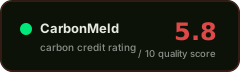
5.8 / 10
Integrity
5.2
Transparency
6.1
Claim Safety
5.4
Documentation
7.2

Score Breakdown

Integrity

verified Additionality is confirmed by the VVB using an investment test (validation report, 2023).

missing Baseline/quantification reliability is weakened by contradictions in grid emission factor and ER totals across validation reports (2022 vs 2023).

Transparency

verified Key MRV elements are present (methodology ACM0002 v20.0, monitoring period 2020–2022, VVB identified as CCSC) in the 2023 monitoring/validation package.

missing Conflicting figures and periods across documents reduce traceability of what was actually monitored and verified.

Claim Safety

verified Project is explicitly not CORSIA-eligible, reducing aviation-claim channel risk (registry extract).

missing Over-crediting risk is elevated by inconsistent ER totals and changing grid emission factors across validation reports (2022 vs 2023).

Documentation

verified Document set is relatively complete (PDD, monitoring report, validation report, issuance) with 25 documents used and high extraction confidence.

missing Multiple corrective actions (including LoA/MoC and grid EF procedure alignment) indicate earlier documentation/eligibility weaknesses that required fixes (monitoring report, 2023).

Detailed Analysis

Integrity

The validation report (2023-05-15) confirms additionality via an investment test, which supports additionality robustness. However, quantification integrity is undermined by contradictions between validation reports on both the grid emission factor (0.9502 in 2022-12-19 vs 0.8269 in 2023-05-15) and the verified ER total (68,535 in 2022-12-19 vs 173,441 in 2023-05-15). Leakage is applied as a 0% deduction, but the latest monitoring report (2023-05-13) does not provide a leakage justification, weakening confidence in the leakage assessment.

Transparency

The monitoring report (2023-05-13) provides a clear monitoring period (2020-06-30 to 2022-07-31) and the project uses a well-known grid-connected renewable methodology (ACM0002 v20.0). The VVB is identified (CCSC) and the extracted record includes both claimed and verified ERs for the current package. Transparency is reduced by conflicting ER totals and crediting-period statements across documents, making it harder for third parties to reconcile what was verified for which period.

Claim Safety

The project is stated as not CORSIA-eligible, which lowers the risk of aviation-related double-claim pathways. Nonetheless, the large spread in ER totals across validation reports (88,413 in 2014; 68,535 in 2022; 173,441 in 2023) and the change in grid emission factor between 2022 and 2023 increase perceived over-crediting/greenwashing risk unless clearly explained in the public record. Leakage treatment is also a weak point because the latest monitoring report does not address leakage justification while still applying 0% leakage deduction.

Documentation

The extracted record indicates a relatively robust document set (PDD, monitoring report, validation report, issuance) with 25 documents used and high extraction confidence. However, the monitoring report (2023-05-13) lists multiple corrective actions, including alignment of the grid EF procedure with China DNA guidance and requests related to LoA/MoC and CDM consideration evidence, indicating earlier documentation gaps. These issues do not necessarily invalidate the project, but they reduce confidence that the documentation trail has been consistently strong over time.

Overall

I privilege the more recent 2023 documents where conflicts exist (e.g., ER total 173,441 and grid EF 0.8269 from the 2023 validation report; crediting period 2020–2030 from the 2023 monitoring report) because they are later in time and appear to reflect updated determinations. However, the magnitude of the contradictions—especially ER totals (2014 vs 2022 vs 2023) and the crediting-period mismatch (2010–2020 vs 2020–2030)—signals data reliability and traceability problems that warrant a material score penalty. The safeguards-related contradictions (FPIC, grievance mechanism, benefit sharing) are also concerning because earlier monitoring (2014) indicates they were absent while the 2023 monitoring report indicates they are present, suggesting either changes over time or inconsistent reporting that should be clarified.

Audit Analysis

This VCS wind project has VVB-confirmed additionality and a recent monitoring/verification package, but several cross-document inconsistencies (ERR totals, grid emission factor, and even the crediting period) weaken confidence in the quantified results. Leakage treatment is weakly evidenced in the latest monitoring record, and multiple corrective actions indicate earlier documentation and eligibility gaps that required remediation.

Project Description

This carbon project was registered as a CDM project on June 22, 2011, and will use a renewable crediting period of 3x7 years under the CDM GHG program starting from June 25, 2011. The CO2 emission reductions generated from the project during this period will be verified as unique CERs to avoid double counting. Only emission reductions achieved from June 30, 2010 to June 21, 2011, will be considered as VCUs under VCS (Version 3.4).

Red Flags

  • Major inconsistencies across reports on verified/claimed ERs (173,441 vs 68,535 vs 88,413) and on the grid emission factor (0.8269 vs 0.9502), increasing over-crediting risk.
  • Crediting period is inconsistent across monitoring records (2010–2020 vs 2020–2030), creating uncertainty about what period the ERs relate to.
  • Latest monitoring record does not address leakage justification while applying a 0% leakage deduction.

Credit Vintages

Issued Retired Available
2010
88,413 88,413 0
2014
183,100 174,752 8,348
2015
183,888 183,888 0
2016
186,518 186,518 0
2017
190,496 190,496 0
2018
7,211 7,112 99
2019
20,993 8,334 12,659
2020
58,235 0 58,235
Total 918,854 839,513 79,341

Cosa migliorerebbe questo punteggio

  • Publish a clear reconciliation note explaining why ER totals and the grid emission factor differ across the 2014, 2022, and 2023 validation/verification records (including which monitoring periods and parameters changed).
  • Provide an explicit leakage assessment consistent with ACM0002 requirements (even if negligible) in the latest monitoring report, with a documented justification for the 0% leakage deduction.
  • Clarify the applicable crediting period and how it maps to the monitoring period and issuance, to remove ambiguity between the 2010–2020 and 2020–2030 statements.

Questi suggerimenti indicano quali prove pubbliche aggiuntive potrebbero migliorare il livello di confidenza di questa valutazione. Non garantiscono un punteggio futuro più alto.

Risk Indicators

Additionality

VVB-confirmed investment test

Permanence

Avoidance project; no reversal events reported

Leakage

0% leakage with weak/contradictory justification

Baseline

Project-specific baseline; EF/approach disputed across reports

Safeguards

Safeguards reported but inconsistent over time

Double-claim

Not CORSIA-eligible; CCP status not stated

Where to buy

Marketplaces

+ Know where to buy this?

Listing multiple projects? Send us a CSV at [email protected].

⚑ Dispute this rating
Analysis Provenance Scored 2026-04-02 General Methodology v2.0 Documentazione completa

Sei il proprietario di questo progetto?

Correzione metadati (gratuita)

Nome, paese, marketplace o link errati? Segnalacelo.

Non modifica lo score.

[email protected]

Rivalutazione con nuovi documenti

Hai documentazione aggiornata non ancora inclusa? Puoi richiedere un nuovo run della pipeline con i nuovi input.

Invia Documenti