Hyundai Steel Waste Energy Cogeneration Project
Score Breakdown
Integrity
missing Numerous corrective actions in the monitoring report and validation report highlighting incorrect baseline treatment and methodological errors (monitoring report 2022; validation report 2022)
verified Additionality was confirmed by the VVB via an investment test (validation/monitoring documents)
Transparency
verified VVB named (Shenzhen CTI) and monitoring period provided (2017-07-01 — 2020-03-23); recent monitoring report dated 2022-04-05
missing Key values missing from available extracts: total ERR claimed not stated, buffer pool percentage not stated, leakage deduction not provided
Claim Safety
missing Baseline established as project-specific with many CARs that indicate incorrect application of the ACM0012 procedure and operating margin calculation errors (monitoring report 2022)
inferred CORSIA not applicable (reduces one double-claim vector) but CCP status not stated, and methodological weaknesses increase over-crediting risk
Documentation
verified Several documents present and recent monitoring/validation reports (n_docs_used = 18, monitoring report 2022, min extraction confidence high)
missing Significant corrective actions required and contradictions between earlier and later reports (e.g., inconsistent safeguards/grievance reporting and differing total ERR figures) reduce confidence
Detailed Analysis
Integrity
The verification pathway shows additionality confirmed by the VVB via an investment test (validation/monitoring documents). However, the monitoring report and validation records list many corrective action requests that indicate the project description and calculations do not follow ACM0012 procedures (for example, incorrect FWCM calculation, omitted steps in the electricity emission factor tool, and mis-specified operating margin). Leakage is explicitly noted as not addressed in the Project Description and no leakage deduction percentage is provided, which is a serious omission for an industrial avoidance project. Buffer pool percentage and permanence protections are not stated in the extracted records.
Transparency
Transparency is mixed: the VVB is named (Shenzhen CTI) and a recent monitoring report (2022-04-05) and validation report are available, and the monitoring period is disclosed. However, several key quantitative fields are missing from the extracted record (total ERR claimed, buffer pool %, leakage deduction), and there are contradictions between documents regarding safeguards, grievance mechanism and benefit-sharing status. Extraction confidence is high, so missing fields likely reflect true absence from available documents rather than extraction failure.
Claim Safety
There is elevated risk of over-crediting. The project uses a project-specific baseline under ACM0012, and numerous CARs identify errors in baseline selection, operating margin calculations, fuel emission factor treatment and boundary definitions (monitoring report 2022). Although CORSIA eligibility is false (reducing one double-claim channel), CCP approval status is not stated, and the inconsistent ERR totals between validation reports add concern about reliability of claimed reductions.
Documentation
Documentation coverage is reasonably good in quantity and recency (n_docs_used = 18; monitoring report 2022; validation report present) and extraction confidence is high. The VVB is named and appears independent. Nonetheless, the presence of many corrective actions and contradictions between earlier (2012/2018) and later (2022) documents means documentation does not yet demonstrate that identified methodological problems were fully resolved.
Overall
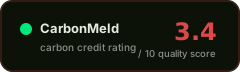
I privileged the most recent documents where contradictions exist: the 2022 monitoring/validation records over earlier 2012/2018 reports because the latest verification and monitoring outcomes should reflect corrections and restatements. Specifically, I used the 2022 validation figure of 4,170,592 tCO2e as the current verified total rather than the 2018 figure of 5,798,682, and I treated the 2022 monitoring report's statements that safeguards, grievance mechanisms, benefit sharing and FPIC were conducted as the prevailing record. These contradictions reduce confidence in data reliability and therefore lowered the integrity and claim safety scores. Given the multiple unresolved corrective actions around baseline, leakage and calculation procedures, overall quality is limited despite reasonable documentation quantity. Note: the gate rule that would cap overall if integrity <4.0 is acknowledged (mentioned) and the current overall score (4.0) sits below that cap so no further adjustment applied here.
Audit Analysis
The project shows VVB confirmation of additionality but exhibits serious baseline, methodological and leakage deficiencies flagged by multiple corrective actions. Documentation is available and recent, but material methodological issues and inconsistent emission totals reduce confidence and raise over‑crediting risk.
Project Description
The Hyundai Steel Waste Energy Recovery Co-generation Project is a 400MW cogeneration plant that generates electricity by utilizing surplus waste gasses produced by Steel. By reusing the waste gasses, the proposed project prevents their emission to the atmosphere after incineration. The project will produce approximately 2,741,035MWh electricity and 1,285,000 ton steam will be sent to Steel.
Red Flags
- Multiple corrective action requests (CAR1–CAR3 and many PD deficiencies) questioning baseline, monitoring and calculation steps
- Leakage explicitly not addressed in the Project Description and no leakage deduction stated
- Contradictory verified emission totals between validation reports (2018 vs 2022), indicating data reliability issues
Credit Vintages
| Issued | Retired | Available | ||
|---|---|---|---|---|
| 2010 | 871,522 | 871,522 | 0 | |
| 2011 | 1,987,794 | 1,977,272 | 10,522 | |
| 2012 | 1,999,040 | 1,998,640 | 400 | |
| 2013 | 1,714,345 | 1,490,011 | 224,334 | |
| 2014 | 1,564,269 | 1,176,222 | 388,047 | |
| 2015 | 1,384,786 | 1,384,786 | 0 | |
| 2016 | 1,249,824 | 1,213,000 | 36,824 | |
| 2017 | 1,460,655 | 993,992 | 466,663 | |
| 2018 | 1,511,668 | 793 | 1,510,875 | |
| Total | 13,743,903 | 11,106,238 | 2,637,665 |
Cosa migliorerebbe questo punteggio
- Resolve all corrective actions: re‑apply ACM0012 step-wise baseline and electricity emission factor procedures and publish corrected calculations
- Explicitly address leakage with quantified deduction or reasoned justification and disclose buffer pool percentage and reversal treatment
Questi suggerimenti indicano quali prove pubbliche aggiuntive potrebbero migliorare il livello di confidenza di questa valutazione. Non garantiscono un punteggio futuro più alto.
Risk Indicators
VVB-confirmed investment test
buffer not stated
not addressed
project baseline with major CARs
FPIC/grievance present but contradictory
CORSIA no, CCP status unknown
Where to buy
Marketplaces
+ Know where to buy this?
Listing multiple projects? Send us a CSV at [email protected].
⚑ Dispute this rating
Sei il proprietario di questo progetto?
Correzione metadati (gratuita)
Nome, paese, marketplace o link errati? Segnalacelo.
Non modifica lo score.
[email protected] →Rivalutazione con nuovi documenti
Hai documentazione aggiornata non ancora inclusa? Puoi richiedere un nuovo run della pipeline con i nuovi input.
Invia Documenti →