Indonesia Biogas Programme
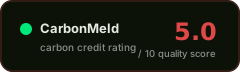
Score Breakdown
Integrity
verified additionality confirmed by the VVB (verification report)
missing baseline is project-specific and baseline reassessment date not stated; buffer pool percentage not provided
Transparency
verified named VVB (TÜV NORD CERT GmbH) and a recent monitoring period (2024) available
missing conflicting ERR, FNRB and usage-rate figures across reports; some source docs listed as unknown
Claim Safety
missing CORSIA-eligible (increases double-claiming risk) and CCP status not stated
missing large contradictions in total emission reductions and usage rates increase over‑crediting risk
Documentation
verified multiple evidence documents and 31 docs used; verification report dated 2019 and monitoring reports referenced
inferred extraction confidence is medium and some documents are listed as unknown, reducing reliability
Detailed Analysis
Integrity
Additionality is confirmed by the VVB in the verification report and the project uses a project-specific baseline (positive). However the baseline has not been clearly reassessed in the record, no buffer pool percentage is provided, and leakage deduction percentage is not stated despite a claimed quantified justification — these gaps weaken permanence and leakage handling. No material findings or corrective actions were reported in the verification report, which supports operational integrity. Taken together, these facts justify a moderate integrity score.
Transparency
The project names its VVB (TÜV NORD CERT GmbH) and provides a current monitoring period (2024), and many documents were used (n=31) which supports transparency. However, there are explicit contradictions between documents for key figures (total ER claimed and verified, FNRB, usage rates) and some source entries are listed as unknown; extraction confidence is only medium. These contradictions and unknown documents reduce confidence in the public record and lower transparency.
Claim Safety
The project is flagged as CORSIA-eligible, which raises double-claim concerns especially because CCP status is not stated. There are large discrepancies in emission reduction figures and in the usage rate (0.81586 in a 2022 monitoring report vs 88.98 in a 2017 report) that could indicate unit/aggregation inconsistencies or reporting errors and increase over-crediting risk. National default FNRB is used (value 58.36 in a more recent monitoring report), which is acceptable but the FNRB itself changed over time (contradiction with 64.8 in 2017), adding uncertainty to reported baseline assumptions.
Documentation
Evidence includes a verification report (2019), monitoring reports (various dates), PDD, validation report and others, and 31 documents were used, which is substantial. However, min_extraction_confidence is medium and several contradictions reference unknown or older documents; some important fields remain not stated (leakage deduction percentage, buffer pool). The documentation is therefore adequate but not robust or fully consistent.
Overall
I privileged the more recent and specific monitoring and verification documents where contradictions arose: for usage rate I prioritised the 2022 monitoring report value (0.81586) over the 2017 value (88.98) because the 2017 number appears inconsistent in units or aggregation and is older; for additionality I favoured the project PDD (2018) stating a barriers test over an undated 2024 'combined' entry because the PDD is the authoritative project design document; for leakage justification I used the 2016 verification report statement that leakage was quantified over a 2015 report that did not address leakage; for FNRB I privileged the 2022 monitoring report value (58.36) over the 2017 value (64.8) because it is more recent; for total ERs I used the more recent verified totals (51,872 reported in 2021/unknown) over older 2016 figures. These contradictions and some unknown-source entries reduced scores and confidence. Overall the project scores in the mid-range: verified and documented but with multiple inconsistencies and missing quantified safeguards (leakage deduction, buffer) that warrant caution on credit quality and claim safety.
Audit Analysis
The project shows several positive integrity signals (VVB verification of additionality, no material findings, and quantified leakage justification) but has important data gaps and contradictions (ERRs, FNRB, usage rates, and missing leakage deduction and buffer provisions). Documentation is moderately complete but extraction confidence is only medium and some key values conflict across sources, raising moderate concern for over-crediting and double-claiming risk given CORSIA eligibility.
Project Description
In rural Indonesia farming depends on a healthy natural environment. Because of the increasing threat from the changing climate, farming income is put at risk. Domestic biogas provides a sustainable way for small farmers with livestock to reduce dependence on firewood and expensive fossil fuels for cooking. Biogas significantly improves living conditions and helps to mitigate the negative effects of climate change. The Indonesia biogas programme distributes biogas digesters as a local sustainable energy source by developing a commercial, market-oriented sector. This provides business opportunities for construction companies and employment for masons. Farmers receive a subsidy from the carbon finance and have access to loans through local cooperatives. Project Impact and Benefits There is no smoke development when cooking with biogas. This means health benefits for the whole family, in particular for women and children. In addition, cooking is easier and faster. The empowerment of women is supported by providing equal access for men and women to certified biogas training. The training also includes the use of bio-slurry as a fertiliser. Women have the opportunity to benefit from both biogas and bio-slurry. The bio-slurry is an excellent and free alternative to chemical fertilisers. Various studies have shown that bio-slurry has a very positive effect on agricultural productivity. 28.557 Biogas installations have been installed and 9.043 Households use bio-slurry as fertiliser. The project has achieved the following impacts to 2023: SDG 13: Climate Change – 528.781 Tonnes of CO2 reduced (verified 2011-2023) SDG 1: No Poverty – Savings in fuel expenditure SDG 2: Zero Hunger – 9.043 households use bio-slurry as fertiliser, increasing crop production SDG 5: Gender Equality – 61 minutes time savings per day (certified by W+ standard) resulting in time available for economic activities or leisure SDG 7:
Red Flags
- Contradictory emission and activity figures across multiple monitoring/verification reports (ERRs, FNRB, usage rates).
- Project is CORSIA-eligible and CCP status not stated — increased double-claim risk; no leakage deduction percentage or buffer pool documented.
Credit Vintages
Nessuna emissione registrata sul registro.
Il marketplace dichiara i vintage: 2021 (non verificato).
Cosa migliorerebbe questo punteggio
- Provide a clear, recent baseline reassessment and document any buffer pool or reversal coverage and a leakage deduction percentage.
- Resolve contradictions by publishing reconciled monitoring and verification tables (ERRs, FNRB, usage rates) with clear units and a traceable audit trail; confirm CCP/CORSIA claim status.
Questi suggerimenti indicano quali prove pubbliche aggiuntive potrebbero migliorare il livello di confidenza di questa valutazione. Non garantiscono un punteggio futuro più alto.
Risk Indicators
VVB-confirmed
no buffer/unclear reversal cover
quantified but deduction not stated
project baseline, reassessment unclear
FPIC and grievance present
CORSIA-eligible / CCP unknown
Where to buy
Marketplaces
+ Know where to buy this?
Listing multiple projects? Send us a CSV at [email protected].
⚑ Dispute this rating
Registry Documents
monitoring
- 20210712 VPA1 MR v1.3.pdf
- 20221101 VPA1 MR v05_clean.docx
- Monitoring Report_4th monitoring period_01.01.2016 to 31.12.2016_v4.pdf
- Monitoring Report_4th monitoring period_01.01.2016 to 31.12.2016_v5.pdf
- Monitoring Report_7th monitoring period_01.01.2019 to 31.12.2019_v1.5.pdf
- TM_T-PerfCert_v3.0-Project-Annual-Report_IDBP_GS1174_GS5303_2024.pdf
- +23 more
Other
pdd
registry_page
validation
- GS1174 Validation Report_03.07.2018_v1.pdf
- Verification Report_6th monitoring period_01.06.2018 to 31.12.2018_v1.2.pdf
- _1_Verification Report_1st monitoring period_01.06.2011 to 31.05.2013_v1.4.pdf
- _1_Verification Report_2nd monitoring period_01.06.2013 to 31.12.2014_v1.pdf
- _1_Verification Report_3rd monitoring period_01.01.2015 to 31.12.2015_v1.pdf
- _1_Verification Report_5th monitoring period_01.01.2017 to 31.12.2017_v1.2.pdf
- +11 more
Sei il proprietario di questo progetto?
Correzione metadati (gratuita)
Nome, paese, marketplace o link errati? Segnalacelo.
Non modifica lo score.
[email protected] →Rivalutazione con nuovi documenti
Hai documentazione aggiornata non ancora inclusa? Puoi richiedere un nuovo run della pipeline con i nuovi input.
Invia Documenti →