Kenya Biogas Programme
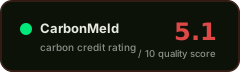
Score Breakdown
Integrity
verified Additionality was confirmed by the VVB using a combined test, which is stronger than an unverified project assertion.
missing Leakage treatment is inconsistent: one verification record says leakage was deemed negligible at 0%, while a monitoring report referenced a 10% deduction.
Transparency
verified The project has named third-party verification by TÜV NORD CERT GmbH and a defined monitoring period from 2023-04-01 to 2024-03-13.
missing The extracted record shows multiple contradictions in usage rates, credited emissions, and monitoring approach, which reduces reporting clarity.
Claim Safety
verified The baseline was reassessed in 2021 and the project uses a stated project baseline rather than an unstated approach.
missing The verified usage rate of 80.4% is below the national default FNRB value of 89.48, and the record contains conflicting emissions totals and leakage assumptions.
Documentation
verified The evidence set includes multiple official document types, and the extraction confidence is medium rather than low.
missing Several key fields are contradictory across documents, and the reversal risk treatment is not clearly documented.
Detailed Analysis
Integrity
The project has a reasonable integrity foundation because the verification report confirms additionality through a combined test and reports no material findings or corrective actions. The baseline was last reassessed in 2021, which supports methodological recency. That said, leakage is not cleanly resolved: one document treats it as negligible with a 0% deduction, while another references a 10% deduction, so the integrity score is pulled down by this inconsistency and by the lack of a clear buffer pool or reversal treatment.
Transparency
Transparency is moderate because the project names a recognized VVB, provides a monitoring period, and includes both claimed and verified emissions figures. However, the extracted record contains several contradictions, including different usage rates, different monitoring methods, and different credited emissions totals across documents. The record also does not clearly state CORSIA or CCP status, which leaves some registry and claim-context uncertainty.
Claim Safety
Claim safety is weakened by the mismatch between the verified usage rate of 80.4% and the national default FNRB value of 89.48, which suggests the project may be conservative on one parameter but still not fully straightforward to interpret. The conflicting leakage treatment and differing emissions totals create over-crediting risk, even though the project is Gold Standard certified. Because CORSIA and CCP status are not stated, dual-claim risk cannot be fully ruled out from the extracted record alone.
Documentation
Documentation quality is fair because multiple official document types were used, including validation, verification, monitoring, and PDD materials, and extraction confidence is medium. The record is not sparse, but it is internally inconsistent on several important fields, which reduces reliability. The crediting period also appears in conflicting forms across documents, suggesting that the documentation trail is not fully harmonized.
Overall
Overall, this is a mid-quality biogas crediting case: the project has credible third-party validation and verification, but the evidence trail contains several contradictions that materially weaken confidence. I privileged the more specific and later verification-report values where possible, especially for additionality and the most recent monitoring period, because they are closer to issuance and more operationally relevant; however, I still discounted the score because the contradictions on usage rates, leakage, and emissions totals indicate reliability issues. The gate rules are not applied here, but the integrity score remains above the threshold that would trigger the overall cap.
Audit Analysis
This is a Gold Standard biogas project with some solid integrity signals, including VVB-confirmed additionality, a recent baseline reassessment, and no material findings reported in the verification record. However, the record shows several material inconsistencies across documents, especially on usage rates, leakage treatment, and credited emissions, which weakens confidence in the claimed volume and overall claim safety.
Project Description
Domestic biodigesters provide a way for households with livestock to reduce their dependence on polluting firewood and expensive fossil fuels. Cooking on biogas is fast and smokeless, improving family health, especially among women and children. Leftover slurry from the biogas process is an excellent organic fertilizer that improves crop yields – and having more vegetables to sell, provides families with extra income. Kenya was among the first countries in Africa to adopt biogas technology in the early 1950's. However, scaling only occurred with the introduction of the Kenya Biogas Programme in 2009. The Kenya Biogas Programme is implemented by African Bioenergy Programmes Ltd (ABPL). The overall objective is to develop a commercially viable biogas sector that supports the use of domestic biogas as a local, sustainable energy source. Since the start of the programme in 2009, over 18,000 biodigesters have been built across Kenya; early 2020 88% of them were in operation and use. Entrepreneurship is encouraged and, to date, nearly 100 masons have started their own business entities, helping to build the local economy. A barrier for some families is the cost to apply the biogas technology, the programme has therefore initiated credit partnerships with financial institutions. Working together with rural micro finance institutions and saving cooperatives, it ensures that biodigester buyers get the most favourable credit terms. Income from carbon credit sales benefits directly biogas users in forms of after-sales support, bioslurry training and other useful services. Hivos founded and strengthened ABPL to enable it to take on implementation of the Kenya Biogas Programme. In 2021 Hivos handed over carbon project development and certification. FairClimateFund supports international marketing and selling carbon credits generated from this project. Project impacts and benefits: 18,346 biodigesters installed 110,076 direct beneficiaries 378,732 tCO2 red
Red Flags
- Credited emissions differ materially across documents, with the verification record and later extracted figures not fully aligning.
- Leakage treatment is inconsistent across documents, and reversal risk is not clearly addressed with a buffer pool or equivalent safeguard.
Credit Vintages
| Issued | Retired | Available | ||
|---|---|---|---|---|
| 2017 | 3,480 | 3,480 | 0 | |
| 2018 | 6,534 | 6,534 | 0 | |
| 2019 | 10,992 | 10,788 | 204 | |
| 2020 | 13,304 | 13,073 | 231 | |
| 2021 | 14,531 | 14,227 | 304 | |
| 2022 | 15,564 | 12,706 | 2,858 | |
| 2023 | 11,953 | 697 | 11,256 | |
| 2024 | 2,137 | 0 | 2,137 | |
| Total | 78,495 | 61,505 | 16,990 |
Cosa migliorerebbe questo punteggio
- Publish a reconciled emissions and leakage table that explains which document values are authoritative and why.
- Provide explicit reversal-risk treatment and registry-status clarity, including buffer pool participation and any CORSIA or CCP eligibility statement.
Questi suggerimenti indicano quali prove pubbliche aggiuntive potrebbero migliorare il livello di confidenza di questa valutazione. Non garantiscono un punteggio futuro più alto.
Risk Indicators
VVB-confirmed combined test
No buffer pool stated
Conflicting leakage treatment
Project baseline, reassessed in 2021
FPIC and grievance mechanism present
CORSIA/CCP status not stated
Where to buy
Marketplaces
+ Know where to buy this?
Listing multiple projects? Send us a CSV at [email protected].
⚑ Dispute this rating
Registry Documents
monitoring
- 12July19 ABC PoA- VPA transition Annex v1.6 (clean).pdf
- 17May25 VPA06_MPVI survey_SDG_ER v1.2_conf.xlsx
- 13aug24 VPA06_CPII ER SDG v1.4.xlsx
- 03Jul24 VPA5801_VPA06 CPI MPV_MR_MPV_v1.6.docx
- 06SEP24 VPA06_CPII ER SDG v1.5.xlsx
- Monitoring Report_1st monitoring period_14.03.2017 to 28.02.2019_v1.3.docx
- +3 more
Other
pdd
registry_page
validation
- Verification Report_2nd monitoring period_01.03.2019 to 30.04.2020_v1.pdf
- GS5801-VPA06 DCR FValR 2024-08-18_TR_VAA_AK_tc.pdf
- 2024-01-03 Design Change Validation Report_PoA2747_clean.pdf
- GS5801_Kenya CPI MP5_FVerR_v1.0_10-07-2024.pdf
- GS5801-VPA06 DCR FValR 2024-09-09_c.pdf
- CCIPL 2301 FVR VPA06_CC..pdf
- +3 more
Sei il proprietario di questo progetto?
Correzione metadati (gratuita)
Nome, paese, marketplace o link errati? Segnalacelo.
Non modifica lo score.
[email protected] →Rivalutazione con nuovi documenti
Hai documentazione aggiornata non ancora inclusa? Puoi richiedere un nuovo run della pipeline con i nuovi input.
Invia Documenti →