Renewable Energy Wind Power Project in Rajasthan, India
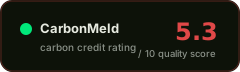
Score Breakdown
Integrity
verified Additionality was tested using an investment test and the VVB confirmed it in the verification report.
missing Leakage is only treated as deemed negligible with a 0% deduction, while reversal handling is not addressed and no buffer pool is stated.
Transparency
verified The project has a named VVB, a defined monitoring period, and a Gold Standard registry record.
missing The extracted record does not state usage monitoring details, and the ERR totals differ between the verification report and the PDD.
Claim Safety
verified The project is an avoidance project using ACM0002 with a project baseline and no leakage deduction.
missing Claimed and verified emission reductions are inconsistent across documents, and CORSIA eligibility is not stated.
Documentation
verified Multiple official document types were available, including verification, monitoring, PDD, and appendix materials.
missing One key document was only moderately readable, and several important items such as buffer pool, usage monitoring, and reversal treatment are not found in the extracted record.
Detailed Analysis
Integrity
The verification report confirms additionality through an investment test and says the VVB validated it, which is a meaningful positive for project integrity. The baseline is project-specific under ACM0002, and leakage is treated as negligible with a 0% deduction, but the absence of a stated buffer pool and the fact that reversal events are not addressed weaken permanence confidence. No material findings or corrective actions were reported in the verification record.
Transparency
Transparency is moderate because the project has a named verifier, a defined monitoring period, and a clear registry identity under Gold Standard. At the same time, the extracted record does not provide usage monitoring details, and the reported emission reduction totals are inconsistent across documents, which makes the public record harder to audit. The monitoring and verification trail is present, but not fully complete in the extracted data.
Claim Safety
Claim safety is weakened by the mismatch between claimed and verified emission reductions across documents, which raises over-crediting risk. The project uses a standard renewable-energy methodology and a project baseline, which is better than an unstated baseline, but the lack of CORSIA status and the absence of a CCP mention leave market-claim risk unresolved. The leakage treatment is favorable, yet the volume inconsistency remains the main concern.
Documentation
Documentation breadth is decent because the extracted record includes verification, monitoring, PDD, and appendix materials, and the project spans a long crediting period. However, one key document was only moderately readable, which lowers confidence in the extraction quality. Several important fields are missing or not stated, including buffer pool coverage, usage monitoring, and reversal treatment, so the documentation is incomplete for a high-confidence assessment.
Overall
I privileged the later verification report for safeguard, leakage, and grievance-related statements because it is more recent and more specific than the earlier record, while noting that the earlier document conflicts on those points. I also privileged the verification report’s claimed and verified ERR figures over the PDD where they conflict, but the discrepancy itself is a reliability red flag and lowers the score. Overall, the project looks credible on additionality and methodology, but the unresolved contradictions, missing permanence controls, and incomplete monitoring detail keep the assessment in the mid range.
Audit Analysis
This is a certified Gold Standard wind project with VVB-confirmed additionality and a project baseline, which supports a moderate integrity score. However, the record has several reliability gaps and contradictions, including differing crediting-period and ERR figures across documents, no stated buffer pool, and no clear reversal treatment, which weakens confidence in the claimed volume.
Project Description
This wind power project has been commissioned by Vish Wind Infrastructure LLP and consists of 37 wind turbine generators of 800Kw each, forming a combined capacity of 29.6 MW. The project activity generates electricity for the state grid of Rajasthan and helps reduce the energy demand-supply gap in the state, contributing to sustainable growth by providing clean and green electricity. The project is located across Ugawa, Korwa & Kita villages of Jaisalmer District and Salodi & Jelu Villages of Jodhpur district in the Rajasthan state of India. The project utilizes 37 Wind Energy Converters (WECs) with a capacity of 0.8 MW each, for a total installed capacity of 29.6 MW. The generated electricity is fed into the Indian grid, improving Rajasthan's power supply. This project presents a compelling opportunity to contribute to a sustainable future for Rajasthan. By fostering a cleaner environment, creating jobs, strengthening the local electricity grid, and promoting economic development, this project paves the way for a more prosperous future for the region. Project Impacts and Benefits This wind power project serves as a catalyst for sustainable development in the region by promoting: Social Well-being: Infrastructure Development and Grid Strengthening: The project has lead to the development of essential infrastructure, such as road networks, within the wind farm location. This improved accessibility, along with a strengthened local grid, benefits the local population by enhancing electricity availability. Poverty Alleviation: Job creation (direct and indirect) during construction and operation of the wind farm provides economic opportunities and improves livelihoods for local communities. Energy Security: By harnessing a clean and renewable energy source like wind power, the project reduces dependence on imported fossil fuels and associated price fluctuations, leading to increased energy security for Rajasthan. Environmental We
Red Flags
- Credited emissions reductions differ across documents, with the verification record and PDD not matching on claimed and verified totals.
- No buffer pool percentage is stated and reversal events are not addressed, leaving permanence controls unclear.
- FPIC is not documented, and the earlier verification record appears to conflict with later safeguard and grievance statements.
Credit Vintages
| Issued | Retired | Available | ||
|---|---|---|---|---|
| 2015 | 38,230 | 0 | 38,230 | |
| 2016 | 45,950 | 10,886 | 35,064 | |
| 2017 | 55,366 | 27,683 | 27,683 | |
| 2018 | 70,336 | 35,151 | 35,185 | |
| 2019 | 74,094 | 37,047 | 37,047 | |
| 2020 | 45,096 | 23,159 | 21,937 | |
| 2021 | 40,129 | 4,467 | 35,662 | |
| 2022 | 4,129 | 0 | 4,129 | |
| Total | 373,330 | 138,393 | 234,937 |
Cosa migliorerebbe questo punteggio
- Publish a reconciled emissions-reduction table that explains the differences between the verification report, monitoring report, and PDD figures.
- Document permanence and safeguard controls more fully, including buffer pool treatment, reversal provisions, usage monitoring, and FPIC evidence.
Questi suggerimenti indicano quali prove pubbliche aggiuntive potrebbero migliorare il livello di confidenza di questa valutazione. Non garantiscono un punteggio futuro più alto.
Risk Indicators
VVB-confirmed investment test
No buffer pool stated
0% deduction with limited justification
Project baseline, reassessment not stated
Safeguards mentioned, FPIC not documented
CORSIA status not stated; CCP not mentioned
Where to buy
Marketplaces
+ Know where to buy this?
Listing multiple projects? Send us a CSV at [email protected].
⚑ Dispute this rating
Sei il proprietario di questo progetto?
Correzione metadati (gratuita)
Nome, paese, marketplace o link errati? Segnalacelo.
Non modifica lo score.
[email protected] →Rivalutazione con nuovi documenti
Hai documentazione aggiornata non ancora inclusa? Puoi richiedere un nuovo run della pipeline con i nuovi input.
Invia Documenti →