Vai al contenuto principale
GS avoidance Bangladesh Vintage 2023 Registry: Certified & crediting Documentazione completa General Methodology v2.0

Solar Water Filtration Units for Rural Areas in Coastal Bangladesh

GS-3062 ↗

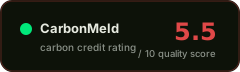
5.5 / 10
Integrity
5.8
Transparency
5.2
Claim Safety
5.1
Documentation
6.0

Score Breakdown

Integrity

verified Additionality was confirmed by the VVB, and the project uses a stated project baseline under the Gold Standard methodology.

missing Leakage justification is marked as not addressed in the monitoring report, and one corrective action request was raised.

Transparency

verified The monitoring period, VVB name, usage monitoring method, and claimed emission reductions are stated in the monitoring report.

missing Verified emissions are not found in the extracted record, and the extraction confidence is only medium.

Claim Safety

verified The project is Gold Standard certified and reports no reversal events, which helps reduce some claim risk.

missing A 0% leakage deduction is paired with an unresolved leakage explanation, and the record does not state CORSIA or CCP status.

Documentation

verified Multiple document types were used, including the PDD, stakeholder consultation material, and the monitoring report.

missing One material finding and corrective action request were recorded, and some key fields such as additionality test type and baseline reassessment timing are not stated.

Detailed Analysis

Integrity

The project benefits from VVB-confirmed additionality and a stated project baseline under the Gold Standard methodology, which supports the core crediting logic. It also reports no reversal events, and as an avoidance project it has limited permanence risk. That said, the monitoring report records a corrective action request, and leakage is shown as 0% while the justification is not addressed, which weakens the robustness of the emissions claim.

Transparency

The monitoring report provides a clear monitoring period, identifies Earthood Services Limited as the VVB, and states the usage monitoring method as an annual survey. It also gives a claimed emissions figure and a verified usage rate of 98.96%, but the extracted record does not include verified emissions. The extraction confidence is medium, so the documentation is usable but not fully complete.

Claim Safety

Claim safety is helped by Gold Standard certification and the absence of reported reversal events. However, the record shows a 0% leakage deduction with an unresolved leakage explanation, which raises over-crediting risk. CORSIA eligibility and CCP status are not stated, so dual-market claim risk cannot be ruled out from the extracted evidence.

Documentation

The evidence base includes the PDD, stakeholder consultation material, and the monitoring report, and the project has 18 documents used in extraction. FPIC, grievance handling, and benefit sharing are mentioned, which is positive for social documentation. Still, the record lacks the additionality test type, baseline reassessment timing, and verified emissions, and one material finding required corrective action, so completeness is only moderate.

Overall

Overall, this is a mid-quality crediting file with some strong elements, especially VVB-confirmed additionality, Gold Standard certification, and no reported reversals. I privileged the latest monitoring report for leakage and safeguard status because it is more recent than earlier documents; that means the newer statement that leakage was not addressed outweighs the earlier 'deemed negligible' note, and the newer grievance/safeguard information outweighs older contrary entries. The contradictions around usage rate, grievance mechanism, leakage justification, safeguards, benefit sharing, and FPIC reduce reliability and keep the score in the middle range.

Audit Analysis

This is a Gold Standard-certified avoidance project with VVB-confirmed additionality and no reported reversals, which supports a moderate integrity profile. However, leakage treatment is weakly justified, there is one corrective action request, and several key items are missing or inconsistent, which limits confidence in the claimed reductions.

Project Description

Rural and coastal Bangladesh face significant challenges with access to safe and clean water. According to a 2019 Multiple Indicator Cluster Survey, only 11.6% of households have access to piped water. While 98.5% of households technically have access to improved sources of drinking water, 81.9% of household water was found to be contaminated with E. coli. The survey also revealed that nearly 40% of households with improved water sources and more than 90% of households with unimproved water sources still had E. coli contamination. Despite this, only 9.7% of the population treats their water, with just 5% relying on boiling to ensure safe drinking water. This highlights a critical need for effective water treatment methods that are both sustainable and accessible to the broader population. The project has been implemented in six districts: Bagerhat, Khulna, Barguna, Pirojpur, Gopalganj, and Satkhira, with plans for expansion to other areas of Bangladesh in the future. It is spearheaded by the Bangladesh Bondhu Foundation (BBF), a non-profit, voluntary organization established with the support of Value Network Venture Advisory Services (VNV). The project deploys low-GHG water purification technologies that use a combination of reverse osmosis (RO) and ultraviolet (UV) ray treatment. These technologies effectively remove microbial contamination and other harmful substances, such as suspended particulates and salinity, making the water safe for consumption. The initiative also includes retrofitting non-operational solar water filtration systems that were previously installed by the government alongside the installation of new systems. This approach creates a sustainable, clean drinking water ecosystem, significantly reducing the reliance on firewood for water purification and lowering the associated greenhouse gas emissions from non-renewable biomass. Project Impacts and Benefits The project has a far-reaching impact by introducing solar-powered water

Red Flags

  • Leakage is set at 0% but the latest monitoring report says it was not addressed, creating a credibility gap.
  • A material finding and corrective action request were issued in the monitoring report, and verified emissions are not stated in the extracted record.

Credit Vintages

Issued Retired Available
2022
36,282 8,793 27,489
2023
252,570 10,499 242,071
2024
199,662 0 199,662
Total 488,514 19,292 469,222

Cosa migliorerebbe questo punteggio

  • Provide a clear leakage assessment and supporting justification, or revise the deduction if leakage is not truly negligible.
  • Publish verified emissions, baseline reassessment details, and a resolution of the corrective action request to improve confidence and transparency.

Questi suggerimenti indicano quali prove pubbliche aggiuntive potrebbero migliorare il livello di confidenza di questa valutazione. Non garantiscono un punteggio futuro più alto.

Risk Indicators

Additionality

VVB-confirmed additionality

Permanence

No reversals reported

Leakage

0% deduction but justification weak

Baseline

Project baseline stated, reassessment timing missing

Safeguards

FPIC and grievance mechanism present, but inconsistently doc

Double-claim

CORSIA/CCP status not stated

Where to buy

Marketplaces

+ Know where to buy this?

Listing multiple projects? Send us a CSV at [email protected].

⚑ Dispute this rating
Analysis Provenance Scored 2026-04-14 General Methodology v2.0 Documentazione completa

Sei il proprietario di questo progetto?

Correzione metadati (gratuita)

Nome, paese, marketplace o link errati? Segnalacelo.

Non modifica lo score.

[email protected]

Rivalutazione con nuovi documenti

Hai documentazione aggiornata non ancora inclusa? Puoi richiedere un nuovo run della pipeline con i nuovi input.

Invia Documenti