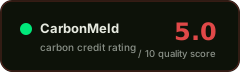
Tatar Hydro Electricity Power Plant
Score Breakdown
Integrity
verified Additionality is presented as an investment test and is stated as confirmed by the VVB in the monitoring report (2022).
missing Baseline/leakage and core quantification inputs show inconsistencies across documents, and corrective actions flag electricity data and metering control issues (monitoring report, 2022).
Transparency
verified Monitoring period is clearly stated (2021-08-01 to 2022-07-31) and the VVB is identified as Earthood Services Limited (monitoring report, 2022).
missing Key public-facing quantities are missing or inconsistent in the extracted record (claimed ER not found; verified ER and grid factor conflict across documents).
Claim Safety
verified Uses an established grid-connected renewable methodology (ACM0002 v13.0.0), which can support conservative accounting when inputs are consistent.
missing Over-crediting risk is elevated by contradictory ER totals and conflicting grid emission factors between the PDD and validation report.
Documentation
verified Multiple official document types are available (monitoring report, validation report, PDD) with high extraction confidence and a named VVB.
missing Numerous corrective actions indicate documentation/reporting gaps (meter calibration dates, meter changes, missing socio-economic impact summary, and data mismatches).
Detailed Analysis
Integrity
The monitoring report (2022) indicates additionality was assessed via an investment test and states it was confirmed by the VVB, which supports additionality robustness. However, leakage handling is inconsistent: the validation report (2021) deems leakage negligible, while the monitoring report (2022) does not address leakage, and no leakage deduction is evidenced in the extracted record. Integrity is further weakened by corrective actions in the monitoring report (2022) citing mismatches between reported electricity data and supporting documents and incomplete disclosure around meter calibration and meter replacements—both directly affect baseline/emissions reduction quantification.
Transparency
The monitoring period (2021-08-01—2022-07-31) and the VVB (Earthood Services Limited) are clearly identified in the monitoring report (2022), which supports traceability. At the same time, the extracted record does not contain a claimed ER total, and the verified ER figure is contradictory across validation documents, reducing transparency on what was actually assessed and issued. The monitoring report (2022) also includes multiple corrective actions requiring missing template-required narrative sections, indicating reporting completeness issues.
Claim Safety
Claim safety is constrained by material inconsistencies that can drive over-crediting risk: the grid emission factor differs between the PDD (2024) and the validation report (2022), and the verified ER total conflicts sharply between two validation reports (2021 vs 2022). Leakage is not consistently treated (validation report says negligible; monitoring report does not address it), which increases the risk that public claims omit relevant caveats. CORSIA eligibility and CCP status are not found in the extracted record, so buyers cannot easily position the credits against higher-integrity labels based on the available data.
Documentation
Documentation coverage is moderate-to-good: multiple document types are present (monitoring report, validation report, PDD) and extraction confidence is high, with 17 documents used. However, the monitoring report (2022) lists several corrective actions that point to incomplete or inconsistent documentation (electricity data mismatches, missing implementation-status and socio-economic impact summaries, and incomplete metering calibration/change details). These issues reduce confidence that the document set is internally consistent and audit-ready without further clarification.
Overall
Key contradictions reduce confidence in the project record. For leakage, the more recent monitoring report (2022) stating leakage is not addressed was privileged over the older validation statement of negligible leakage (2021), because monitoring should reflect actual applied accounting during the monitored period; this lowers integrity and claim safety. For safeguards (safeguards mentioned, FPIC, grievance mechanism, benefit sharing), the monitoring report (2022) was privileged over the older validation report (2014) because it is more recent and likely reflects updated practices, but the inconsistency itself still lowers documentation reliability. For additionality confirmation, the monitoring report (2022) was privileged over the older/unclear 2013 source because it is explicit and tied to the current VVB context, but the contradiction signals recordkeeping issues. For verified ER totals, the 2022 validation figure (136,178) was privileged over the 2021 figure (1,222,788) because it is more recent and closer to the stated monitoring period, yet the magnitude of the discrepancy is a major red flag. For the grid emission factor, the PDD (2024) value (0.4568) was privileged as the most recent project document, but the conflict with the 2022 validation value suggests methodological/input updates that should be reconciled. For the crediting period, the monitoring report (2013–2023) was privileged over the 2025 validation statement (2023–2033) because it aligns with the stated crediting window and the monitoring report’s own corrective action noting a crediting-period inconsistency; nonetheless, this contradiction materially increases eligibility and boundary risk.
Audit Analysis
This VCS hydropower project has a clear MRV frame (ACM0002) and VVB involvement, but several internal inconsistencies across documents (crediting period, grid emission factor, leakage treatment, and even verified ER figures) weaken confidence in the crediting claims. Corrective actions in the monitoring/verification cycle also point to data-quality and reporting-control issues that increase over-crediting and reputational risk.
Project Description
The Tatar Hydroelectricity Power Plant (HEPP) generates electricity using the Peri Stream as a renewable resource, without emitting pollutants or Green House Gases (GHGs). With a capacity of 128.22 MWe and expected annual production of 429,560 MWh, the project is estimated to reduce 231,898 tCO2/year.
Red Flags
- Conflicting emissions reduction figures across validation documents (136,178 vs 1,222,788), creating material uncertainty about credited volumes.
- Leakage treatment is inconsistent: the validation report deems leakage negligible, while the monitoring report does not address leakage at all.
- Crediting period is inconsistent across documents (2013–2023 vs 2023–2033), raising questions about eligibility and period boundaries.
- Corrective actions cite mismatched electricity data, incomplete meter calibration/change information, and missing required monitoring report content.
Credit Vintages
| Issued | Retired | Available | ||
|---|---|---|---|---|
| 2013 | 23,288 | 23,288 | 0 | |
| 2014 | 59,104 | 59,104 | 0 | |
| 2015 | 197,815 | 197,815 | 0 | |
| 2016 | 152,038 | 152,038 | 0 | |
| 2017 | 80,092 | 80,092 | 0 | |
| 2018 | 179,657 | 98,386 | 81,271 | |
| 2019 | 257,355 | 115,000 | 142,355 | |
| 2020 | 186,671 | 186,671 | 0 | |
| 2021 | 86,768 | 86,768 | 0 | |
| Total | 1,222,788 | 999,162 | 223,626 |
Cosa migliorerebbe questo punteggio
- Publish a reconciliation note (or updated verification/monitoring annex) that explains and corrects the conflicting ER totals, grid emission factor values, and leakage treatment across the validation/monitoring/PDD documents.
- Close all corrective actions with objective evidence (meter calibration certificates with exact dates, meter replacement logs, and corrected electricity generation/supporting documents) and re-issue the monitoring report sections required by the VCS MR template.
Questi suggerimenti indicano quali prove pubbliche aggiuntive potrebbero migliorare il livello di confidenza di questa valutazione. Non garantiscono un punteggio futuro più alto.
Risk Indicators
Investment test stated; confirmation inconsistent across records
Avoidance renewable electricity; no reversal events evidenced
Negligible vs not addressed; no deduction evidenced
Project-specific baseline; key inputs conflict across documents
FPIC/grievance/benefit sharing reported but inconsistent across documents
CORSIA/CCP status not found in extracted record
Where to buy
Marketplaces
+ Know where to buy this?
Listing multiple projects? Send us a CSV at [email protected].
⚑ Dispute this rating
Sei il proprietario di questo progetto?
Correzione metadati (gratuita)
Nome, paese, marketplace o link errati? Segnalacelo.
Non modifica lo score.
[email protected] →Rivalutazione con nuovi documenti
Hai documentazione aggiornata non ancora inclusa? Puoi richiedere un nuovo run della pipeline con i nuovi input.
Invia Documenti →