Teesta- V Hydro Power Project In Sikkim
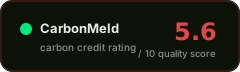
Score Breakdown
Integrity
verified Additionality is confirmed by the VVB using an investment test (validation/verification record in extracted facts).
missing Leakage treatment is weak: the 2024 monitoring report does not address leakage and no leakage deduction is evidenced in the extracted record.
Transparency
verified Clear monitoring period is provided (2012-06-01 to 2018-03-31) and the VVB is identified (LGAI Technological Center, S.A.).
missing Extensive corrective actions in the 2024 monitoring report indicate incomplete/unclear MRV presentation (metering details, monitoring procedures, audit history, roles/responsibilities).
Claim Safety
verified The project is stated as not CORSIA-eligible, reducing aviation-claim channel risk.
missing Over-crediting/claims risk is elevated by contradictions in total emission reductions and inconsistent safeguards-related statements across documents.
Documentation
verified Multiple document types are available (monitoring report, validation report, PDD, issuance) and extraction confidence is high.
missing The 2024 monitoring report required many corrective actions, suggesting documentation completeness and consistency issues.
Detailed Analysis
Integrity
The extracted record indicates additionality was confirmed by the VVB using an investment test (validation/verification documentation referenced in merged facts). Baseline setting is project-specific under ACM0002, and the timing of any baseline reassessment is not stated in the extracted record, which weakens robustness over a long crediting period (2008-04-01 to 2018-03-31). Leakage is a key weakness: the 2024 monitoring report does not address leakage and no leakage deduction is evidenced, creating an integrity gap for grid-connected renewable crediting.
Transparency
The monitoring period (2012-06-01—2018-03-31) and VVB (LGAI Technological Center, S.A.) are clearly identified in the extracted facts, supporting basic transparency. However, the 2024 monitoring report lists numerous corrective actions (e.g., missing metering/calibration documentation, inconsistent project title, incomplete monitoring procedures, missing organizational roles, and missing comparisons to PDD estimates), indicating that MRV reporting quality and completeness were insufficient at submission. These issues reduce confidence that the monitoring narrative and data presentation are consistently auditable from the public record.
Claim Safety
CORSIA eligibility is stated as false, which lowers the risk of aviation-related claims being layered onto these credits. Nonetheless, claim safety is weakened by major inconsistencies in reported emission reductions across documents and by conflicting statements on safeguards-related elements (FPIC, grievance mechanism, benefit sharing), which can be material to reputational and buyer due diligence. Leakage treatment is also inconsistent across documents, increasing perceived over-crediting risk.
Documentation
The evidence set includes a monitoring report, validation report, PDD, and issuance records, with 12 documents used and high extraction confidence, which supports a mid-range documentation score. Still, the 2024 monitoring report’s long list of corrective actions suggests the documentation package had significant completeness and consistency problems at the time of assessment (e.g., missing technical specifications, missing calibration certificates, inconsistent mapping, and incomplete SDG/safeguards sections). These gaps reduce the reliability of the documented basis for credit quantification and non-carbon claims.
Overall
Key contradictions reduce confidence in both credit quantity and non-carbon claims. For emission reductions, the extracted record shows 11,776,268 in the 2024 monitoring report versus 5,082,827 in a 2012 monitoring report; for scoring, the more recent 2024 figure is privileged as it aligns with the stated monitoring period through 2018, but the discrepancy materially lowers scores due to reliability concerns. Leakage is 'not addressed' in the 2024 monitoring report but was 'deemed negligible' in the 2012 validation report; the more recent monitoring report is privileged because it should reflect applied monitoring/quantification practice, and the inconsistency is penalized. Safeguards-related contradictions (safeguards mentioned yes/no; FPIC yes/no; grievance mechanism yes/no; benefit sharing yes/no) are treated conservatively by prioritizing the more recent monitoring report where it indicates absence, while penalizing the project for inconsistent disclosure across documents.
Audit Analysis
This VCS hydropower project has VVB-confirmed additionality and matching claimed vs verified emission reductions in the latest extracted record, but it shows notable weaknesses around leakage treatment and social safeguards evidence. Multiple cross-document inconsistencies (ERR totals and safeguards/FPIC/grievance claims) and a long list of corrective actions in the 2024 monitoring report increase reliability and greenwashing-risk concerns.
Project Description
The National Hydroelectric Power Corporation Limited implemented the Teesta HE Project - Stage V, a run-of-the-river scheme that produces 2572.67 MU of energy that is absorbed into the Eastern region, connected to the NEWNE grid. The project has an installed capacity of 510 MW and consists of a concrete gravity dam, a 15 km long head race tunnel, and an underground power house with three generating units of 170 MW capacity each.
Red Flags
- Conflicting emission reduction totals across monitoring/validation records (11,776,268 vs 5,082,827) undermine confidence in credit quantity.
- Leakage is not addressed in the 2024 monitoring report, conflicting with earlier validation that deemed leakage negligible.
- Safeguards, FPIC, grievance mechanism, and benefit-sharing are inconsistent across documents, raising stakeholder-risk and claims-risk concerns.
- The 2024 monitoring report contains numerous corrective action requests, indicating MRV and documentation quality gaps.
Credit Vintages
| Issued | Retired | Available | ||
|---|---|---|---|---|
| 2008 | 1,210,583 | 764,729 | 445,854 | |
| 2009 | 203,870 | 203,697 | 173 | |
| 2010 | 2,492,259 | 2,300,912 | 191,347 | |
| 2011 | 529,028 | 12,928 | 516,100 | |
| Total | 4,435,740 | 3,282,266 | 1,153,474 |
Cosa migliorerebbe questo punteggio
- Publish a reconciled ERR table across all issuance/monitoring/vintage periods explaining the 11,776,268 vs 5,082,827 discrepancy, with registry issuance references and VVB confirmation.
- Provide a clear leakage assessment consistent with ACM0002 application (even if negligible) and document the rationale and any deduction applied.
- Resolve safeguards contradictions by documenting FPIC status, grievance mechanism operation, and benefit-sharing arrangements with dated evidence and stakeholder consultation records.
Questi suggerimenti indicano quali prove pubbliche aggiuntive potrebbero migliorare il livello di confidenza di questa valutazione. Non garantiscono un punteggio futuro più alto.
Risk Indicators
VVB-confirmed investment test
Avoidance project; no reversal events evidenced
Leakage not addressed / inconsistent
Project-specific baseline; reassessment timing unclear
Safeguards/FPIC/grievance inconsistent
Not CORSIA-eligible; CCP status not stated
Where to buy
Marketplaces
+ Know where to buy this?
Listing multiple projects? Send us a CSV at [email protected].
⚑ Dispute this rating
Sei il proprietario di questo progetto?
Correzione metadati (gratuita)
Nome, paese, marketplace o link errati? Segnalacelo.
Non modifica lo score.
[email protected] →Rivalutazione con nuovi documenti
Hai documentazione aggiornata non ancora inclusa? Puoi richiedere un nuovo run della pipeline con i nuovi input.
Invia Documenti →