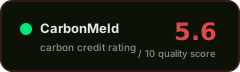
Tepekisla Dam & Hydropower Plant Project
Score Breakdown
Integrity
verified Additionality is confirmed by the VVB using an investment test (validation/verification record; VVB: RINA).
missing Leakage is treated as 0% with missing or inconsistent justification across documents (monitoring report 2024 vs validation report 2024).
Transparency
verified Monitoring period is clearly stated (2020-09-01 to 2023-11-30) and the extracted record shows claimed ERs equal verified ERs (monitoring/validation record).
missing Key parameters and narrative elements are inconsistent across official documents (ER totals, crediting period, safeguards), reducing transparency and traceability.
Claim Safety
verified The most recent extracted ER figure shows no discrepancy between claimed and verified (214,834), lowering immediate over-issuance risk for that period.
missing CORSIA eligibility is not stated in the extracted record and ER totals conflict across validation reports, increasing greenwashing/over-crediting risk.
Documentation
verified A relatively complete document set is referenced (PDD, monitoring report, validation report, issuance) with high extraction confidence and 12 documents used.
missing A corrective action request indicates basic project specification inconsistencies (turbine capacity/type) that should have been harmonized across core documents.
Detailed Analysis
Integrity
The validation/verification record indicates additionality was assessed via an investment test and confirmed by the VVB (RINA), which supports additionality robustness. Baseline setting is project-specific under ACM0002, and the baseline is stated as reassessed in 2025, but the grid EF vintage is not clearly stated in the extracted record, limiting baseline scrutiny. Leakage is applied as a 0% deduction while the monitoring report (2024-02-22) does not address leakage justification, which weakens integrity for an ACM0002 grid-connected renewable project where leakage should at least be explicitly justified. No reversal events are reported, which is generally consistent with an avoidance-type renewable energy project, but permanence provisions (e.g., buffer pool) are not found in the extracted record.
Transparency
The monitoring period is clearly defined (2020-09-01—2023-11-30) and the extracted record shows claimed ERs equal verified ERs (214,834), which is a positive MRV signal for that specific figure. The project uses a recognized VCS methodology (ACM0002 v15.0) and identifies the VVB (RINA). However, multiple inconsistencies across official documents (including ER totals and crediting period dates) reduce the ability for an external reviewer to reconcile what was monitored, validated, and ultimately issued. Some key monitoring-related fields (e.g., usage monitoring method) are not found in the extracted record, though this is less central for grid-connected hydropower than for household energy projects.
Claim Safety
Over-crediting/claim risk is elevated by the contradiction in total emission reductions between validation reports (417,351 in 2021-06-24 vs 214,834 in 2024-04-19), even though the most recent extracted figure matches claimed and verified for 214,834. Leakage treatment is not consistently supported: the monitoring report (2024-02-22) does not address leakage justification while a later validation report (2024-04-19) describes leakage as “quantified,” creating uncertainty about whether leakage was properly handled. CORSIA eligibility is not stated in the extracted record and CCP status is not mentioned, so buyers cannot easily assess aviation/CCP-related claim constraints. The baseline is project-specific, which generally carries higher over-crediting risk than standardized/jurisdictional baselines unless transparently justified and consistently documented.
Documentation
The extracted record references a reasonably complete set of evidence documents (PDD, monitoring report, validation report, issuance) and indicates 12 documents were used with high extraction confidence, supporting a solid documentation score. The monitoring report is recent (2024-02-22) relative to the monitoring period end (2023-11-30), which is a positive recency signal. However, a corrective action request notes inconsistencies between the license/FSR and project documentation on turbine capacity and type, indicating document control issues. In addition, contradictions on safeguards/FPIC and crediting period dates suggest that key statements vary across versions and should be better harmonized and traceable.
Overall
I privileged the more recent validation report value for emission reductions (214,834 from 2024-04-19) over the older validation report (417,351 from 2021-06-24) because later documents typically reflect updated, corrected calculations; nonetheless, the magnitude of the discrepancy materially reduces confidence and lowers scores. For leakage, I privileged the monitoring report (2024-02-22) stating leakage justification is not addressed over the validation report (2024-04-19) saying “quantified,” because monitoring should document how leakage was treated for the monitored period; this inconsistency is a key integrity and claim-safety concern. For safeguards and grievance mechanism, I treated the more recent monitoring report (2024-02-22) as more indicative of current practice than the 2015 validation report, but the contradiction still signals weak, shifting disclosure. For FPIC, I treated the monitoring report (2024-02-22) claim of FPIC conducted as more credible than the later-dated validation report (2025-12-01) stating FPIC was false, because the latter conflicts with an on-the-ground implementation claim; however, the direct contradiction is serious and drives a conservative safeguards view. For the crediting period, I privileged the monitoring report’s 2015–2025 dates over the 2025–2035 dates in the 2025-12-01 validation report because the monitoring report aligns with the project’s long-running operation and the stated monitoring period, but the inconsistency warrants caution when interpreting what period the ERs correspond to.
Audit Analysis
This VCS hydropower project shows some core integrity strengths, including VVB-confirmed additionality and matching claimed vs verified emission reductions in the most recent extracted record. However, multiple cross-document inconsistencies (especially around ER totals, crediting period dates, and safeguards/FPIC statements) and weak leakage treatment reduce confidence and increase over-crediting and reputational risk.
Project Description
The Tepekisla HEPP project involved building a hydroelectric power plant with a capacity of 69.627 MWe in Turkey's Middle Black Sea Region. The plant is located in the Kelkit river, which is the longest tributary of the Yesilirmak river basin.
Red Flags
- Large contradiction in reported emission reductions (214,834 vs 417,351) across validation reports, indicating data reliability issues.
- Leakage is recorded as a 0% deduction while leakage justification is missing in the monitoring report and only described as “quantified” elsewhere.
- Crediting period dates conflict between documents (2015–2025 vs 2025–2035), creating uncertainty about what period the ERs relate to.
- Safeguards/FPIC and grievance mechanism are inconsistently reported across documents, increasing social-risk uncertainty.
Credit Vintages
| Issued | Retired | Available | ||
|---|---|---|---|---|
| 2015 | 23,064 | 23,064 | 0 | |
| 2016 | 113,244 | 0 | 113,244 | |
| 2017 | 63,722 | 0 | 63,722 | |
| 2018 | 67,282 | 0 | 67,282 | |
| 2019 | 97,581 | 0 | 97,581 | |
| 2020 | 75,285 | 0 | 75,285 | |
| 2021 | 42,598 | 0 | 42,598 | |
| 2022 | 67,904 | 0 | 67,904 | |
| 2023 | 81,505 | 0 | 81,505 | |
| Total | 632,185 | 23,064 | 609,121 |
Cosa migliorerebbe questo punteggio
- Publish a clear reconciliation note explaining the ER total change (417,351 to 214,834), including which monitoring periods and calculation updates drove the revision, and align all public documents accordingly.
- Provide explicit leakage assessment text consistent across validation and monitoring (even if 0%), including the rationale under ACM0002 and any quantified components.
- Resolve and standardize crediting period dates across registry-facing documents and reports, with version control and references to VCS registration/renewal decisions.
Questi suggerimenti indicano quali prove pubbliche aggiuntive potrebbero migliorare il livello di confidenza di questa valutazione. Non garantiscono un punteggio futuro più alto.
Risk Indicators
VVB-confirmed investment test
Avoidance project; no reversals reported
0% leakage with weak/inconsistent justification
Project-specific baseline; reassessment timing unclear in practice
Safeguards/FPIC disclosures conflict across documents
CORSIA/CCP status not clearly stated
Where to buy
Marketplaces
+ Know where to buy this?
Listing multiple projects? Send us a CSV at [email protected].
⚑ Dispute this rating
Sei il proprietario di questo progetto?
Correzione metadati (gratuita)
Nome, paese, marketplace o link errati? Segnalacelo.
Non modifica lo score.
[email protected] →Rivalutazione con nuovi documenti
Hai documentazione aggiornata non ancora inclusa? Puoi richiedere un nuovo run della pipeline con i nuovi input.
Invia Documenti →